Bird size profile
Adelie Penguin
Pygoscelis adeliae
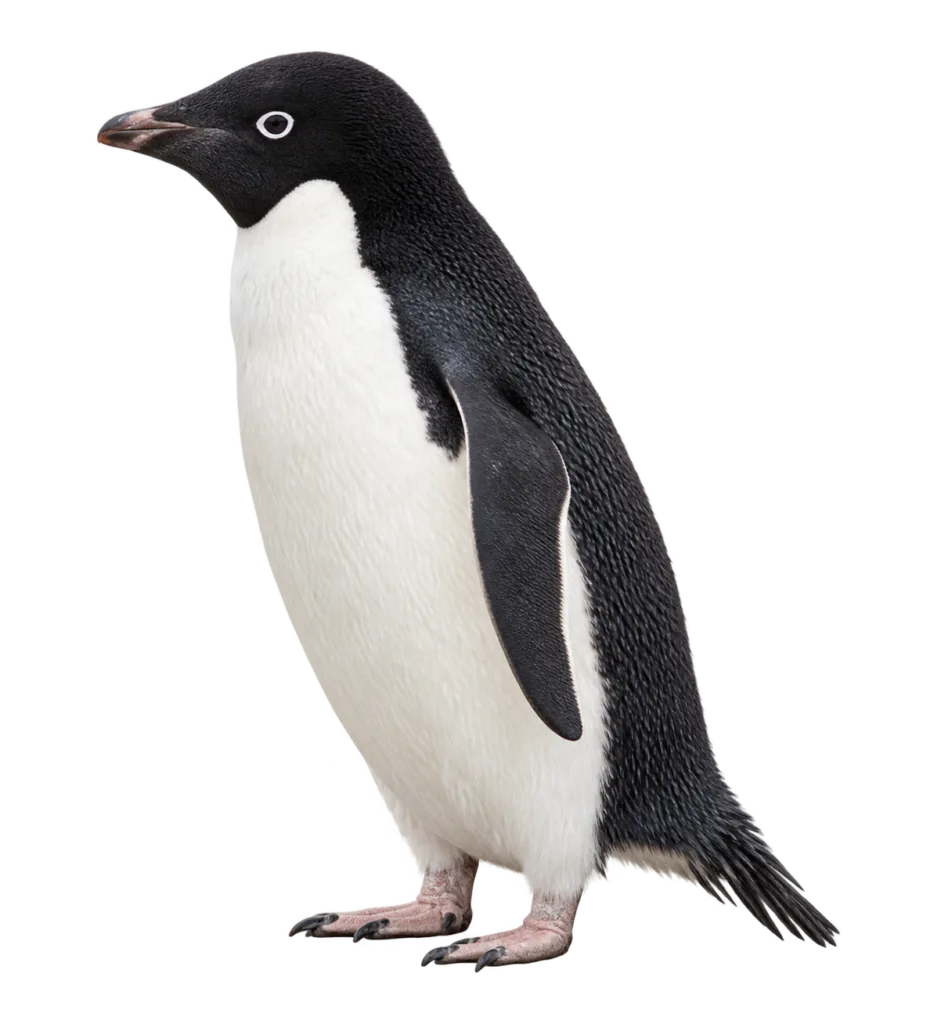
Size at a glance
How big is an Adelie Penguin?
Compare
Compare Adelie Penguin with another bird
Search by common or scientific name.
Morphology
Detailed measurements
Taxonomy
Classification
The Adélie penguin (Pygoscelis adeliae) is a medium-sized Antarctic penguin with an adult body size centered around roughly 70 cm and a commonly reported mass of about 3–6 kg. Those figures are useful reference points, but they do not tell the whole story. Body mass can move sharply through the breeding cycle, males average slightly larger than females, and even a basic measurement such as bill length can differ between studies because researchers do not always measure from the same anatomical landmarks.
How Large an Adélie Penguin Actually Is
Adult Adélie penguins are commonly described as about 70 cm (27.6 in) in standing height or body length. Some published profiles give a broader range, reflecting differences in age, posture, population, and the way measurements are reported.
A standing penguin is also not a rigid object. Its neck may be extended or withdrawn, the body can lean forward, and the long tail may change the apparent outline. For that reason, a field description such as “70 cm tall” should be treated as a practical species-size reference rather than an exact anatomical measurement that every adult will match.
Standing height, body length, and flipper length describe different parts of the bird. One cannot be converted reliably into another. Published values should be kept under the measurement definition used by the original study.
Body Mass Changes Far More Than Skeletal Size
A frequently cited adult weight range is 3–6 kg (6.6–13.2 lb). Unlike bill or flipper length, however, body mass can change considerably within the same individual.
Adélie penguins pass through repeated periods of feeding and fasting during breeding. Adults build reserves before periods when access to food is restricted, then lose mass while attending nests or completing other stages of the breeding cycle. They later regain condition when they can forage more freely. Research following birds through these stages has recorded much wider masses than a simple species profile would suggest, including values above and below the usual 3–6 kg reference range.
That variation makes body mass useful for understanding condition, but less suitable as a fixed measure of structural body size. A 5 kg bird and a 4 kg bird are not necessarily built very differently. They may be the same individual at different points in its annual cycle.
Males Are Slightly Larger, but the Sexes Look Very Similar
Male and female Adélie penguins have essentially the same adult plumage. Visual sexing is therefore difficult without measurements, behavior, molecular methods, or knowledge of an individually marked bird.
Males do average somewhat larger. A modern dataset of adult birds reported the following mean measurements:
| Measurement | Male Mean | Female Mean |
|---|---|---|
| Body mass | 4.5 kg | 4.2 kg |
| Flipper length | 187.3 mm | 180.6 mm |
| Bill length | 24.2 mm | 22.7 mm |
The difference is easiest to detect statistically across many birds rather than by looking at a single pair. Earlier work has likewise found that adult males tend to be heavier and to have longer bills and slightly longer flippers.
Body mass and bill dimensions are particularly informative when researchers estimate sex from external measurements. Flipper length overlaps more between males and females, so it is less useful by itself.
The Bill Looks Shorter Than Its Structure Suggests
The Adélie has a notably compact-looking bill. Much of its base is covered by feathers, leaving only the outer portion clearly exposed. The visible bill is mostly dark, with reddish or orange coloration around the base that may be partly hidden by feathering.
This feather coverage matters when interpreting published bill measurements. One study may measure from the tip to the edge of exposed skin, while another may use a different cranial or feather reference point. Values from different protocols can therefore look unexpectedly far apart without either dataset being wrong.
For example, research on Adélie chick growth cited adult bill means from Cape Crozier of about 35.6 mm for males and 32.9 mm for females, while another adult dataset reported 24.2 and 22.7 mm. Those numbers should not be merged into a single range unless the measurement definitions are known to match.
The same caution applies to museum measurements, field measurements, and values copied between species databases. For a bird with extensive feathering around the bill base, the starting point of the measurement matters.
A Compact Body with an Unusually Noticeable Tail
The adult body has the dense, tapered form typical of a swimming penguin. The head, throat, back, and upper surfaces are dark, while the breast and abdomen are white. Rigid flippers replace the broad folding wings seen in flying birds.
One feature changes the outline more than might be expected from a medium-sized penguin: the relatively long, stiff tail. Adélies belong to the brush-tailed penguin genus Pygoscelis, and their tail feathers can project prominently behind the body when standing or walking.
The tail is not simply decorative plumage. Its stiff feathers can contact the ground and help support or balance the bird when it sits back on its feet. In water, the tail also contributes to control during changes in direction.
The legs are short relative to the body and positioned for a swimming-adapted form rather than long terrestrial strides. Combined with the long tail and upright trunk, this produces the characteristic Adélie silhouette on land.
The White Eye Ring Changes How the Head Looks
Adult Adélies have a nearly black head and face interrupted by a narrow white ring around each eye. Because there are few other bright markings on the head, this small feature is unusually prominent and can make the eye appear larger than it is.
The bill contributes to the compact head shape. Its feather-covered base reduces the amount of exposed bill visible from the side, so the head can appear rounder and the bill shorter than in a penguin with more of the bill exposed.
Adults can also raise feathers at the rear of the crown during displays. This temporarily changes the normally smooth head profile and can create a small angular crest. It is a posture-dependent feature rather than a permanent long crest.
Juveniles Do Not Have the Full Adult Outline and Pattern
Young Adélie penguins change rapidly during their first weeks. Chicks begin with insulating down rather than the smooth waterproof plumage of adults. As they approach fledging, structural measurements such as the flippers, feet, legs, and bill move toward adult proportions, while body mass follows its own growth pattern.
Chicks can reach a peak mass before fledging and then lose part of that mass before going to sea. A heavier chick at one observation therefore is not necessarily structurally larger than another chick measured later in development.
Fledged juveniles also differ visibly from mature birds. Their upperparts can have a bluer cast, the chin and throat may remain white, and the adult white eye ring can be weak or absent. The combination can make a young Adélie look less like the familiar black-headed adult even when much of its body structure is already close to adult form.
Why the Same Bird Can Look Broader or Slimmer
Plumage changes the apparent dimensions of an Adélie penguin. Its feather coat contains a dense insulating layer beneath the outer contour feathers. When the plumage is fluffed, trapped air increases the visible volume of the body. When the feathers are compressed, especially during active movement or swimming, the bird takes on a much sleeker profile.
Posture adds another source of visual variation. An Adélie standing upright with the neck extended can look much taller than one resting with its head drawn toward its shoulders. A bird leaning forward while walking may appear longer and lower. None of these changes represents a change in skeletal size.
Body condition can alter the outline as well. Adults carrying larger energy reserves before a fasting period may look fuller through the trunk than the same birds after losing mass during nest attendance. For size work, direct measurements are therefore more informative than judging apparent bulk from photographs.
Data
Measurement sources
- Data status
- Measured
- Size measurements
- AVONET — Tobias et al. (2022)
- Morphology source
- AVONET — Tobias et al. (2022)
- Morphology dataset
- AVONET v7 — BirdLife taxonomy
- Morphology dataset license
- CC BY 4.0
Full source links, dataset definitions, licensing details and measurement methodology are maintained on the Data Sources & Methodology page.