Bird size profile
African Penguin
Spheniscus demersus
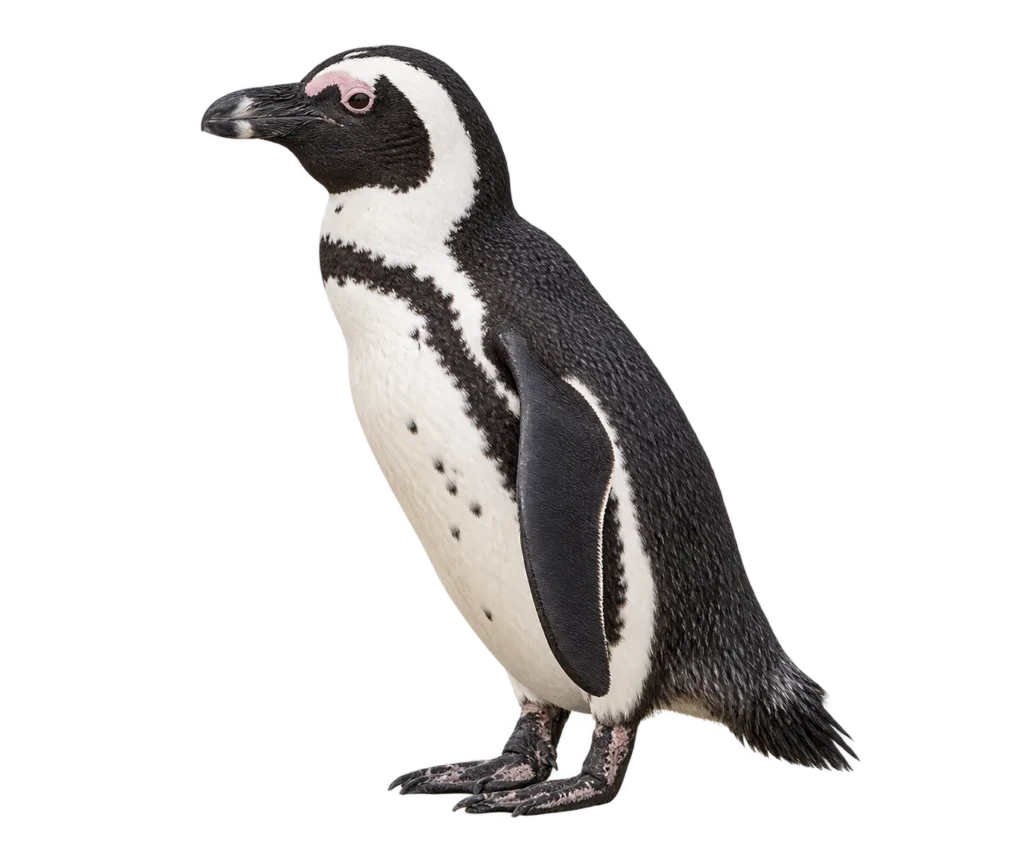
Size at a glance
How big is an African Penguin?
Compare
Compare African Penguin with another bird
Search by common or scientific name.
Morphology
Detailed measurements
Taxonomy
Classification
The African penguin (Spheniscus demersus) is a compact, medium-sized penguin with a low, sturdy build rather than a tall, elongated profile. Published descriptions generally place adults at about 55–70 cm (22–28 in), while adult body mass is often around 3 kg (6.6 lb). Sex, season and the annual moult can all affect measured mass, so weight is less fixed than bill or flipper dimensions.
How Large Is an African Penguin?
Adult size figures vary slightly among references because penguins are not always measured in exactly the same way. Some records describe body length, while others report standing height. A practical adult range is roughly 55–70 cm, with many birds weighing about 2.9–3.5 kg (6.4–7.7 lb) outside the larger fluctuations associated with body condition.
A standing penguin can change its posture considerably by extending or lowering its neck and angling its body. Published height and body-length figures should therefore be kept under their original definitions rather than treated as interchangeable measurements.
The species has a broad chest, short neck and relatively large head. Its legs are short and positioned far back on the body, while the wings have become rigid flippers. These proportions create the dense, upright shape seen on land and a much more streamlined profile in the water.
Males Are Larger, but the Sexes Overlap
Male and female African penguins have essentially the same adult plumage, but males are larger on average. The difference is measurable in the bill, flippers and body mass. It is not large enough to make every individual identifiable by size alone.
A field study involving 167 females and 166 males recorded the following average measurements:
| Measurement | Females | Males |
|---|---|---|
| Bill length | 55.5 mm | 60.3 mm |
| Bill depth | 23.3 mm | 25.9 mm |
| Flipper length | 180.5 mm | 190.6 mm |
| Body mass | 2.996 kg | 3.452 kg |
These are sample means rather than fixed values for every African penguin. The measured ranges of males and females overlapped.
The difference is especially noticeable in the bill. Males tend to have a longer and deeper bill, and bill depth has proved useful in measurement-based methods for estimating sex. Even so, external measurements cannot separate every male from every female because individuals near the middle of the size distribution can have very similar proportions.
Flipper Length Is More Useful Than “Wingspan”
African penguins have wings anatomically, but those wings are modified into stiff flippers. A conventional flying-bird wingspan is therefore not the most useful way to describe their size.
Measured adult flippers commonly fall around 18–19 cm (7.1–7.5 in) on average, with males tending to have longer flippers. In one large sample, female flippers ranged from 165 to 200 mm and male flippers from 174 to 215 mm.
Flipper length should not be doubled to create an estimated wingspan. That would mix two different measurements and would not represent a standard African penguin body dimension.
The flippers are rigid and powerful rather than foldable like the wings of a flying bird. A streamlined trunk, dense bones, webbed feet and rear-set legs further shape the African penguin into a compact diving bird rather than a lightweight aerial one.
Body Mass Can Change Far More Than Skeletal Size
Weight needs more context than measurements such as bill or flipper length. African penguins pass through an annual moult in which the entire plumage is replaced over a short period. They remain on land and cannot feed normally at sea while their waterproof feather covering is being renewed.
Penguins build reserves before this period and then use those reserves while fasting. Research on the species and its moult cycle indicates that an African penguin can lose roughly 40% of its pre-moult body mass. Broader penguin studies report losses around 40–50% during this type of moult.
This makes a single weight reading a poor substitute for structural size. Two adults with similar bill and flipper dimensions may weigh quite differently if they are at different points in the breeding or moulting cycle.
Field measurements show the same pattern on a smaller seasonal scale. In one study population, adult males averaged about 4.16 kg before breeding and about 3.81 kg during breeding, while corresponding female means were about 3.74 kg and 3.31 kg. These figures describe those sampled birds rather than a universal seasonal weight for the species.
How Its Proportions Shape Its Appearance
The African penguin’s measurements produce a body that looks heavier and more compact than its standing height alone suggests. The head is relatively large, the neck is short and thick, and the torso narrows toward the rear. The short tail and legs add little visible length when the bird stands upright.
The bill is much smaller than the flippers but is one of the most informative external measurements. Typical adult means from field studies are around 5.5–6.0 cm in bill length, with males usually toward the larger end of the distribution.
Adult plumage reinforces the body outline. The back and head are dark, while the underside is white with a black band across the upper chest and down the sides. Black spots occur across the pale breast and belly in individual patterns. Bare pink skin above the eyes can become more strongly coloured as blood flow to the area rises during warm conditions.
Dense overlapping feathers cover most of the body and help maintain a smooth exterior in the water. Beneath that feather covering, the skeleton is comparatively heavy for a bird. Reduced buoyancy and the rigid flippers suit a species that propels itself underwater rather than through the air.
Juvenile Size Can Be Misleading
Young African penguins approaching independence can already be surprisingly close to adult mass. In a study of late-stage juveniles, often called “blues,” mean body weights were about 3.0–3.1 kg. Their size alone can therefore make them look more mature than their plumage indicates.
Juveniles are better separated from adults by appearance. They initially have blue-grey upperparts and lack the sharply defined adult facial pattern, black chest band and spotted white underparts. Structural proportions continue to mature, but body mass by itself is not a reliable indicator of whether an African penguin has reached full adult plumage.
Data
Measurement sources
- Data status
- Measured
- Size measurements
- AVONET — Tobias et al. (2022)
- Morphology source
- AVONET — Tobias et al. (2022)
- Morphology dataset
- AVONET v7 — BirdLife taxonomy
- Morphology dataset license
- CC BY 4.0
Full source links, dataset definitions, licensing details and measurement methodology are maintained on the Data Sources & Methodology page.