Bird size profile
American Flamingo
Phoenicopterus ruber
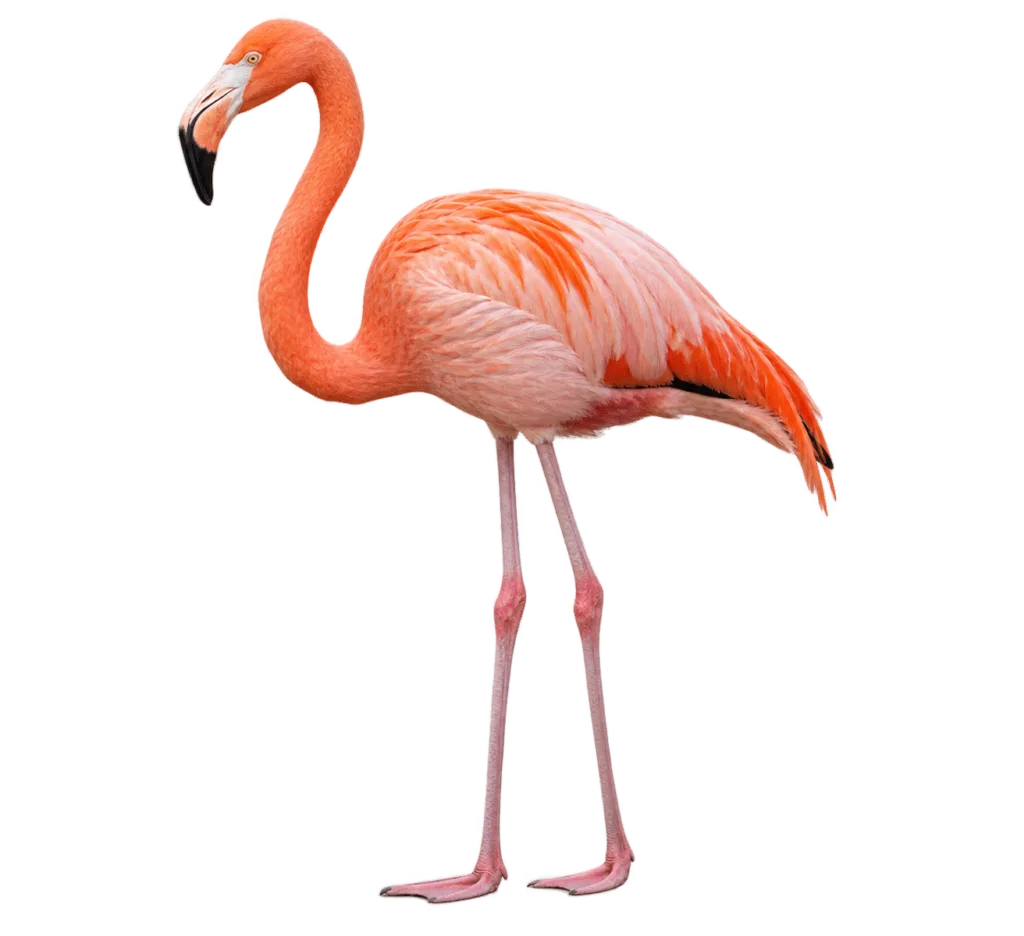
Size at a glance
How big is an American Flamingo?
Compare
Compare American Flamingo with another bird
Search by common or scientific name.
Morphology
Detailed measurements
Taxonomy
Classification
The American Flamingo (Phoenicopterus ruber) combines a relatively narrow body with extremely long legs and neck, so its visible height can seem out of proportion to its mass. Adults are commonly reported at 120–145 cm (47–57 in) in length, with a mass of about 2.1–4.1 kg (4.6–9.0 lb) and a wingspan of roughly 140–165 cm (55–65 in). Those numbers describe different dimensions and should not be treated as interchangeable measures of the bird’s size.
Why Flamingo Height and Length Can Look Confusing
An American Flamingo can stand around 1.5 m tall, yet published body-length figures are often 120–145 cm. The two measurements describe the bird in different ways. Standing height depends heavily on leg extension and neck posture, while standard bird length follows the body from the bill tip toward the tail.
A flamingo can raise or lower its head, curve its neck, or stand with the neck almost fully extended. This makes standing height much more posture-dependent than a conventional length measurement. A tall-looking flamingo is therefore not necessarily a bird with an equally long torso.
The body itself is comparatively compact. Much of the American Flamingo’s vertical profile comes from its exposed lower legs and elongated neck. When the neck is folded into its familiar curves, the same individual can appear much shorter without any change in actual body size.
The Long-Legged Shape Changes How Large the Bird Appears
The legs place the body high above the ground or water surface. They are thin relative to their length, while the torso remains narrow and streamlined. This combination creates a much taller silhouette than the bird’s weight might suggest.
The feet are also small compared with the total height of the bird. Three forward-facing toes are connected by webbing, forming a broad contact surface without adding much visual bulk. The long lower limbs allow the flamingo to move through shallow water while keeping much of the body clear of the surface.
The neck adds another large portion of the visible outline. It contains enough flexibility to form deep curves while resting or feeding, but it can also extend into a long, nearly straight line. Neck position is one reason photographs of different American Flamingos can give very different impressions of size even when the birds are similar in age and body mass.
The Bill Adds Length Without a Large Head
The American Flamingo has a relatively small head attached to a large, sharply bent bill. The bill becomes especially deep near the bend and ends in a black tip, giving the front of the head a heavier appearance than the skull itself would suggest.
This shape is tied closely to feeding. Flamingos commonly feed with the head inverted in shallow water. The tongue moves water through rows of comb-like structures inside the bill, allowing small aquatic food items to be separated from the water and sediment.
The downward bend is therefore more than an identifying feature. It changes the proportions of the entire head-and-neck profile. A straightened neck ends in a compact head but a conspicuous bill, while a feeding bird folds the neck downward and rotates the bill into a working position close to the substrate.
Culmen or bill-length measurements taken from specimens are not the same as total head length. Older and modern references may also use different starting points on the bill, so values should only be compared when the measurement method is known.
The Wings Are Larger Than the Standing Silhouette Suggests
With the wings folded, much of their length disappears against the sides of the body. This makes the American Flamingo look dominated by legs and neck when standing. Once the wings open, the proportions change sharply: a wingspan around 140–165 cm can equal or exceed the bird’s reported body length.
Wing chord is a separate measurement from wingspan. Morphological datasets have recorded flattened wing lengths in roughly the 388–442 mm range for American Flamingos. That figure describes one folded wing measured from the wrist area toward the longest flight feather; it does not mean that the bird has a wingspan of only 40 cm.
Flight also reveals feathers that are easy to miss on a standing bird. Adults have vivid pink wing coverts but black primary and secondary flight feathers. Much of the black remains concealed when the wings are closed, then forms a strong dark area across the rear portion of the extended wing.
The neck and legs are both extended during flight rather than tucked close to the body. As a result, the flying silhouette becomes exceptionally long from bill tip to feet even though the wings supply most of the lateral width.
Males Average Larger, but the Sexes Overlap
Male and female American Flamingos have the same basic proportions and plumage pattern. Size is one of the clearer physical differences, with adult males tending to be larger on average.
Research using known-sex American Flamingos has found sex-related differences in body weight and linear measurements such as the bill, tarsus, middle toe and wing. The distributions still overlap. A relatively small male can fall within the measurement range of females, while a large female can overlap with males.
Body size can provide useful context when several measurements are considered together, but a single value such as height, weight or bill length does not reliably identify the sex of every individual. The external appearance of the two sexes remains broadly similar.
Young Flamingos Keep the Same Basic Body Plan
Juveniles already show the long-legged, long-necked structure associated with flamingos, but their coloration is very different from that of adults. Young birds are dominated by gray, brown and whitish tones, with gray legs and a mostly gray bill ending in a darker tip.
The adult pink coloration develops gradually as the bird matures. Full adult-looking plumage may take roughly two to three years to develop. The underlying proportions change with growth, but color transformation is much more noticeable than a complete change in body shape.
This matters when judging size from photographs. A gray juvenile standing beside brightly colored adults may look like a fundamentally different kind of bird, yet the same distinctive arrangement of long legs, elongated neck, compact torso and bent bill is already present.
Body Mass Is Modest for Such a Tall Bird
An adult mass of roughly 2.1–4.1 kg can seem low beside a standing height approaching 1.5 m. The explanation is visible in the bird’s construction: height is produced mainly by long, slender structures rather than a deep or heavy torso.
This is why weight alone gives an incomplete picture of American Flamingo size. Length describes one axis, wingspan another, while standing height is strongly affected by posture. Mass describes how much the bird weighs but says little about how much vertical space its legs and neck can occupy.
Seen with those measurements separated, the unusual scale of Phoenicopterus ruber becomes easier to interpret. Its apparent size comes less from a massive body than from the extreme extension of the legs, neck and wings around a relatively narrow central body.
Data
Measurement sources
- Data status
- Measured
- Size measurements
- AVONET — Tobias et al. (2022)
- Morphology source
- AVONET — Tobias et al. (2022)
- Morphology dataset
- AVONET v7 — BirdLife taxonomy
- Morphology dataset license
- CC BY 4.0
Full source links, dataset definitions, licensing details and measurement methodology are maintained on the Data Sources & Methodology page.