Bird size profile
American Kestrel
Falco sparverius
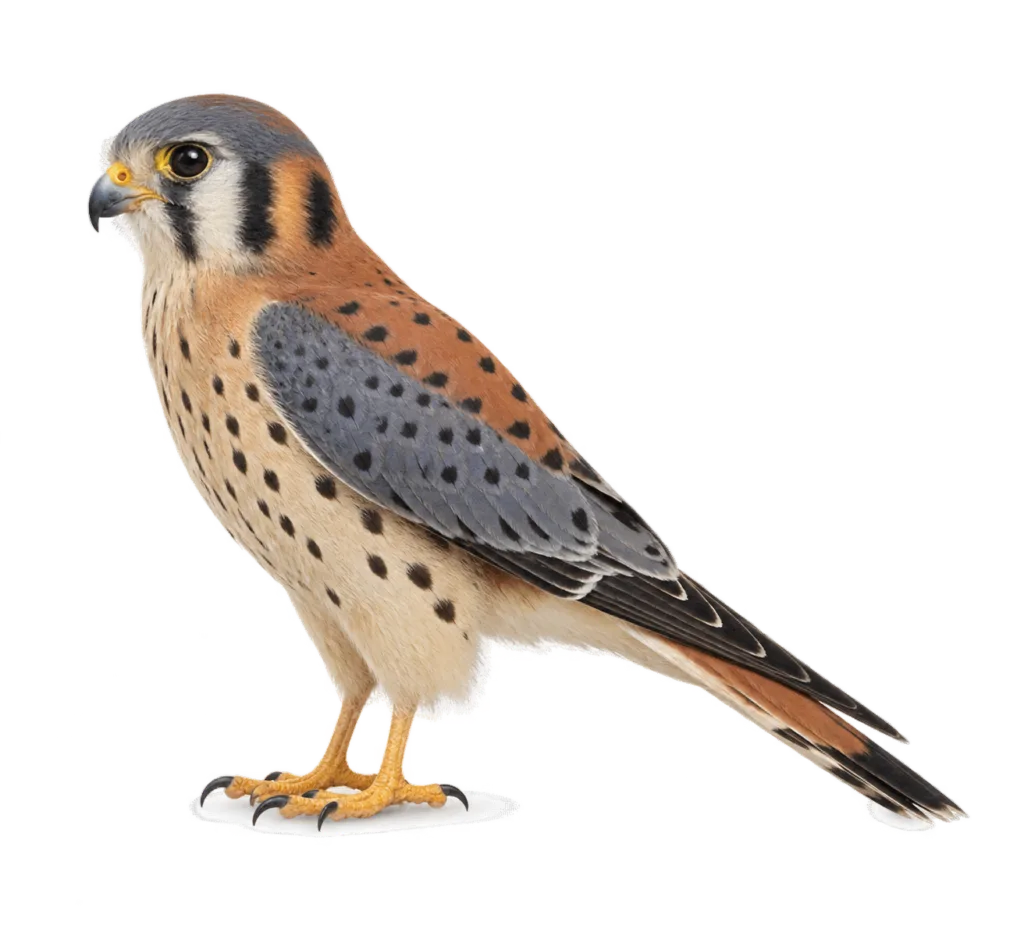
Size at a glance
How big is an American Kestrel?
True-scale visual
American Kestrel compared with a 175 cm person
When a transparent species asset and body-length data are available, BirdSize places the real bird asset and the fixed human reference on one mathematical centimetre scale.
Compare
Compare American Kestrel with another bird
Search by common or scientific name.
Morphology
Detailed measurements
Taxonomy
Classification
The American Kestrel (Falco sparverius) is a compact, lightly built falcon with a body length of about 22–31 cm (8.7–12.2 in), a weight of roughly 80–165 g (2.8–5.8 oz), and a wingspan of approximately 51–61 cm (20.1–24.0 in). These broad species-level ranges include differences associated with sex and geography rather than describing one standard-sized kestrel.
Why the Wingspan Looks Large for Such a Small Falcon
Body length alone can make the American Kestrel seem especially small. Its spread wings tell a different part of the story: the maximum published wingspan is close to twice the bird’s maximum head-to-tail length. This comes from a slender body combined with relatively long, narrow wings rather than from a heavy or broad build.
In flight, the wings taper to pointed tips and may appear bent, with the tips swept backward. The tail is comparatively long and ends in a fairly square shape. These proportions create the light, narrow silhouette characteristic of the species.
Females Are Usually the Larger Sex
American Kestrels show reversed sexual size dimorphism, meaning females tend to be larger than males. Research describing North American kestrels places the difference at roughly 10% in overall size, although individual measurements overlap and the exact difference is not identical in every population.
The size difference is especially relevant when interpreting body mass. A small male and a large female can sit far apart within the species-wide 80–165 g range even though both are normal adults. Length and wingspan ranges also combine birds of both sexes, so these values should not be treated as fixed male or female measurements.
Geography Also Changes Body Size
Not all of the variation comes from sex. American Kestrels occur across a very large part of the Americas, and body size varies geographically. Research on North American populations found a broad latitudinal pattern in which body size increases away from tropical regions, while tropical forms tend to be smaller.
This helps explain why published species measurements cover such a wide interval. A measurement collected from one local population may represent only a narrow part of the full range. Sex, regional population and individual variation can all influence where a particular bird falls within the published limits.
Body Shape Matters as Much as the Numbers
The American Kestrel has a slim torso, relatively small head, pointed wings and a long tail. When perched, the folded wings leave much of the tail visible. In the air, the combination of narrow wings and an elongated tail produces proportions that look different from those of more heavily built raptors. Cornell describes the species as slender, with long narrow wings and a long, square-tipped tail.
Because feathers contribute to both visible length and wingspan, neither measurement represents the dimensions of the skeleton alone. Body length is normally taken from the bill tip to the tail tip, while wingspan describes the distance between the extended wingtips. A 30 cm kestrel therefore does not have a 30 cm rigid body; a substantial part of that measurement comes from the head, bill and tail feathers.
Sex Can Often Be Judged Without Estimating Size
Although females average larger, plumage usually provides a clearer distinction between adult males and females than apparent body size. Adult males typically show blue-gray wings contrasting with a rusty back and tail. Females are more uniformly reddish-brown above, with dark barring across the wings, back and tail. Both sexes have the paired dark vertical facial marks associated with the species.
This visible difference is useful because size ranges overlap. A kestrel that appears large is not automatically female, and a small bird is not automatically male. The combination of plumage, proportions and measured dimensions gives a more reliable picture of an individual bird than size alone.
Data
Measurement sources
- Data status
- Measured
- Size measurements
- Cornell Lab of Ornithology – All About Birds
- Morphology source
- AVONET — Tobias et al. (2022)
- Morphology dataset
- AVONET v7 — BirdLife taxonomy
- Morphology dataset license
- CC BY 4.0
Full source links, dataset definitions, licensing details and measurement methodology are maintained on the Data Sources & Methodology page.