Bird size profile
American Robin
Turdus migratorius
Size at a glance
How big is an American Robin?
True-scale visual
American Robin compared with a 175 cm person
When a transparent species asset and body-length data are available, BirdSize places the real bird asset and the fixed human reference on one mathematical centimetre scale.
Compare
Compare American Robin with another bird
Search by common or scientific name.
Morphology
Detailed measurements
Taxonomy
Classification
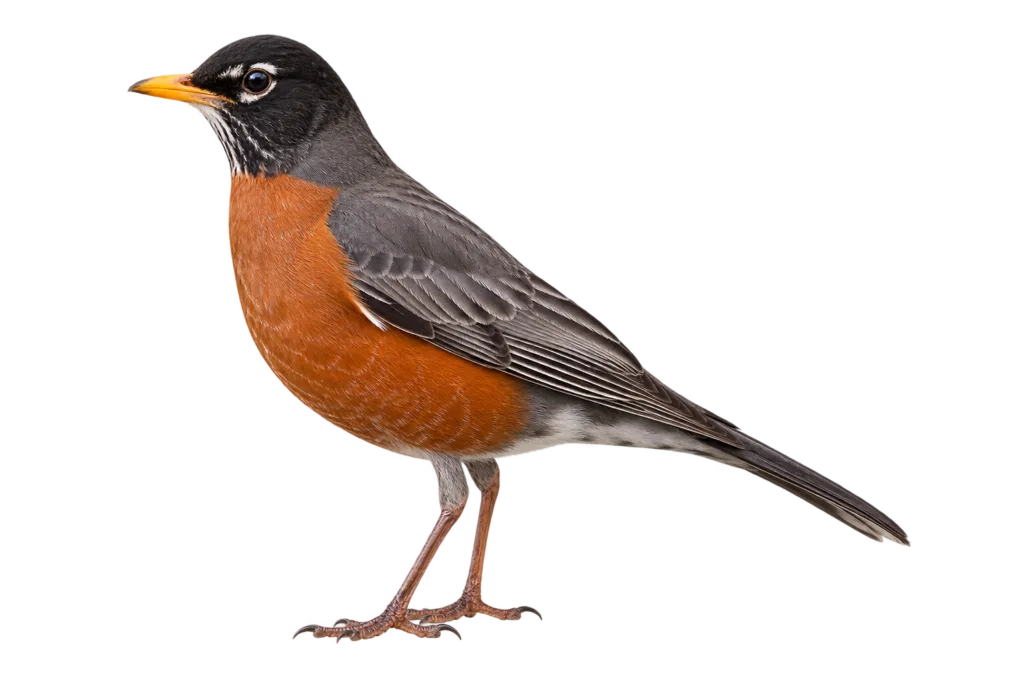
The American Robin (Turdus migratorius) is a large, strongly built thrush with proportions that make it look substantial even among familiar backyard songbirds. Adults are typically 20–28 cm (7.9–11.0 in) long, weigh about 77–85 g (2.7–3.0 oz), and span roughly 31–40 cm (12.2–15.8 in) across the wings. Its rounded body, long legs, and fairly long tail are as useful for judging its size as the measurements themselves.
American Robin Size in Practical Terms
An American Robin occupies a useful middle ground among common North American birds. It is much heavier than a bluebird or most small thrushes, yet nowhere near the bulk of a crow. The combination of body depth and an upright stance can make a robin appear larger than another bird of similar length.
| Bird | Length | Weight | Wingspan |
|---|---|---|---|
| American Robin | 20–28 cm | 77–85 g | 31–40 cm |
| Eastern Bluebird | 16–21 cm | 28–32 g | 25–32 cm |
| Wood Thrush | 19–21 cm | 40–50 g | 30–34 cm |
The comparison with other thrushes is especially useful. An Eastern Bluebird may overlap the lower end of a robin’s length range, but it usually weighs far less. A Wood Thrush also approaches robin-like dimensions in wingspan, although its body is lighter. The American Robin’s size therefore comes partly from mass and body volume rather than length alone.
Why an American Robin Looks So Solid
The robin’s silhouette is built around a large, rounded torso. Its belly is deep, the chest is broad for a thrush, and the head is carried fairly high when the bird stands on the ground. Long legs raise the body well above the surface, creating the familiar upright profile seen on lawns and open ground.
Posture can alter the apparent proportions. A robin standing erect with its neck extended looks taller and slimmer. The same bird crouched while running or feeding can appear shorter and much more rounded. This is one reason shape is more dependable when several features are considered together rather than judging size from a single view.
The American Robin as a Thrush Size Reference
The American Robin is the largest familiar North American thrush by general field profile and provides a useful visual reference for smaller members of the family. Eastern Bluebirds are distinctly lighter and more compact. Wood Thrushes have a robin-like rounded body but are shorter-tailed and substantially lighter. Several other woodland thrushes are slimmer and smaller still.
This difference can be clear even when distance makes plumage hard to see. A robin on open ground often shows a combination of a large belly, long legs, an extended tail, and a deliberate upright stance. Those proportions remain recognizable when the orange underparts or facial details are obscured by poor light.
A bird that appears robin-shaped but noticeably smaller may belong to another thrush species. Length alone can overlap between species, so body mass, tail length, leg length, posture, and head shape provide better context.
Male, Female, and Juvenile Differences
Male and female American Robins are close enough in body dimensions that most general measurement references combine the sexes. Males can average slightly larger, but the difference is not dependable for identifying the sex of an individual bird in the field.
Plumage usually provides more information. Adult males tend to have a darker head that contrasts strongly with the gray-brown back, along with rich orange underparts. Females are commonly paler around the head and show less contrast between the head and back. There is enough individual variation that some adults cannot be confidently separated by plumage alone.
Juveniles have a much more distinctive appearance. Dark spotting covers the breast and can also be visible across the back, breaking up the smoother color pattern of an adult. This spotted juvenile plumage can make a young robin look structurally different at first glance even though the basic long-legged, round-bodied thrush shape is already apparent.
Why Two American Robins Can Look Different
Not every American Robin has the same apparent size or color. Feather position can change the outline considerably. A bird with its body feathers fluffed in cool conditions looks deeper and rounder, while sleek feathers produce a narrower profile. Viewing angle also matters: the relatively long tail adds much more apparent length in a side view than when the bird faces forward.
Color varies geographically as well. Many western birds are paler than eastern birds and may show very little white at the corners of the tail. Breeding birds from parts of Canada’s Atlantic coast can be much darker, including extensive blackish coloring around the upper back and neck. The distinctive San Lucas population of Baja California Sur is notably pale.
These regional color differences do not change the basic American Robin structure. Across its range, the combination of a rounded body, long legs, fairly long tail, straight bill, and relatively large thrush proportions remains one of the most dependable ways to recognize the species.
Data
Measurement sources
- Data status
- Measured
- Size measurements
- Cornell Lab of Ornithology – All About Birds
- Morphology source
- AVONET — Tobias et al. (2022)
- Morphology dataset
- AVONET v7 — BirdLife taxonomy
- Morphology dataset license
- CC BY 4.0
Full source links, dataset definitions, licensing details and measurement methodology are maintained on the Data Sources & Methodology page.