Bird size profile
Andean Condor
Vultur gryphus
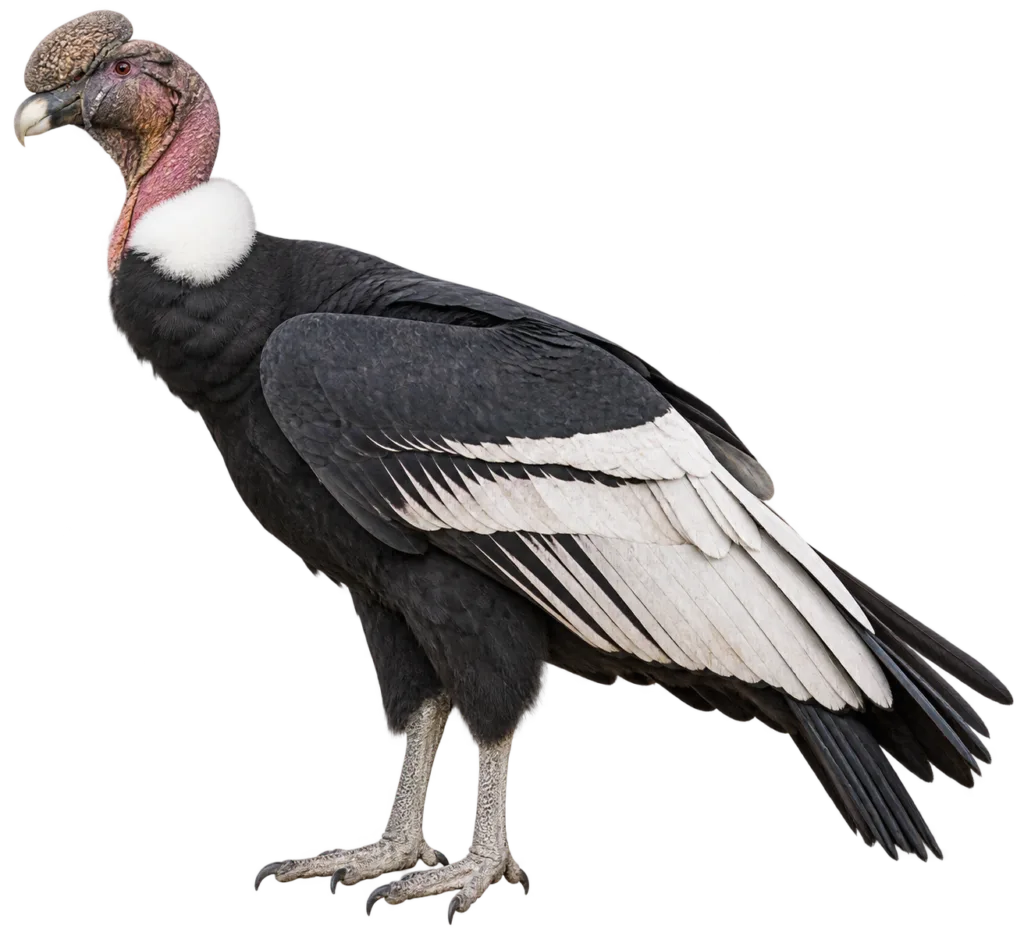
Size at a glance
How big is an Andean Condor?
Compare
Compare Andean Condor with another bird
Search by common or scientific name.
Morphology
Detailed measurements
Taxonomy
Classification
The Andean condor (Vultur gryphus) combines a body roughly a meter long with wings that can stretch more than three meters from tip to tip. That contrast is the clearest way to understand its size: the bird is large on the ground, but its full scale becomes much more apparent when the wings are open.
How Large Is an Andean Condor?
Published measurements place adult body length at about 97.5 to 128 cm (38 to 50 in), measured along the bird from the beak toward the tail. Some institutional records round the upper end to about 1.3 m (4.25 ft). The species can reach a wingspan of about 3.2 m (10.5 ft).
Body mass varies widely because males and females are not the same size. Across the species, reported adult weights extend from roughly 7.7 to 15 kg (17 to 33 lb). The highest values are associated with large adult males.
A 3.2 m wingspan describes the distance between the tips of the fully extended wings. It does not mean the condor is three meters tall or three meters long. Its beak-to-tail body length is closer to one meter, reaching about 1.3 m in large birds.
Males Are Noticeably Heavier Than Females
The Andean condor has an unusual pattern for a bird of prey: the male is larger than the female. Research on wild condors has described males as roughly 30–40% heavier than females, although the difference varies among individuals and datasets.
Commonly reported adult ranges put males at about 11–15 kg (24–33 lb) and females at about 8–11 kg (18–24 lb). Maximum figures therefore should not be treated as the normal weight of every Andean condor.
The size difference can also be recognized without weighing the bird. Adult males have a prominent fleshy comb on the head and more developed wattling around the neck. Females lack the large comb. These features make sex easier to identify than in many other vultures, where males and females can look very similar.
Why the Wings Dominate Its Appearance
An Andean condor with folded wings can look compact compared with the scale suggested by its wingspan. Once the wings open, each wing projects well beyond the body, creating the broad flight surface needed by such a heavy soaring bird.
The outer primary feathers separate into distinct finger-like tips during flight. This arrangement helps the bird control airflow while circling in rising air and moving through uneven mountain winds. The wings are built mainly for efficient soaring rather than continuous powered flight.
Field measurements also show why body mass matters. In research on wild Andean condors, males were substantially heavier than females, while the difference in wing area was much smaller. The heavier males therefore carry more weight for a similar amount of wing surface. That affects the air conditions in which different-sized condors can soar most efficiently.
A Three-Meter Wingspan Does Not Mean Constant Flapping
Moving wings of this size through repeated powered strokes would be costly. Andean condors instead obtain much of their altitude and forward movement from rising air. Thermal updrafts, slope lift and other wind conditions allow the bird to gain height and glide without continuously beating its wings.
Flight-recorder research on immature Andean condors found that the birds spent only about 1% of recorded flight time flapping. More than three quarters of their flapping was associated with takeoff. One tracked condor remained airborne for more than five hours and covered about 172 km (107 mi) without a recorded wingbeat.
This flight pattern helps explain why the condor’s dimensions cannot be considered separately. A body that may weigh 15 kg requires enormous wings, but those wings work most effectively when the bird can use moving air rather than relying on muscle power alone.
How Its Size Looks on the Ground
The folded-wing profile is much narrower than the bird’s airborne silhouette. The long body, thick neck, large hooked bill and heavy torso still make an adult condor unmistakably substantial, but a perched bird does not occupy anything close to its full 3.2 m flight width.
Body length also should not be converted into a standing-height estimate. Bird length is normally taken along the body from beak to tail, while standing posture changes with the angle of the neck, legs and body. A published body length of 1.0–1.3 m therefore describes a different measurement from height.
The contrast becomes clearest during takeoff. The condor must accelerate a heavy body while opening a very wide pair of wings, which is one reason elevated launch points and favorable air currents suit its flight style so well. Once airborne, the same large wing surface that makes powered takeoff demanding allows the bird to spend long periods soaring with very little flapping.
Data
Measurement sources
- Data status
- Measured
- Size measurements
- AVONET — Tobias et al. (2022)
- Morphology source
- AVONET — Tobias et al. (2022)
- Morphology dataset
- AVONET v7 — BirdLife taxonomy
- Morphology dataset license
- CC BY 4.0
Full source links, dataset definitions, licensing details and measurement methodology are maintained on the Data Sources & Methodology page.