Bird size profile
Anna’s Hummingbird
Calypte anna
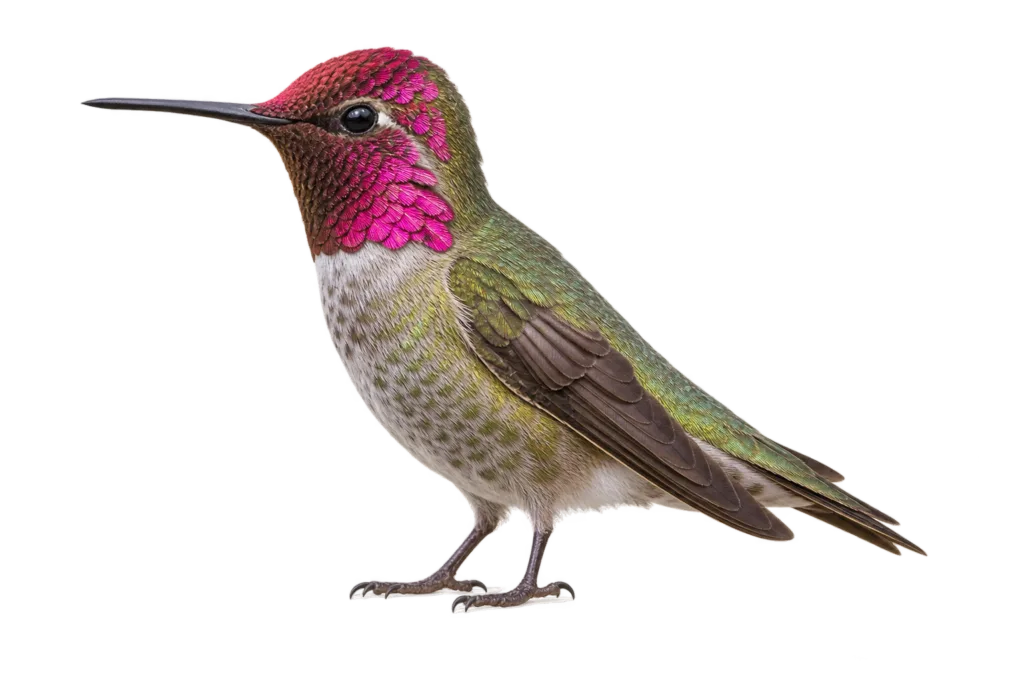
Size at a glance
How big is an Anna’s Hummingbird?
Compare
Compare Anna’s Hummingbird with another bird
Search by common or scientific name.
Morphology
Detailed measurements
Taxonomy
Classification
Anna’s Hummingbird (Calypte anna) is a medium-sized hummingbird with a compact, stocky build. A typical reference length is about 3.9 inches (10 cm), with a wingspan near 4.7 inches (12 cm) and a body mass commonly reported within 3–6 g. Those numbers describe a very small bird, but its broad tail, relatively sturdy body and straight bill give it a fuller outline than length alone suggests.
A Compact Body With Distinct Proportions
Anna’s Hummingbird has a straight, fairly short bill for its overall proportions and a broad tail. When the bird is perched, the tail normally extends beyond the folded wingtips. This relationship between the wings and tail is useful because total body length can hide how the bird’s mass is distributed.
The torso appears rounded and compact rather than especially slender. The head is small in absolute terms, yet the bill projects far enough beyond it to create the familiar hummingbird profile. The combination of a deep-looking body, short neck and broad tail helps explain why Anna’s Hummingbird is often described as stocky within the hummingbird family.
Body mass also varies within the species. A range such as 3–6 g should not be read as a fixed weight for every individual. Age, sex, condition and recent feeding can all affect the mass recorded when a bird is measured.
Male Head Feathers Change the Bird’s Apparent Shape
Adult males have iridescent reddish-pink feathers across both the throat and crown. The colored throat patch, or gorget, therefore covers much more of the head than the throat-only patches seen in many hummingbirds. Depending on feather position and viewing angle, this can make the male’s head look broader and more heavily feathered than its skeletal dimensions would suggest.
The effect is strongly dependent on light. The same crown and throat feathers can appear bright magenta, reddish pink, dark or nearly gray as the viewing angle changes. This is structural iridescence rather than a simple flat pigment color, so apparent color intensity is not a reliable indicator of body size.
Females are green above and grayer below and may carry a small concentration of iridescent reddish feathers in the center of the throat. Immature males can also show incomplete development of the adult male head pattern. As a result, two Anna’s Hummingbirds of similar physical dimensions can present noticeably different head profiles in the field.
The Tail Is Both a Size Feature and a Functional Structure
The relatively broad tail contributes strongly to the species’ perched silhouette, but male tail morphology also has a specialized role during display flight.
Research using high-speed video, experimental feather manipulation and wind-tunnel tests showed that the male’s outermost tail feathers produce the sharp sound heard near the bottom of the display dive. The trailing portion of those feathers flutters rapidly as air passes over it. During recorded dives, males opened the tail for only about 0.06 seconds, yet that brief movement was enough to produce the characteristic high-frequency sound.
This makes the tail more than a passive part of total body length. Its shape contributes to the bird’s visible proportions while individual feather structure also performs a mechanical function during display behavior.
Bill Shape Is Not Identical Across Every Anna’s Hummingbird
A single species description often treats the bill as a fixed feature: straight, narrow and relatively short. Museum research published in 2025 showed that the finer details are more variable.
Researchers examining historical Anna’s Hummingbird specimens found associations between supplemental feeder availability and changes in bill form. Birds linked with greater feeder availability showed bills that tended to be longer and more tapered, with changes in the shape of the upper bill. Male bill shape also showed greater dorsal pointedness in association with feeder use.
The same study found that bill size decreased in association with colder conditions at higher latitudes. These results show why a species-wide bill measurement should be treated as a reference value rather than an exact template for every population and time period.
For size identification, the most stable description remains the overall combination: a straight bill, compact body and broad tail. For detailed morphology, however, Anna’s Hummingbird provides a clear example of measurable form varying within a single species as populations occupy different environments.
Data
Measurement sources
- Data status
- Measured
- Size measurements
- AVONET — Tobias et al. (2022)
- Morphology source
- AVONET — Tobias et al. (2022)
- Morphology dataset
- AVONET v7 — BirdLife taxonomy
- Morphology dataset license
- CC BY 4.0
Full source links, dataset definitions, licensing details and measurement methodology are maintained on the Data Sources & Methodology page.