Bird size profile
Atlantic Puffin
Fratercula arctica
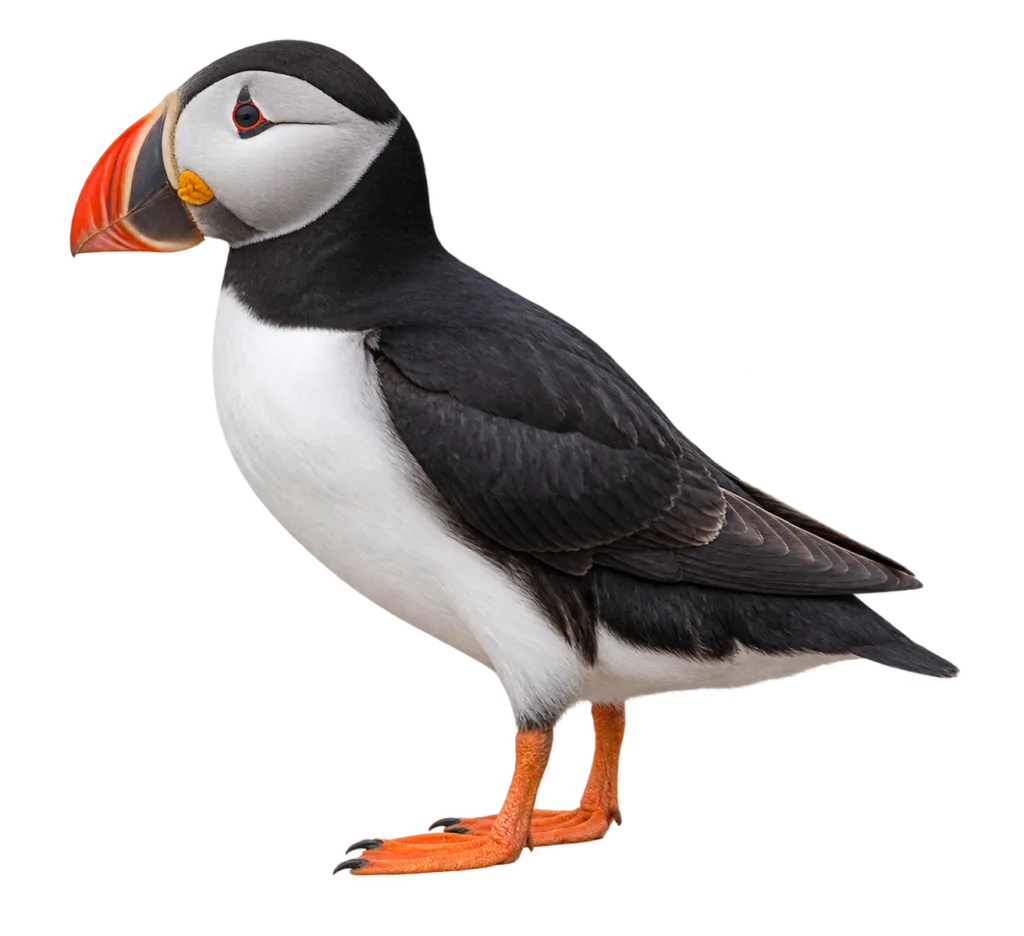
Size at a glance
How big is an Atlantic Puffin?
True-scale visual
Atlantic Puffin compared with a 175 cm person
When a transparent species asset and body-length data are available, BirdSize places the real bird asset and the fixed human reference on one mathematical centimetre scale.
Compare
Compare Atlantic Puffin with another bird
Search by common or scientific name.
Morphology
Detailed measurements
Taxonomy
Classification
The Atlantic Puffin (Fratercula arctica) is a compact auk with a body shape that can make it look larger than its length suggests. Adults are roughly 26–29 cm (10.2–11.4 in) long, but the short neck, deep body, large head, and broad triangular bill give the bird a dense, front-heavy profile.
A Compact Body With an Oversized Head Profile
Atlantic Puffins have a stout build rather than a long-bodied or long-necked shape. The head flows into a very short neck, while the chest and belly form a rounded body. The tail is short, and the legs sit far enough back that a bird standing on land has a distinctly upright posture.
The bill changes the apparent proportions even more. On a breeding adult, it is tall, laterally flattened, and large in relation to the skull. This makes the head look much deeper than it would if only the feathered portion were considered.
On the water, puffins also sit relatively high. Their rounded body remains clearly visible above the surface, reinforcing the impression of a compact bird with considerable bulk packed into a short length.
Length, Mass, and Wingspan Describe Different Parts of Its Size
A commonly published length range for Atlantic Puffins is 26–29 cm (10.2–11.4 in). Wingspan is about 53 cm (20.9 in), while body mass can vary much more, with a broad field-guide range of about 310–550 g (10.9–19.4 oz).
Mass figures should not be treated as though every healthy adult falls near the middle of that full range. British Trust for Ornithology biometric data, for example, give an adult average of about 386.9 g from measured birds. A population average, a sample range, and a species-wide field-guide range describe different things.
BTO biometric data give an average adult wing length of about 159.5 mm. That is a measurement of one wing and should not be confused with the roughly 53 cm distance across both extended wings. Mixing these measurements can produce an apparent size conflict where none exists.
Atlantic Puffins Become Larger Toward the High Arctic
There is no single body size that represents every Atlantic Puffin population equally well. Morphological studies have found a broad north–south pattern in which birds from higher latitudes tend to be larger.
High-Arctic puffins from areas such as Greenland and Svalbard are especially large. Birds from more southerly colonies in Britain, Ireland, the Faroes, and nearby regions tend to fall toward the smaller end of the species’ structural size variation. Populations from Iceland, Norway, and parts of the western Atlantic often occupy intermediate ranges, although individual measurements overlap.
Traditional scientific literature has sometimes divided these forms into named subspecies largely through differences in wing, bill, body mass, and geography. More recent genetic work shows that Atlantic Puffin population structure is more complicated than a simple three-size division. For a size profile, the more dependable point is the physical pattern itself: body dimensions vary geographically, and northern birds can be noticeably larger than southern birds.
Males Average Slightly Larger, but the Sexes Overlap
Male and female Atlantic Puffins look very similar, yet biometric studies detect small average differences. Males tend to have somewhat larger bills and slightly greater structural dimensions and body mass.
The difference is modest compared with the variation among individual birds. Research on modern specimens has found males averaging only a few percent larger across measured skeletal traits, with extensive overlap between the sexes.
Bill measurements can contribute to statistical sexing methods when researchers combine them with colony-specific data, age information, or genetic testing. Size alone is not a dependable visual method for deciding whether a puffin seen in the field is male or female.
The Bill Changes Size and Shape With Age and Season
The Atlantic Puffin’s most conspicuous structure is not visually constant throughout its life. Young birds have a smaller, less developed bill. As puffins mature, the bill becomes deeper and develops additional grooves, so head proportions can change even after much of the bird’s structural growth has occurred.
Season also affects appearance. The breeding bill carries the familiar bright outer plates and gives the head its broad, colorful profile. After breeding, parts of this outer covering are shed. The bill becomes slightly smaller and duller, while the face also becomes grayer.
This means two adult Atlantic Puffins with similar body dimensions can appear different in head size depending on when they are observed. A breeding adult’s bill exaggerates the front of the silhouette, whereas a nonbreeding bird presents a less bulky facial profile.
Short Wings Keep the Silhouette Dense
Atlantic Puffins have relatively short, straight wings attached to a compact body. In the air, this produces rapid, nearly continuous wingbeats rather than the slower flapping or extended soaring associated with long-winged seabirds.
The same proportions suit movement below the surface. Puffins use their wings for underwater propulsion while steering partly with their feet. The wings therefore work in two very different environments without becoming long enough to dominate the bird’s body profile.
A wingspan near 53 cm is almost twice the bird’s body length, yet the wings still look short when folded because little extends beyond the compact torso and short tail.
Even One Colony Can Change in Average Body Size
Long-term measurements from Machias Seal Island show that Atlantic Puffin size is not fixed across generations. Researchers studying birds there since the 1990s found that fledglings raised during warmer sea-surface conditions tended to be smaller. Fledgling size was also related to later adult size, so birds that left the colony smaller tended to remain smaller when measured as adults.
The study found a decline in adult structural size in more recent cohorts and linked much of the pattern to conditions during development, including changes in prey quality. At the same time, bill size became larger in proportion to wing chord.
These findings apply to a monitored population rather than defining a new species-wide measurement range. They show why Atlantic Puffin measurements are best read as biological ranges shaped by location, sex, age, developmental conditions, and the measurement method being used, rather than as one fixed set of dimensions.
Data
Measurement sources
- Data status
- Measured
- Size measurements
- Cornell Lab of Ornithology – All About Birds
- Morphology source
- AVONET — Tobias et al. (2022)
- Morphology dataset
- AVONET v7 — BirdLife taxonomy
- Morphology dataset license
- CC BY 4.0
Full source links, dataset definitions, licensing details and measurement methodology are maintained on the Data Sources & Methodology page.