Bird size profile
Australian Pelican
Pelecanus conspicillatus
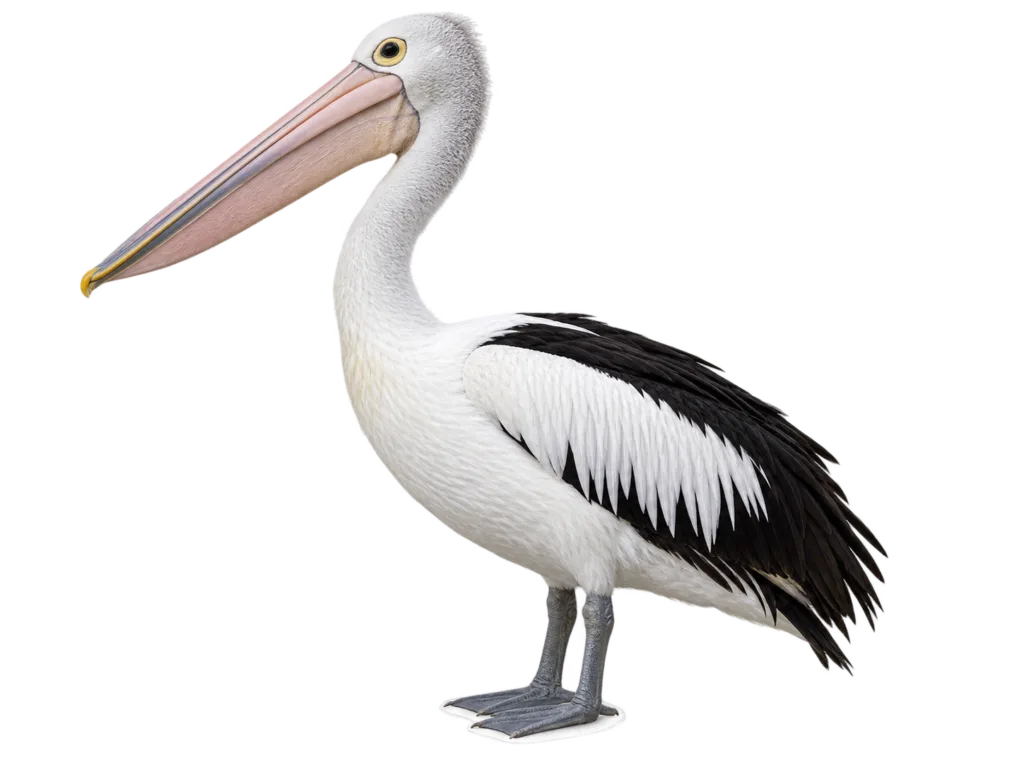
Size at a glance
How big is an Australian Pelican?
Compare
Compare Australian Pelican with another bird
Search by common or scientific name.
Morphology
Detailed measurements
Taxonomy
Classification
The Australian Pelican (Pelecanus conspicillatus) is built on unusually long dimensions. Adults are about 1.6–1.8 m in total length, with a wingspan around 2.3–2.5 m. The feature that most changes its proportions is the bill: an adult bill can approach half a metre in length, extending the head profile far beyond what is typical for a bird of similar body mass.
The Australian Pelican’s Bill Drives Its Long Profile
The published total length of an Australian Pelican should not be read as standing height. Much of that 1.6–1.8 m measurement comes from the long neck, head and especially the bill. The bird can therefore be exceptionally long without having a correspondingly tall or bulky torso.
General species measurements place the bill at roughly 40–50 cm. More detailed adult measurements show a strong difference between the sexes. Male bills have been recorded at 410–495 mm, while female bills fall around 355–408 mm.
This unusually long bill is not a thick, solid structure. The lower jaw supports an expandable gular pouch, while the upper bill ends in a small hook. The combination produces a very large feeding apparatus without giving the head the dense shape that its dimensions might suggest.
Sex Difference Is Strongest in the Bill
Adult males are larger than adult females, but the difference is not equal across every measurement. Bill length shows especially clear separation. Wing measurements overlap much more.
| Adult Measurement | Male | Female |
|---|---|---|
| Bill length | 410–495 mm | 355–408 mm |
| Wing chord | 560–690 mm | 541–605 mm |
| Tail length | 154–225 mm | 147–182 mm |
| Tarsus | 100–150 mm | 95–125 mm |
The bill ranges are almost separated, whereas male and female wing-chord measurements overlap from about 560 to 605 mm. A large-looking bill can therefore contribute more to the visible difference between the sexes than wing length alone.
Body mass is less tidy as a comparison because published values vary with sex, individual condition and the source of the measurements. Species accounts commonly place Australian Pelicans in roughly the mid-single-digit kilogram range, with adult males tending to be heavier than females. Length measurements are more useful when the goal is to understand the bird’s proportions.
A 2.3–2.5 m Wingspan Is Not the Same as Wing Chord
The Australian Pelican’s wingspan reaches about 2.3–2.5 m, making the bird dramatically wider in flight than its folded-wing appearance suggests. This number describes the spread from one wingtip to the other when both wings are extended.
Wingspan and Wing Chord Measure Different Dimensions
Wing chord measures one folded wing from the carpal joint to the tip of the longest primary. Adult Australian Pelican wing-chord measurements are roughly 541–690 mm depending on sex and individual size. They should not be treated as half of the bird’s wingspan.
The distinction matters because the published numbers can otherwise seem contradictory. A bird with a wing chord of around 600 mm can still have a wingspan well above two metres. Wingspan includes both extended wings and the width of the body between them, while wing chord follows a different anatomical measurement.
The long wings also change the pelican’s apparent proportions in flight. On the ground or water, most of that width is folded against the body. Once airborne, the broad black-and-white wings become the dominant dimension, while the neck is drawn back and the bill projects ahead of it.
Folded Wings Hide Much of the Bird’s Width
An Australian Pelican resting on water can look much more compact than the wingspan figure suggests. The wings are folded tightly along the back, much of the body sits low relative to the waterline, and the long neck can be held in a curved posture. The bill remains the most obvious linear feature.
Flight reverses that visual balance. With more than two metres between the wingtips, width becomes much more noticeable than body length. This is why photographs taken on water and photographs taken in flight can give very different impressions of the same species’ size.
The legs contribute relatively little to the bird’s total profile. Adult tarsus measurements are about 95–125 mm in females and 100–150 mm in males. They are short compared with the bill, neck and wings, so the Australian Pelican does not gain its size from long legs in the way many large wading birds do.
The Throat Pouch Adds Volume, Not Structural Length
The expandable pouch beneath the bill can hold a large volume of water when fully distended, with published accounts giving a capacity of up to about 13 litres. It functions mainly as a temporary scoop during feeding rather than as a storage compartment.
This flexibility can make the head and throat look much larger in feeding photographs than they do when the pouch is relaxed. The change is mostly in volume and shape. It does not mean the bird has gained another fixed body dimension, which is useful to remember when judging size from photographs.
The same distinction applies to breeding adults. Changes in pouch and facial colour can make the head appear more prominent, but the underlying proportions remain those of the same long-billed, broad-winged pelican. For measurement purposes, the rigid bill and skeletal landmarks provide more consistent reference points than the expandable pouch.
Data
Measurement sources
- Data status
- Measured
- Size measurements
- AVONET — Tobias et al. (2022)
- Morphology source
- AVONET — Tobias et al. (2022)
- Morphology dataset
- AVONET v7 — BirdLife taxonomy
- Morphology dataset license
- CC BY 4.0
Full source links, dataset definitions, licensing details and measurement methodology are maintained on the Data Sources & Methodology page.