Bird size profile
Bald Eagle
Haliaeetus leucocephalus
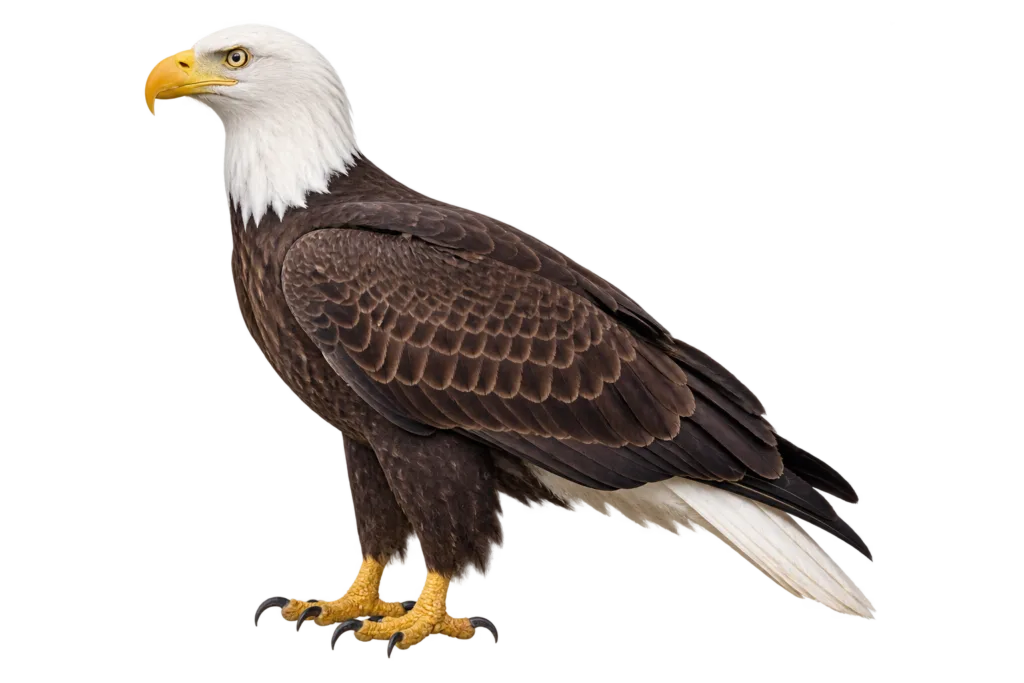
Size at a glance
How big is a Bald Eagle?
True-scale visual
Bald Eagle compared with a 175 cm person
When a transparent species asset and body-length data are available, BirdSize places the real bird asset and the fixed human reference on one mathematical centimetre scale.
Compare
Compare Bald Eagle with another bird
Search by common or scientific name.
Morphology
Detailed measurements
Taxonomy
Classification
The Bald Eagle (Haliaeetus leucocephalus) is a very large North American raptor with a heavy body, broad wings, a large head, and a long hooked bill. Published measurements place adults across a wide size range rather than at one fixed size. Cornell Lab measurements give a body length of 27.9–37.8 inches (71–96 cm), a weight of 105.8–222.2 ounces (3,000–6,300 g), and a wingspan figure of 80.3 inches (204 cm). Sex and geography account for part of the variation seen among individual birds.
Why Bald Eagles Vary So Much in Size
Two adult Bald Eagles standing together can differ noticeably in bulk. Females are larger than males, a pattern also found in many other birds of prey. The U.S. Fish and Wildlife Service reports that females may reach about 14 pounds and an 8-foot wingspan, while males may reach about 10 pounds and a 6-foot wingspan.
Location adds another source of variation. Bald Eagles from northern parts of the species’ range tend to grow larger than those farther south. An eagle from Alaska may therefore fall toward the larger end of published measurements even when compared with another healthy adult of the same species.
Published figures do not always describe the same sample or use the same reporting method. A combined species range, an average measurement, and a maximum recorded for one sex are different kinds of information. They should not be merged into a single supposed “normal” size.
The Body Shape Behind the Numbers
Raw length does not fully explain why a Bald Eagle looks so large. Much of its visual presence comes from its proportions. The body is deep and heavy, the head projects strongly in front of the wings, and the bill is large even for a raptor. These features give the bird a substantial silhouette whether it is perched or flying.
The wings are long but also notably broad. During soaring flight, a Bald Eagle commonly holds them nearly flat, producing the broad, plank-like profile used by birders to recognize the species at a distance. The primary feathers at the tips separate visibly, forming the familiar fingered outline of a large soaring bird.
This shape also explains why wingspan and body length should be treated as separate measurements. Wingspan describes the distance from one fully extended wingtip to the other. Body length measures the bird from the bill to the end of the tail. Neither value can be reliably calculated from the other because they describe different parts of the bird’s structure.
Female and Male Size Differences
Sexual size difference is especially useful when two Bald Eagles are seen together. In an established pair, the larger bird is often the female. The distinction may be visible in body depth, head size, bill proportions, and general bulk, although judging sex from a lone bird without a direct comparison is much harder.
These are upper figures rather than measurements that every bird will reach. Geographic variation also overlaps with the sex difference, so a large male from one region may not fit neatly beside a smaller female from another region.
Why Weight Is More Variable Than the Silhouette Suggests
Body mass covers a particularly broad range. Cornell Lab data span roughly 3.0 to 6.3 kilograms, while Alaska wildlife information reports Bald Eagles there at about 8 to 14 pounds (3.6–6.4 kg). The northern population’s larger body size helps explain why Alaska figures sit toward the heavier part of the species range.
Weight and structural size also describe different things. A bird can have the same basic skeletal dimensions while its body mass varies within a narrower personal range. For size comparison, measurements such as length and wingspan describe physical extent, while mass describes how heavy the bird is at the time it is weighed.
Age Changes Appearance More Than Identification by Size
Adult Bald Eagles are easy to associate with a white head and tail, but those markings are not present on young birds. Immature eagles are largely brown with variable white mottling, and the adult color pattern develops gradually over several years. The U.S. Fish and Wildlife Service places the development of mature plumage at roughly four to five years of age.
This matters when judging size in the field because a large brown eagle is not necessarily a different or smaller eagle species. An immature Bald Eagle can already present the broad-winged, heavy-bodied proportions associated with Bald Eagles while lacking the adult’s white head and tail. Shape, proportions, flight posture, and plumage therefore work together when identifying an eagle.
What a Wingspan Figure Actually Represents
A wingspan near 7 feet is a useful mental reference for a Bald Eagle, but it should not be treated as a universal measurement for every individual. Sex, regional body size, and the source’s sampling method can shift the number. Government sources may describe approximate or upper sex-specific spans, while ornithological databases may publish measurements drawn from a different set of birds.
The most dependable interpretation is therefore structural rather than based on one number: a Bald Eagle is a large, heavy-bodied eagle with exceptionally broad wings. Measurements refine that picture, while the bird’s proportions explain why even an individual that falls below the upper published limits still appears much larger than most hawks and other commonly encountered raptors.
Data
Measurement sources
- Data status
- Measured
- Size measurements
- Cornell Lab of Ornithology – All About Birds
- Morphology source
- AVONET — Tobias et al. (2022)
- Morphology dataset
- AVONET v7 — BirdLife taxonomy
- Morphology dataset license
- CC BY 4.0
Full source links, dataset definitions, licensing details and measurement methodology are maintained on the Data Sources & Methodology page.