Bird size profile
Barnacle Goose
Branta leucopsis
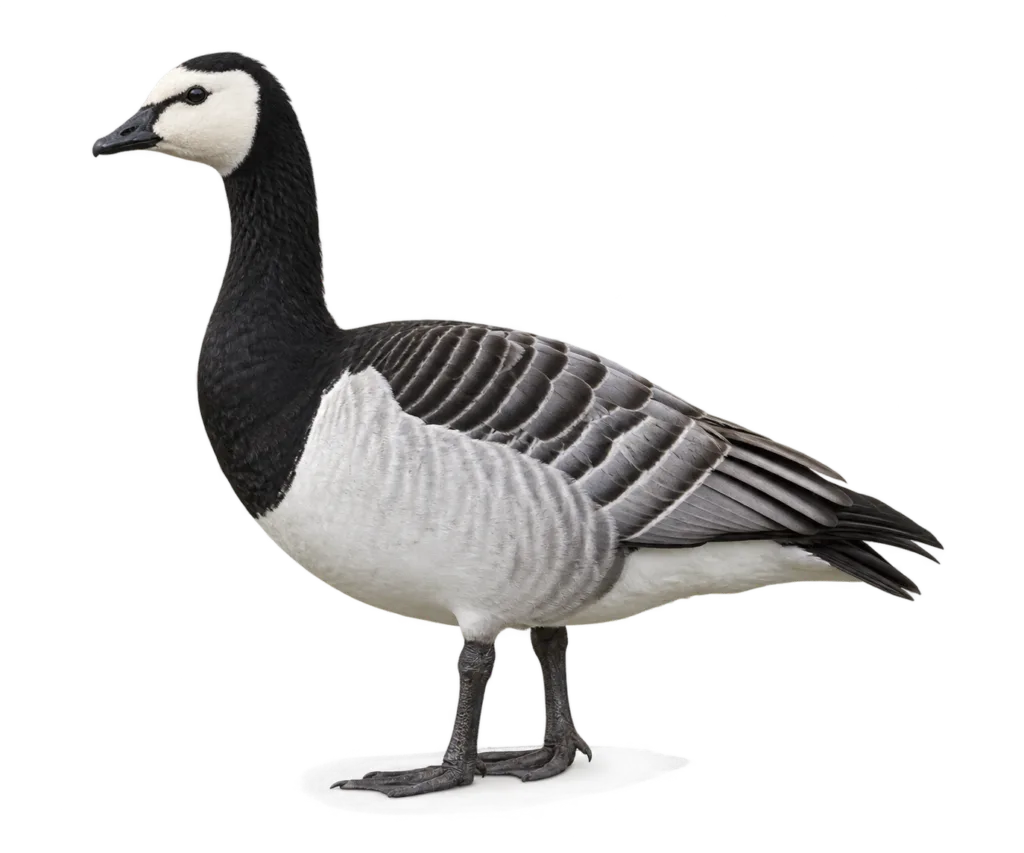
Size at a glance
How big is a Barnacle Goose?
Compare
Compare Barnacle Goose with another bird
Search by common or scientific name.
Morphology
Detailed measurements
Taxonomy
Classification
The Barnacle Goose Branta leucopsis is a compact, relatively small goose with a short bill, sturdy body, and broad wings. Adults are typically 58–70 cm long, with a wingspan of about 132–145 cm. Body mass commonly falls between 1.3 and 2.2 kg, although an individual bird’s weight is more variable than its structural measurements.
How Large Is a Barnacle Goose?
The proportions matter as much as the raw measurements. A Barnacle Goose has a deep body carried on relatively short legs, while the neck is not especially long for a goose. Its short, stubby black bill also makes the head look compact. These features give a standing bird a dense, neatly proportioned appearance rather than a tall or elongated one.
Males Tend to Be Heavier and Longer-Winged
Males and females have the same basic plumage pattern, so size provides more useful evidence of sex than coloration does. Measurements from live adult birds show a consistent average difference, although the ranges overlap too much for body size alone to identify the sex of every individual.
| Adult Group | Average Wing Length | Average Body Weight |
|---|---|---|
| Males | 421.1 mm | 1.93 kg |
| Females | 399.9 mm | 1.72 kg |
| All Adults | 411.2 mm | 1.83 kg |
The difference is clearer in a large measured sample than it is when watching an isolated goose. Adult male wing measurements in that dataset ranged from 395 to 443 mm, while females ranged from 380 to 425 mm. Adult male body weights covered roughly 1.64–2.20 kg and female weights about 1.48–1.98 kg.
Wing Length and Wingspan Are Different Measurements
The roughly 400 mm wing measurements recorded from handled Barnacle Geese should not be confused with the bird’s wingspan. Wing length measures one folded wing using a standardized biometric method. Wingspan measures the distance from one wingtip to the other when both wings are extended.
A Barnacle Goose can have an individual wing measurement near 41 cm while still spanning well over 1.3 m with both wings fully extended. The two figures describe different parts of its structure and should not be substituted for one another.
The broad spread of the open wings is especially noticeable because it contrasts with the bird’s compact body. In flight, the long wings also expose the pale, silvery upperwing pattern, making the overall outline look less compact than it does when the bird is standing or feeding.
Plumage Makes the Body Shape Easy to Read
Barnacle Geese have unusually sharp boundaries between major areas of plumage. The face is mostly white, while the crown, neck, throat, and breast are black. The belly is much paler, and the upperparts are gray to silvery with dark barring.
That pattern visually divides the bird into distinct sections. The dark breast emphasizes the front of the body, while the pale belly and barred back reveal the rounded trunk. A short black bill keeps the head profile compact rather than projecting far forward.
Juveniles soon acquire the basic proportions and color arrangement of adults, though their plumage is duller. Structural growth therefore becomes more useful than color alone when assessing how close a young bird is to adult dimensions.
Body Weight Is Not a Fixed Measure of Size
Length, skeletal dimensions, and adult wing length are relatively stable once growth is complete. Body mass is different. It responds to fat stores, feeding conditions, season, molt, and other physiological demands, so two adult Barnacle Geese with similar structural dimensions can weigh noticeably different amounts.
This variation can be substantial. Research on captive Barnacle Geese found that body mass fell by about 25% from the pre-molt level during the flightless wing-molt period, even though food remained freely available. The birds reduced feeding while feather growth increased their metabolic demands.
For that reason, weight is best treated as a condition-sensitive measurement rather than a direct substitute for structural body size. Wing, head, or leg dimensions describe the underlying frame of the bird more consistently, while mass can change around that frame during the year.
Data
Measurement sources
- Data status
- Measured
- Size measurements
- AVONET — Tobias et al. (2022)
- Morphology source
- AVONET — Tobias et al. (2022)
- Morphology dataset
- AVONET v7 — BirdLife taxonomy
- Morphology dataset license
- CC BY 4.0
Full source links, dataset definitions, licensing details and measurement methodology are maintained on the Data Sources & Methodology page.