Bird size profile
Barred Owl
Strix varia
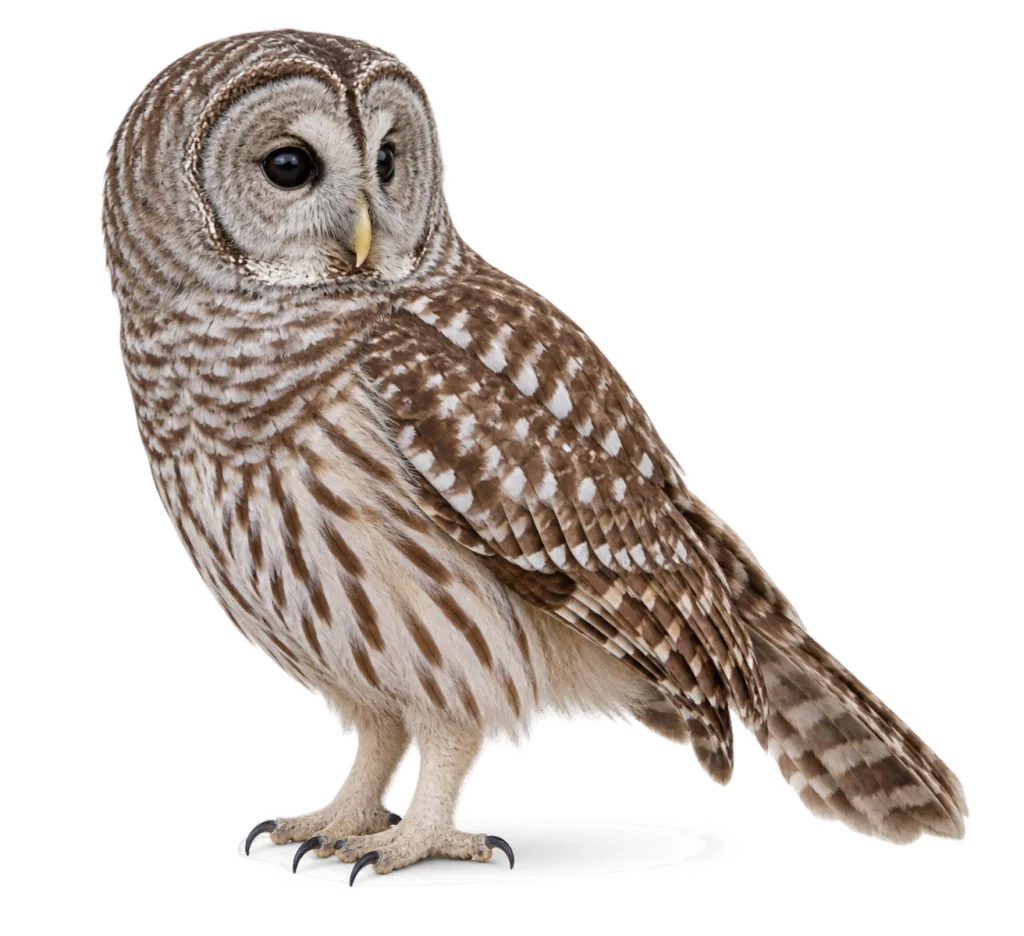
Size at a glance
How big is a Barred Owl?
Compare
Compare Barred Owl with another bird
Search by common or scientific name.
Morphology
Detailed measurements
Taxonomy
Classification
The Barred Owl (Strix varia) is a broad-bodied, medium-large owl whose apparent size comes from more than body length alone. Its rounded head, dense plumage, wide wings, and fairly full tail create a substantial silhouette, while body mass varies much more between individuals than a simple length measurement suggests.
How Large Is a Barred Owl?
Current Cornell Lab measurements place adult Barred Owls at about 43–50 cm (16.9–19.7 in) in length, with a 99–110 cm (39.0–43.3 in) wingspan. Recorded body mass covers a much broader proportional range, from roughly 470 to 1,050 g (16.6–37.0 oz).
Mass is especially important when interpreting Barred Owl size. Two adults can be similar in overall length while differing noticeably in weight. A bird near the upper end of the mass range is not necessarily proportionally longer in every body measurement.
Females Are Heavier More Than They Are Longer
Barred Owls show reversed sexual size dimorphism, with females generally larger than males. Detailed measurements also show that the difference is much stronger in body mass than in some linear dimensions.
A morphometric dataset published in Conservation Physiology included 24 males and 53 females for which body composition was directly measured. Males averaged 677 g, while females averaged 877 g. In the same sample, average unflattened wing chord differed by only 9 mm: 315 mm in males and 324 mm in females.
Foot-pad length: 62 mm
Exposed culmen: 24 mm
Foot-pad length: 65 mm
Exposed culmen: 26 mm
Females in that sample averaged about 30% heavier than males, yet their average wing chord was only about 3% longer. The pattern helps explain why sex differences can be obvious when birds are weighed but much harder to judge from a distant perched owl.
There is also substantial overlap. Male masses in the dataset ranged from 575 to 830 g, while females ranged from 652 to 1,170 g. Wing measurements overlapped even more. Size can therefore support sex identification when combined with other information, but apparent size alone does not separate every male from every female.
The Shape Behind the Barred Owl’s Size
A Barred Owl is built around a compact body with broad, rounded wings, a rounded head without ear tufts, and a medium-length rounded tail. These proportions matter because a perched bird and a flying bird can give very different impressions of size.
With the wings folded, much of their length is visually absorbed into the body outline. Once extended, the span is around a meter across, more than twice the head-to-tail length of many individuals. A flying Barred Owl can therefore appear much larger than the same bird sitting upright on a branch.
The head also changes the visual proportions. Dark eyes sit within a broad facial disc, and the absence of ear tufts keeps the crown rounded. Rather than creating a tall, pointed outline, the head flows into the body as a wide, blunt shape.
Length, Wingspan, and Wing Chord Measure Different Things
Barred Owl measurements from different datasets cannot always be placed in the same column. Body length, wingspan, and wing chord describe different physical dimensions.
A wing chord near 320 mm does not conflict with a wingspan around one meter. The first measurement covers one folded wing; the second covers both fully extended wings plus the width of the body between them. One value should not be converted into the other unless an appropriate measured relationship has been established for the species and dataset.
The same caution applies to mass. Weight cannot be inferred reliably from length alone. Seasonal condition, sex, stomach contents, fat reserves, and other biological variation can alter measured mass without producing an equivalent change in skeletal dimensions.
Young Barred Owls Can Look Larger Than Their Mass Suggests
Young Barred Owls have especially loose, fluffy plumage, so visual bulk develops before adult body mass is reached. Cornell Lab nest information places newly hatched chicks at just over 1.5 oz, or roughly 43 g. During the nestling period they gain about half an ounce per day under typical conditions.
Young usually leave the nest at roughly 28–35 days old, when they may have reached only about 50–75% of adult body weight. They can therefore have a surprisingly large owl-like outline while still being lighter and less developed than an adult.
A recently fledged Barred Owl may already have a broad head and a heavily feathered body, but the flight feathers, musculature, coordination, and total body mass are still developing. Visible bulk is not the same as adult size.
Why Published Barred Owl Measurements Do Not Always Match
Different reputable references may give slightly different Barred Owl ranges. Some use measurements gathered from many populations, while others report a particular study sample. Sex ratio, geographic origin, season, measurement technique, and sample size can all shift the values.
Taxonomy also matters when using older literature. In 2021, the American Ornithological Society treated the Mexican Strix sartorii as a separate species, the Cinereous Owl, rather than a subspecies of the Barred Owl. Modern Strix varia measurements therefore should not automatically be mixed with older datasets assembled under a broader Barred Owl species concept.
Data
Measurement sources
- Data status
- Measured
- Size measurements
- AVONET — Tobias et al. (2022)
- Morphology source
- AVONET — Tobias et al. (2022)
- Morphology dataset
- AVONET v7 — BirdLife taxonomy
- Morphology dataset license
- CC BY 4.0
Full source links, dataset definitions, licensing details and measurement methodology are maintained on the Data Sources & Methodology page.