Bird size profile
Bearded Vulture
Gypaetus barbatus
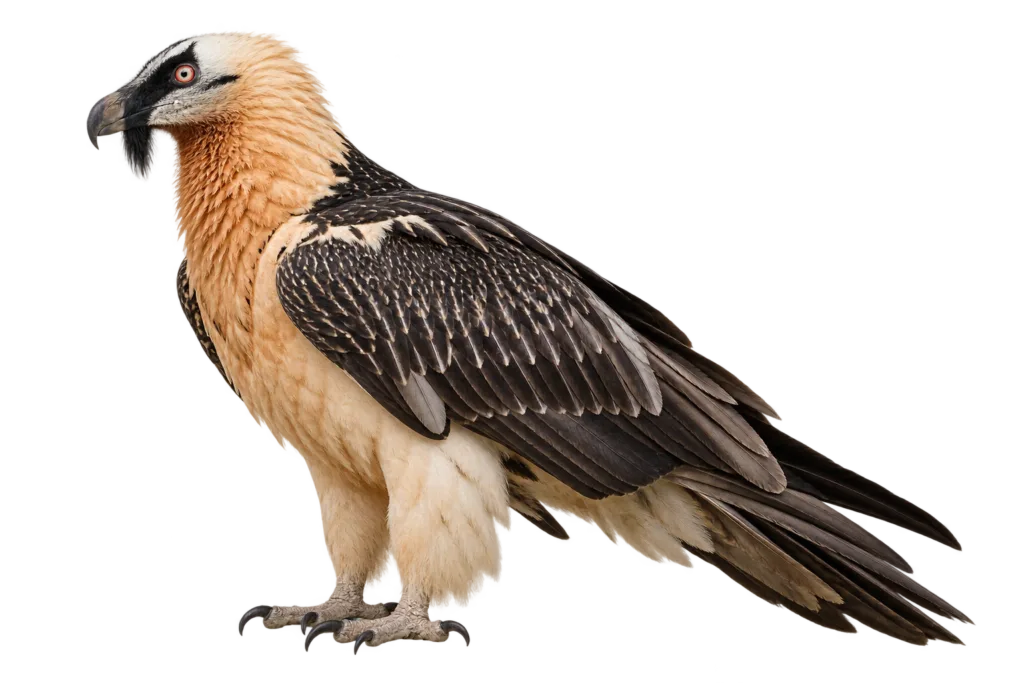
Size at a glance
How big is a Bearded Vulture?
Compare
Compare Bearded Vulture with another bird
Search by common or scientific name.
Morphology
Detailed measurements
Taxonomy
Classification
The Bearded Vulture (Gypaetus barbatus) is built around length and span rather than heavy bulk. A commonly used adult reference range is about 100–115 cm in body length, 2.5–2.85 m across the wings, and 4.5–7.1 kg in mass. The result is an unusually elongated vulture: nearly three metres from wingtip to wingtip at the upper end of the range, yet with a body that looks lean rather than massive.
A Long-Winged Vulture Rather Than a Broad-Winged One
Much of the Bearded Vulture’s apparent size comes from its proportions. Adult wings are long and comparatively narrow, with a swept shape that differs from the very broad outline often associated with large vultures. The body itself is relatively slender, and the head looks small against the span of the wings.
This combination can make a flying bird appear larger than its mass alone would suggest. Wingspan contributes far more to the visual impression than body thickness. The neck projects forward, while the long tail extends well behind the body, stretching the silhouette in both directions.
The Tail Changes How Body Length Is Perceived
The Bearded Vulture’s tail is not a minor detail in its profile. In adults it forms a long wedge or diamond shape that projects clearly behind the wings. Because of this extension, total length does not translate into a proportionally large torso. A notable share of the bird’s visible length is created by the tail.
This is also why wingspan and total length describe different aspects of size. Wingspan reflects the enormous lateral reach of the bird, while total length includes a tail that is unusually prominent for a vulture. Two birds with similar body mass can therefore look very different if their wing and tail proportions differ.
Total length is measured from the tip of the bill to the end of the tail. It should not be read as a measurement of torso length. In the Bearded Vulture, the extended tail makes that distinction especially important.
Young Birds Have a Stockier Flight Outline
Age changes the Bearded Vulture’s proportions as well as its plumage. Juveniles and young immatures have broader, more rounded wings than mature birds. Their trailing wing edge is less even, and the tail is shorter, broader and more rounded.
With maturity, the outline becomes more elongated. The wings appear narrower and cleaner-edged, while the tail develops the long wedge shape associated with an adult. A young bird can therefore look heavier and more compact in flight even when it is already close to adult structural size.
Dark juvenile plumage can strengthen that impression. Adults develop a much paler head and underbody, while young birds are predominantly dark brown. The shift in color does not create the change in dimensions, but it can alter how easily the body’s outline is read at a distance.
Females Average Larger, but the Sexes Overlap
Male and female Bearded Vultures look much alike, but females tend to be larger. The difference is measurable rather than dramatic. A morphometric study of 42 molecularly sexed males and 54 females from the Pyrenees found sex-related differences in several external measurements.
Female birds averaged larger in measurements including wing chord and wing width. Body mass also differed between the sampled sexes. The distributions still overlapped, so apparent size alone is a poor way to assign sex to a free-flying individual.
The researchers obtained better separation by considering several measurements together rather than treating one dimension as a reliable male-or-female cutoff. This is an important distinction for a species in which plumage does not provide an obvious adult sex marker.
Why Published Bearded Vulture Size Ranges Differ
Not every reference gives identical limits for the species. One widely used conservation reference lists adults at 100–115 cm long, with a 2.5–2.85 m wingspan and a mass of 4.5–7.1 kg. A broader zoological account gives 94–125 cm for length, 2.31–2.83 m for wingspan and about 4.5–7.2 kg for mass.
These ranges should remain attached to the datasets that produced them rather than being merged into a new artificial limit. Different geographic samples, age composition and measurement datasets can produce slightly different published boundaries while still describing the same species.
Regional Form Also Affects Expected Size
Two subspecies are commonly recognized: Gypaetus barbatus barbatus and Gypaetus barbatus meridionalis. The African G. b. meridionalis is generally smaller than the nominate form, so measurements from different parts of the species’ range do not always represent birds of identical average build.
The distinction is not based on size alone. G. b. meridionalis also has less extensive feathering on the lower tarsus and differs in some adult facial markings. Older names such as G. b. aureus still appear in some literature, but they are included within the nominate subspecies in current widely used taxonomy.
The “Beard” Belongs to a Relatively Small Head
The feature behind the English name is a cluster of dark, bristle-like feathers at the base of the bill. These join the dark facial markings around the eye and give the head a distinctive shape at close range. Unlike many vultures, the Bearded Vulture has a fully feathered head and neck.
The head remains relatively small in proportion to the wings and body. A strong hooked bill, feathered neck and dark facial pattern provide detail at close range, but they contribute much less to the bird’s large-scale outline than the wings and tail.
Adult underparts may range from pale cream to deep rusty orange. That orange tone is not a larger-bodied regional form or a sex difference: much of it comes from iron-rich material staining naturally pale feathers. The intensity can therefore vary greatly between individuals without indicating a change in structural size.
Data
Measurement sources
- Data status
- Measured
- Size measurements
- AVONET — Tobias et al. (2022)
- Morphology source
- AVONET — Tobias et al. (2022)
- Morphology dataset
- AVONET v7 — BirdLife taxonomy
- Morphology dataset license
- CC BY 4.0
Full source links, dataset definitions, licensing details and measurement methodology are maintained on the Data Sources & Methodology page.