Bird size profile
Bee Hummingbird
Mellisuga helenae
Size at a glance
How big is a Bee Hummingbird?
Compare
Compare Bee Hummingbird with another bird
Search by common or scientific name.
Morphology
Detailed measurements
Taxonomy
Classification
The Bee Hummingbird (Mellisuga helenae) is the smallest living bird. This Cuban endemic reaches its most extreme size in adult males, but a single measurement does not describe the whole species: females are noticeably larger, published body masses differ among datasets, and the male’s breeding plumage changes the apparent outline of the head and throat.
How Small Is a Bee Hummingbird?
A commonly reported set of adult measurements places males at about 5.5 cm (2.2 in) long and 1.95 g (0.069 oz). Females average roughly 6.1 cm (2.4 in) and 2.6 g (0.092 oz). The difference is large enough that sex should be considered when a Bee Hummingbird measurement is used as a reference.
| Adult | Length | Body Mass | Size Pattern |
|---|---|---|---|
| Male | About 5.5 cm (2.2 in) | About 1.95 g (0.069 oz) | Smaller and lighter sex |
| Female | About 6.1 cm (2.4 in) | About 2.6 g (0.092 oz) | Larger and heavier sex |
Using these commonly cited averages, the female is about 0.6 cm longer and 0.65 g heavier. That weight difference is substantial on a bird whose entire mass is only a few grams: the female value is roughly one-third higher than the male value.
Bee Hummingbird mass should not be treated as one fixed number. A 2021 systematic study described the species as about 5–6 cm long and reported masses of approximately 1.7 g for males and 2.2 g for females. Other species accounts give the higher averages shown above. Different samples, individual condition and measurement circumstances can produce different reported values without changing the basic pattern: adult females are larger than adult males.
Why the Smallest Bird Does Not Look Extremely Slender
The Bee Hummingbird compresses its tiny measurements into a compact form. Its body can look relatively rounded rather than long and narrow, so photographs without a familiar scale may not communicate just how small the bird is.
The bill is short for a hummingbird and has been described as dull black and very slightly decurved. Because total bird length extends from the front of the bill to the end of the tail, bill and tail proportions both contribute to the published length figure. A 5.5 cm male is not carrying that length in its torso alone.
Male and Female Shape Differences Go Beyond Body Mass
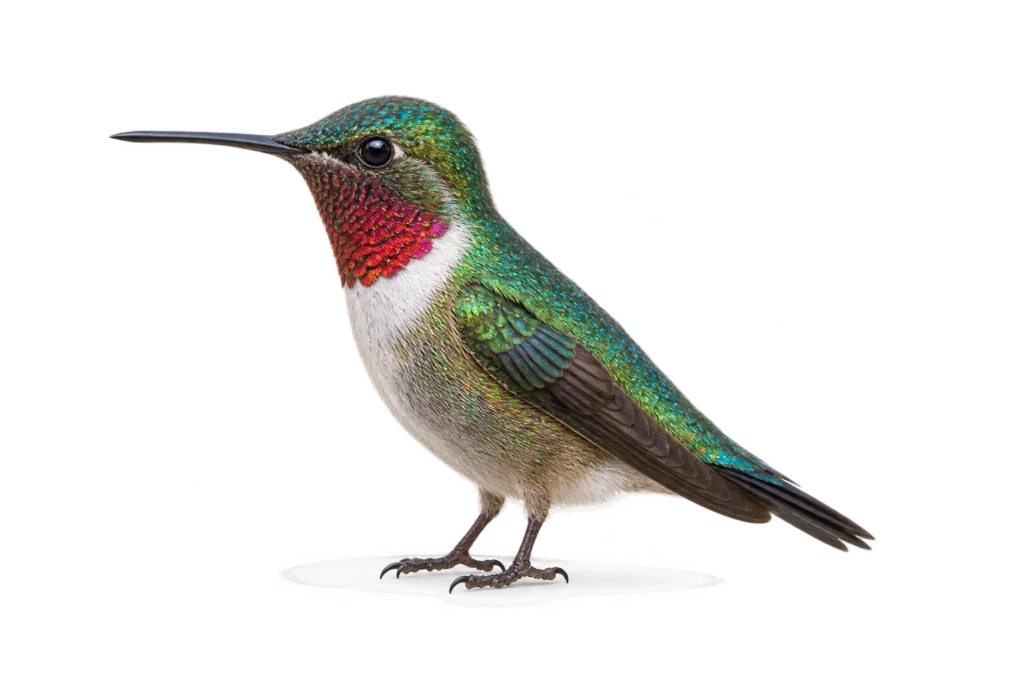
Adult males and females differ in both size and visible structure. The breeding male develops an iridescent red head and throat area with elongated lateral feathers. These plumes extend the visual outline around the neck even though they add little to the bird’s underlying body size. The upperparts can appear deep blue, while the lower surface is mostly pale grayish white.
Females lack the male’s enlarged iridescent head and throat display. Their upperparts range from green and greenish blue to a stronger blue tone, while the underparts are pale. The rounded tail and broad white areas on the outer tail feathers provide another structural cue.
Young males can complicate identification because some female-like tail markings may still be present before full adult male plumage develops. Color alone therefore does not always reveal sex or age. Tail pattern, body size and the state of the head and throat feathers are more useful when considered together.
What the “Smallest Bird” Record Measures
The Bee Hummingbird’s record is most clearly expressed through adult body length and mass. The particularly small adult male is the extreme form, averaging under 2 g in the commonly reported dataset. The female is larger but remains only a little over 6 cm long and around a few grams in mass.
Length and weight should also be kept separate. Length describes the bird from bill to tail, while body mass reflects how much the individual weighs at the time it is measured. One cannot be reliably calculated from the other, and two Bee Hummingbirds with nearly the same length do not have to weigh exactly the same amount.
This distinction also explains why a Bee Hummingbird may be described with slightly different numbers in different references. Values around 5–6 cm describe the same remarkably small size class, while sex-specific measurements provide a more useful picture than treating every adult as though it had one standard length and weight.
Its Plumage Can Change the Apparent Size
The male’s iridescent head and throat feathers are structural display features as well as color features. Their appearance changes with light angle, and the elongated feathers at the sides of the throat can make a displaying male seem broader around the head than a female of greater actual body mass.
This creates an unusual visual contrast: the smaller sex can look more elaborate, while the larger female has a simpler outline. In side views, the short bill, compact trunk and tail occupy much of the bird’s total 5–6 cm length. In frontal or displaying views, the male’s throat plumes can instead dominate the silhouette.
For size work, measurements taken from the bird itself are therefore more useful than judging scale from plumage alone. Sex, age and feather position can change the visible outline even when the underlying skeletal dimensions have not changed.
Data
Measurement sources
- Data status
- Measured
- Size measurements
- AVONET — Tobias et al. (2022)
- Morphology source
- AVONET — Tobias et al. (2022)
- Morphology dataset
- AVONET v7 — BirdLife taxonomy
- Morphology dataset license
- CC BY 4.0
Full source links, dataset definitions, licensing details and measurement methodology are maintained on the Data Sources & Methodology page.