Bird size profile
Belted Kingfisher
Megaceryle alcyon
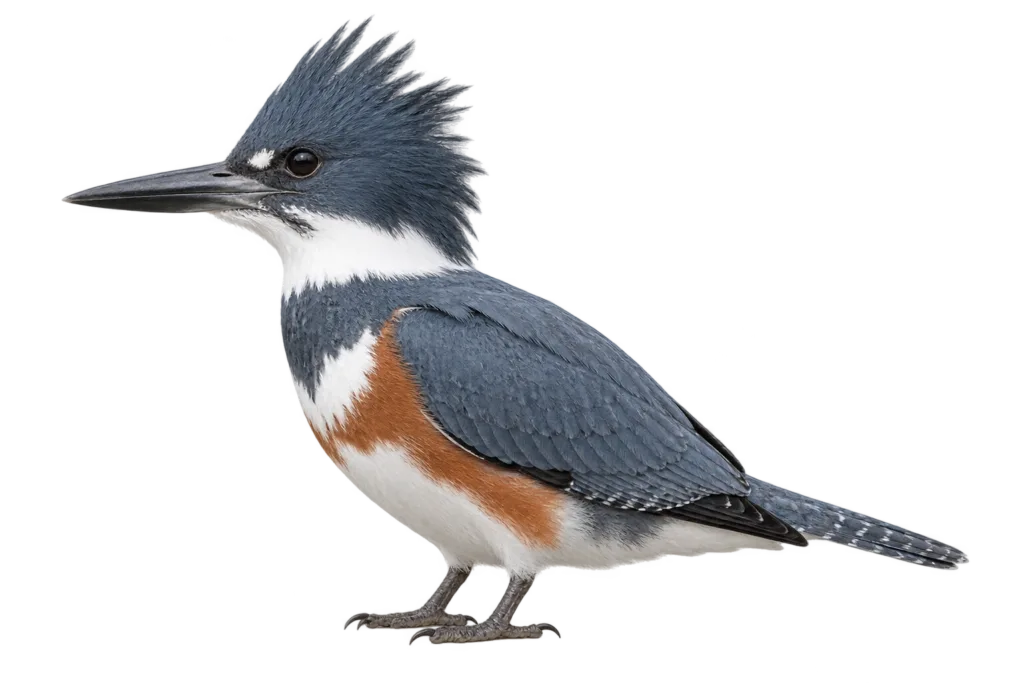
Size at a glance
How big is a Belted Kingfisher?
True-scale visual
Belted Kingfisher compared with a 175 cm person
When a transparent species asset and body-length data are available, BirdSize places the real bird asset and the fixed human reference on one mathematical centimetre scale.
Compare
Compare Belted Kingfisher with another bird
Search by common or scientific name.
Morphology
Detailed measurements
Taxonomy
Classification
The Belted Kingfisher (Megaceryle alcyon) is a stocky, medium-sized kingfisher whose apparent size is shaped as much by proportion as by raw measurements. A large crested head, long heavy bill, short legs, and compact body give the bird its familiar top-heavy profile. Adults generally measure 28–35 cm (11.0–13.8 in) in length, weigh about 140–170 g (4.9–6.0 oz), and span roughly 48–58 cm (18.9–22.8 in) across the wings.
Why the Belted Kingfisher Looks Larger Than Its Body Length Suggests
Total length alone does not describe this species especially well. The straight, pointed bill projects far beyond the face, while the shaggy crest adds height and visual bulk to the head. Together they make the front half of the bird look unusually large compared with the torso.
The effect is strongest when the bird is perched upright. The shoulders and chest appear broad, the neck is visually shortened by the large head, and the legs contribute very little visible height. Its tail is medium-length and square-tipped rather than strongly elongated.
How to Read the Published Measurements
The commonly cited 28–35 cm length is measured from the tip of the bill to the end of the tail. It should not be interpreted as body height or torso length. A Belted Kingfisher therefore has less actual body length than the full measurement might imply when imagined as a straight 35 cm object.
Weight shows a similar need for context. A commonly used field-reference range is 140–170 g, with values near 150 g often reported as typical. Other specimen and banding datasets can contain individuals outside compact field-guide ranges. Measurement ranges describe sampled birds rather than absolute biological limits for every individual.
A 48–58 cm wingspan is the distance across both extended wings. It should not be converted into body length or used to infer the length of a single wing. Each measurement describes a different part of the bird’s structure.
The Bill Dominates the Head Profile
The Belted Kingfisher has a heavy bill that narrows to a sharp point. Morphological descriptions place the bill among the most prominent features of the species, and it can appear longer than the head itself when viewed from the side.
This shape is closely tied to feeding. Belted Kingfishers watch the water from exposed perches or hover before diving headfirst toward prey. The long bill reaches the target ahead of the rest of the head and body. Its size is therefore functional rather than simply decorative.
The crest changes the outline in a different way. Feathers on the crown and rear of the head can stand out in an uneven, shaggy ridge. Because feather position varies, the crest can make two birds of similar structural size appear to have noticeably different head dimensions in photographs.
Male and Female Size Overlaps Heavily
Adult males and females share the same general build and occupy strongly overlapping measurement ranges. Some morphometric accounts describe females as slightly larger on average, but the difference is not reliable enough for identifying the sex of an individual bird by body size.
Plumage is much more useful. Both adults have blue-gray upperparts, a white collar, white underparts, and a broad blue-gray breast band. Adult females add a chestnut band across the upper belly and chestnut coloring along the flanks. Adult males lack this second rusty band.
This produces an unusual visual pattern in which the female is more colorful, even though male and female body shapes remain very similar.
Young Birds Reach an Adult-Like Shape Early
Juvenile Belted Kingfishers soon develop the same large-headed, heavy-billed outline seen in adults. By the time young birds are flying independently, overall size is therefore a poor way to separate them from mature birds.
The breast pattern provides better evidence. Juveniles can show rusty or reddish-brown coloring mixed into the upper breast band rather than the cleaner adult pattern. This can be especially useful with a bird that otherwise appears fully grown.
Small Feet on a Bird That Excavates Its Nest
The legs and feet are proportionally small compared with the head and bill, yet the feet have a specialized structure. Kingfishers have partially fused front toes, a condition known as syndactyly. In the Belted Kingfisher, this compact foot arrangement helps with digging the nesting tunnels that the birds excavate in earthen banks.
Short legs also fit the bird’s normal posture. Belted Kingfishers spend much of their time perched above water rather than walking extensively on the ground or wading. On a branch or wire, the body sits close to the feet, reinforcing the compact appearance created by the large head and broad chest.
Shape Changes Noticeably in Flight
A perched Belted Kingfisher can look compact and almost neckless. In flight, the extended wings change those proportions. The bird’s 48–58 cm wingspan becomes much more apparent, while the large head and projecting bill remain visible ahead of the body.
White patches in the outer wings can also become conspicuous when the wings open. These markings alter the visual impression of wing area, so a flying bird may appear broader than the same individual seen with its wings folded.
The combination of a large head, straight projecting bill, compact torso, and relatively short legs remains visible across postures. Those proportions are more dependable for understanding the Belted Kingfisher’s build than any single measurement taken in isolation.
Data
Measurement sources
- Data status
- Measured
- Size measurements
- Cornell Lab of Ornithology – All About Birds
- Morphology source
- AVONET — Tobias et al. (2022)
- Morphology dataset
- AVONET v7 — BirdLife taxonomy
- Morphology dataset license
- CC BY 4.0
Full source links, dataset definitions, licensing details and measurement methodology are maintained on the Data Sources & Methodology page.