Bird size profile
Black Swan
Cygnus atratus
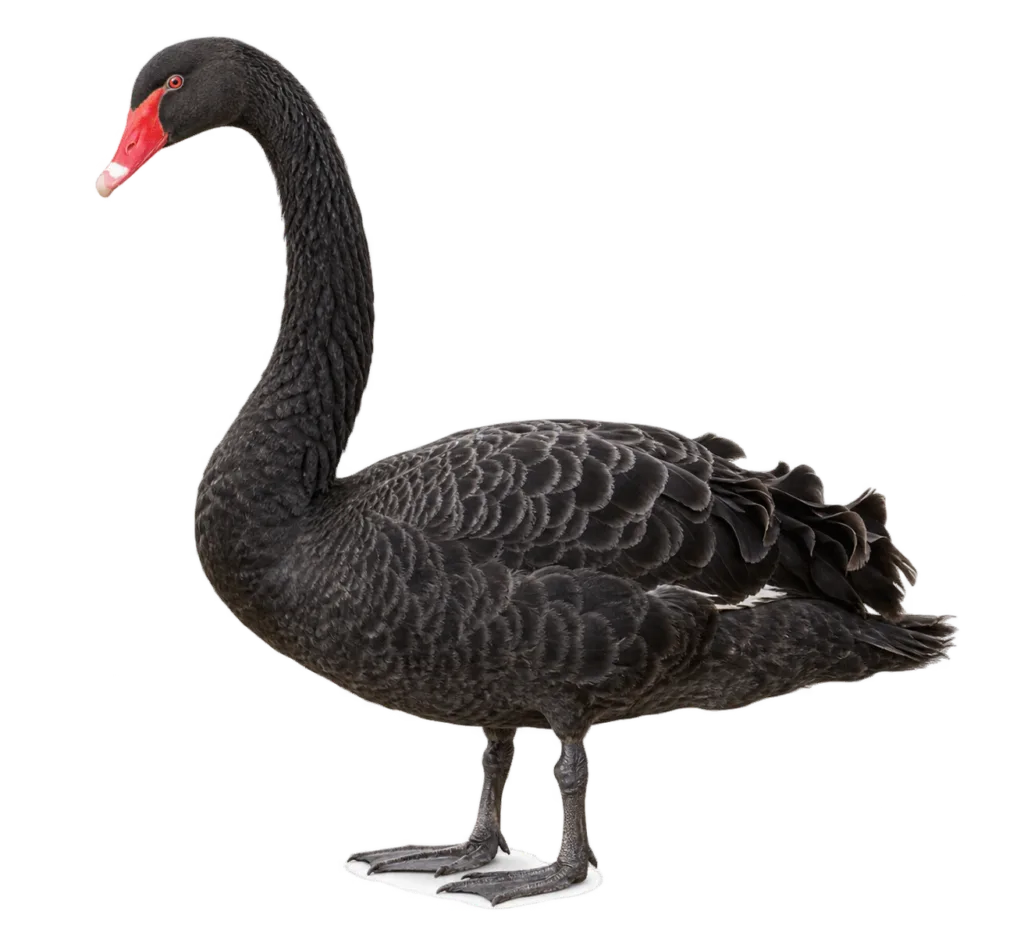
Size at a glance
How big is a Black Swan?
Compare
Compare Black Swan with another bird
Search by common or scientific name.
Morphology
Detailed measurements
Taxonomy
Classification
The Black Swan, Cygnus atratus, is a large waterbird with an unusually long neck, a heavy body and broad wings. Published measurements place adult body length at roughly 1.1–1.4 m (3.6–4.6 ft), while the wings can span about 1.6–2.0 m (5.2–6.6 ft). The Australian Museum gives a length range of 120–142 cm.
Those dimensions are not equally obvious when the bird is swimming. A Black Swan on the water shows a compact oval body beneath a long, flexible neck, while much of its wing area remains folded against the sides. In flight, the same bird looks much broader because the full wing surface is exposed.
Why Black Swan Size Can Be Hard to Judge
The neck has a strong effect on apparent size. It can be held nearly upright, curved into the familiar swan profile or drawn closer to the body. A photograph taken with the neck extended may therefore make one bird look much longer than another even when their body dimensions are similar.
Body length and wingspan also describe different parts of the bird. Length follows the bird from the front of the body to the rear, with the neck and head contributing heavily to the measurement. Wingspan measures the distance between fully extended wingtips. A Black Swan can consequently have a body length of around 1.4 m while reaching close to 2 m across the open wings.
Length, wingspan and body mass should not be treated as interchangeable measures of size. Posture can alter how long a swan appears, while body mass can vary with sex, age, breeding condition and the individual bird.
Males Are Larger Than Females
Male and female Black Swans have very similar plumage, so body proportions provide more information about sex than coloration does. Adult males are generally larger and heavier than adult females.
A morphometric study of Black Swans from South-East Queensland and the Australian Capital Territory found males to be larger than females across the measurements examined. The difference was not restricted to body mass. Measurements of structures such as the head, tarsus and radius also tended to be greater in males.
The researchers found that a combination of total head length, tarsus length and radius length could classify sex with much better reliability than appearance alone. Their multi-measurement analysis correctly assigned 92.1% of the birds studied. That result also shows why visually judging a single bird from body size alone remains uncertain: the sexes overlap rather than forming two completely separate size classes.
Body mass is especially variable. The same study found differences associated with breeding status and age as well as sex, making weight less useful as a fixed description of how large every Black Swan should be.
The Long Neck Changes the Bird’s Proportions
The Black Swan’s neck is long relative to its rounded body. This structure is useful while feeding because the bird can reach submerged vegetation without diving completely underwater. The Australian Museum notes that Black Swans can obtain food by extending the neck into water up to about a metre deep.
That feeding anatomy helps explain the species’ distinctive outline. Much of the apparent height of a swimming Black Swan comes from the neck rather than the torso. When feeding with the head underwater, the visible bird can suddenly look much shorter even though its actual body size has not changed.
The body itself is broad and buoyant, with large webbed feet positioned for swimming. On land, the same proportions produce a heavier, less streamlined appearance than they do on water.
Its Wings Are Larger Than They Look at Rest
A resting adult appears almost completely black because the pale flight feathers are largely concealed inside the folded wing. Once the wings open, broad white primaries and outer secondary feathers become visible and create a sharp contrast with the dark body.
The extended wings also reveal the true scale of the bird. A span approaching two metres is much wider than the narrow profile seen when a Black Swan is floating with both wings folded.
Large wings do not make takeoff instantaneous. Black Swans normally need open water for a running launch, using repeated foot contact with the surface while the wings build enough lift. The Australian Museum notes that they require roughly 40 m or more of clear water for takeoff.
Adult Plumage Hides Part of the Wing Structure
Adult Black Swans have predominantly black body plumage, a deep orange-red to red bill and a narrow pale band near the end of the bill. The contrasting white flight feathers are much easier to see when the bird stretches its wings or flies.
This arrangement can make the folded wing difficult to separate visually from the rest of the body. Curled and raised feathers along the rear of the wing add texture to the silhouette, while the long neck and small head keep most visual attention toward the front of the bird.
The male and female share this basic pattern. Size and structural measurements offer more useful sex clues than plumage color, although close observation or measurement is needed for reliable separation.
Young Black Swans Have Different Proportions and Color
Cygnets begin life covered in pale grey down rather than black adult plumage. As juveniles develop, their feathers become darker, but young birds can remain noticeably greyer or browner than adults. Their bills are also less intensely colored.
The Australian Museum describes younger birds as much greyer than adults and notes that their wing tips are dark. This differs from mature birds, in which white flight feathers become one of the clearest features of the open wing.
Growing birds can approach adult structural dimensions before every adult plumage feature is fully developed. Research on Black Swan morphometrics found little difference in several structural measurements between immature and adult birds, even though adults were heavier. A large greyish individual is therefore not necessarily a small bird simply because it has not acquired the full appearance of a mature Black Swan.
Data
Measurement sources
- Data status
- Measured
- Size measurements
- AVONET — Tobias et al. (2022)
- Morphology source
- AVONET — Tobias et al. (2022)
- Morphology dataset
- AVONET v7 — BirdLife taxonomy
- Morphology dataset license
- CC BY 4.0
Full source links, dataset definitions, licensing details and measurement methodology are maintained on the Data Sources & Methodology page.