Bird size profile
Black Vulture
Coragyps atratus
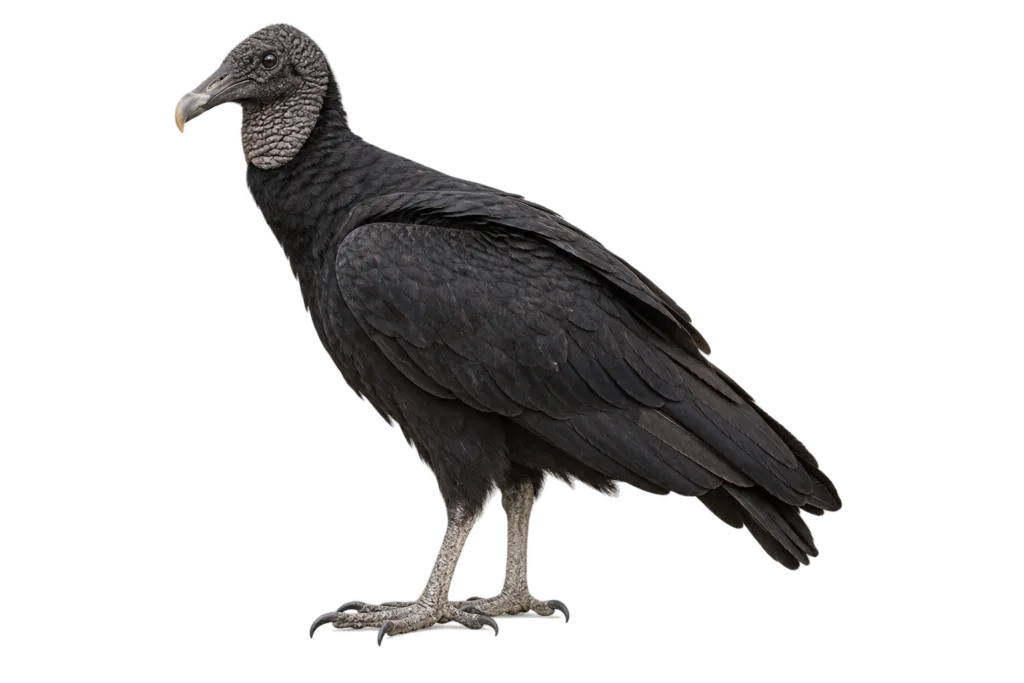
Size at a glance
How big is a Black Vulture?
Compare
Compare Black Vulture with another bird
Search by common or scientific name.
Morphology
Detailed measurements
Taxonomy
Classification
The Black Vulture (Coragyps atratus) is a large bird with unusually compact proportions for a soaring scavenger. Standard North American measurements place its body length at about 60–68 cm, mass at roughly 1.6–2.2 kg, and wingspan at about 137–150 cm. Those numbers describe only part of its size: broad wings, an extremely short tail, and a small head give the bird a stockier outline than wingspan alone suggests.
A Large Bird Built on Compact Proportions
The Black Vulture carries much of its visual mass through the body and inner wing rather than through a long tail or narrow wing outline. With the wings folded, the bird can look dense and heavy-bodied. Once airborne, the same proportions produce a broad silhouette with relatively little structure extending behind the body.
Published body length should not be read as standing height. Ornithological length describes the bird along its body from the bill toward the end of the tail. This distinction matters especially for the Black Vulture because the tail contributes comparatively little to its total outline.
A span approaching 1.5 m sounds long, but the Black Vulture does not have the stretched appearance associated with many large soaring birds. Its wings are broad and rounded, while the tail is very short. The result is a bird that looks wide rather than long when the wings are fully spread.
The Short Tail Changes the Whole Silhouette
The tail is one of the most important proportions for understanding Black Vulture size in the field. It is short and rounded, with relatively little tail projecting behind the body during flight. The legs can appear close to the end of the tail because there is so little tail length beyond the body.
This compact rear profile makes the wings seem even broader. When a Black Vulture circles overhead, the silhouette is dominated by the wing surface rather than by a long body-and-tail axis.
The head contributes to the same effect. It is small in relation to the body, with bare dark skin and a narrow, strongly hooked bill. A large torso between a small head and short tail gives the perched bird a different sense of proportion from what its total length measurement might suggest.
Broad Wings Produce a Distinct Flight Shape
Black Vultures hold their broad, rounded wings mostly flat and often angle them slightly forward. The outer primary feathers separate into visible fingers. Pale or silvery areas near the outer underside of the wings can make the tips look even more prominent when light passes through them.
The species does not rely on uninterrupted gliding. Its normal flight often includes several firm, fairly rapid wingbeats followed by a shorter glide. That rhythm fits its wing proportions: the wings provide ample lifting surface, but their shape is more compact than the long, high-aspect-ratio plan associated with birds specialized for prolonged low-cost gliding.
Aerodynamic studies of Black Vultures have also shown that the bird can alter the spread and area of its wings as flight speed changes. The separated primary tips act as slots, helping the wing work at high lift conditions. Research on the species has linked its relatively low aspect ratio with an ability to make effective upward takeoffs from level ground.
Male and Female Size Overlaps Heavily
Black Vultures are not reliably sexed by body size. Males and females look alike, and measured wing dimensions overlap broadly.
A Smithsonian study examined 26 Black Vultures from a wintering population in Nashville, Tennessee. The 19 females averaged 2.20 kg in body mass and the seven males averaged 2.04 kg. Despite that difference in the sample means, the statistical analysis did not support a reliable sex-based difference in body weight. Both sexes had the same average measured wingspan of 1.44 m.
The study also found broad overlap in wing area, wing loading, and aspect ratio. Female wingspans in the sample ranged from 1.36 to 1.52 m, while male wingspans ranged from 1.32 to 1.49 m. A single bird’s span therefore gives little basis for deciding whether it is male or female.
This is useful when interpreting published measurements. A general Black Vulture size range does not need separate male and female bands simply because the sexes are different biologically. For the main flight dimensions, their distributions overlap too much for size to work as a dependable visual separator.
Wing Size Matures Before Every Adult Feature Does
Age introduces a different kind of variation. Young Black Vultures can differ in feather shape and head development even after the main dimensions of the wings have approached adult form.
In the Nashville specimen study, immature birds and adults did not show a clear age-based separation in wingspan, wing area, wing loading, or aspect ratio. The primary feathers still offered an age clue: younger birds tended to have more pointed primary tips, while adults showed rounder tips.
The study also noted that the mature bare skin and textured structures of the adult head and neck develop later than the principal wing proportions. A younger bird can therefore have nearly adult-scale flight surfaces without yet showing every external feature associated with a fully mature adult.
What Makes a Black Vulture Look Bigger or Smaller
Viewing angle changes the apparent size of this species more than the underlying measurements do. A bird directly overhead can look especially broad because both wings are fully visible while the short tail adds little length. During a glide seen from the side, the same individual may seem more compact.
Wing position also matters. Fully spread primaries expose the entire span and the fingered tips. During active flapping or faster flight, changes in wing sweep and area make the outline narrower. A perched bird removes wingspan from the visual equation almost entirely, leaving the heavy body, bare head, and short tail to define its apparent size.
For that reason, the most informative description of Black Vulture size combines measurements with proportion. A body around 60–68 cm long and a wingspan around 137–150 cm belong to a bird whose form is dominated by broad wings, compact body length, and very little tail projection. Those proportions explain why the species can appear bulky on the ground yet broad and relatively short-ended in the air.
Data
Measurement sources
- Data status
- Measured
- Size measurements
- AVONET — Tobias et al. (2022)
- Morphology source
- AVONET — Tobias et al. (2022)
- Morphology dataset
- AVONET v7 — BirdLife taxonomy
- Morphology dataset license
- CC BY 4.0
Full source links, dataset definitions, licensing details and measurement methodology are maintained on the Data Sources & Methodology page.