Bird size profile
Blue-and-yellow Macaw
Ara ararauna
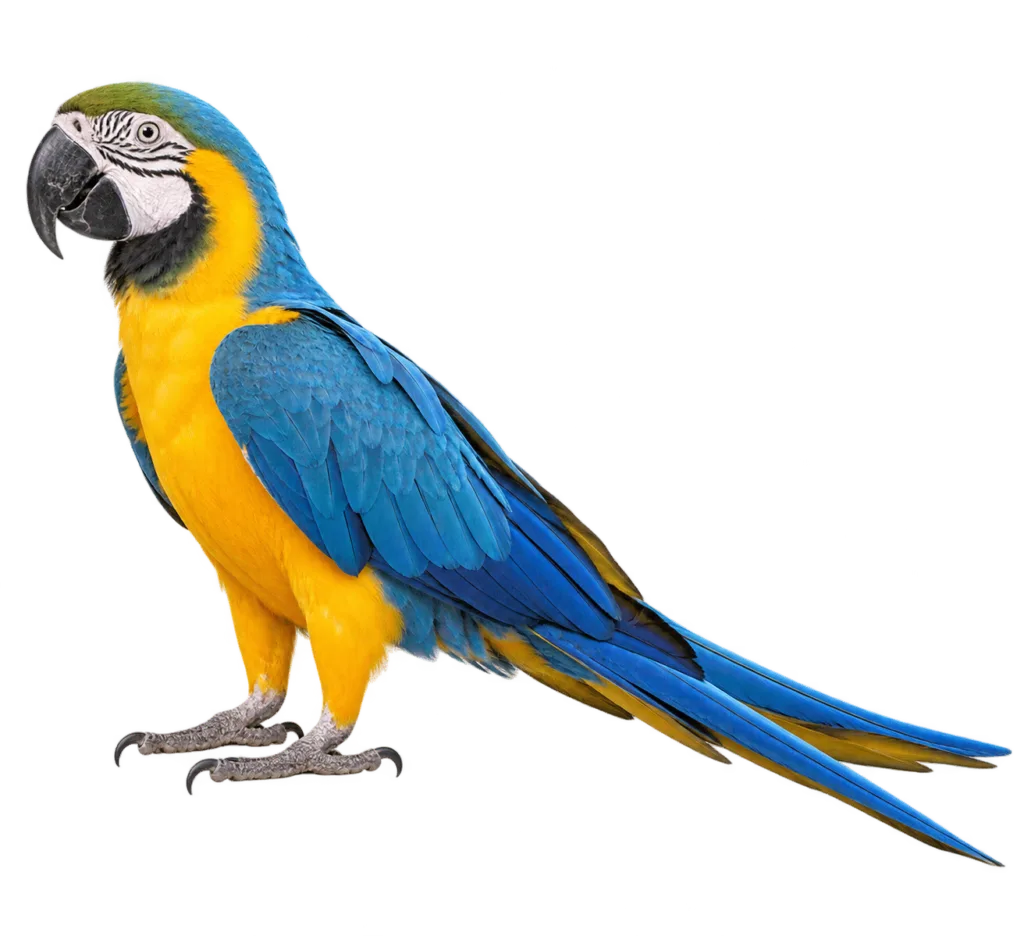
Size at a glance
How big is a Blue-and-yellow Macaw?
Compare
Compare Blue-and-yellow Macaw with another bird
Search by common or scientific name.
Morphology
Detailed measurements
Taxonomy
Classification
The Blue-and-yellow Macaw (Ara ararauna) is a large macaw with a long, tapered tail, a heavy head, and a deep hooked bill. Its reported total length can approach 90 cm, but that figure does not describe a bird with a 90 cm-long body. Much of the apparent length comes from the tail, while body mass is concentrated around the chest, shoulders, head, and bill.
How Large Is a Blue-and-yellow Macaw?
Published measurements vary according to the birds sampled and the way measurements were taken. A commonly cited adult length is about 86 cm (33.9 in). Broader reference data place total length at roughly 81–91.5 cm (32–36 in).
Body mass shows an even wider spread between sources. The World Parrot Trust gives 1,040–1,286 g (2.29–2.84 lb), while broader reference datasets extend from about 900 g to more than 1.8 kg. The wider figures should be treated as a reported species range rather than an expectation that every adult normally occupies the entire interval.
| Measurement | Published Figure | What It Describes |
|---|---|---|
| Total length | About 81–91.5 cm | Head to the tip of the long tail |
| Commonly cited adult length | About 86 cm | A useful representative figure rather than a fixed adult size |
| Typical published mass | About 1,040–1,286 g | Body mass, independent of the bird’s long-tailed appearance |
| Broader reported mass range | About 900–1,814 g | A wider literature range that includes more variation |
| Reported wingspan | About 104–114 cm | Distance across both extended wings |
A Blue-and-yellow Macaw can look exceptionally long without being proportionally heavy because its pointed tail adds so much to the head-to-tail measurement. Weight is more useful for describing body mass, while total length better describes the bird’s overall linear dimensions.
The Long Tail Changes How Its Size Looks
The tail is one of the main reasons this macaw appears larger than its mass alone suggests. Long central tail feathers continue well beyond the compact trunk, producing the familiar elongated macaw outline when the bird is perched.
This also makes direct visual estimates difficult. A perched bird with the tail fully visible can appear much larger than the same individual seen from the front, where most of that length disappears from view.
The body itself is fairly solid through the chest and shoulder region. The wings fold along the sides, while the tail narrows behind the body. These proportions create a shape quite different from a large bird whose length comes mainly from a long neck or large torso.
Wing Shape Adds Width Without Matching the Tail’s Length
Reference data give a wingspan of roughly 104–114 cm (41–45 in). Wingspan should not be confused with the length of one folded wing, and values produced by different measurement methods should not be treated as interchangeable.
An anatomical study of adult Blue-and-yellow Macaws described the wings as relatively short, rounded, and elliptical in shape. That form is consistent with powered flapping flight and maneuvering rather than the extremely long, narrow wings associated with birds specialized for prolonged soaring.
The visual effect is especially clear in flight. The long tail extends far behind the body while the broad wings project laterally, changing the bird from a narrow perched silhouette into a much wider shape.
The Bill Is a Large Part of the Head’s Structure
The black bill is not simply a prominent external feature. Detailed anatomical work published in 2026 found that the upper jaw forms roughly half of total head length. It curves strongly downward and works with the shorter lower jaw as a gripping and crushing unit.
The outer covering of the bill is heavily keratinized. Ridges and small structural projections on the opposing surfaces help stabilize food as the jaws close. The skull and jaw joints also allow movement of the upper bill, giving the macaw a wide gape while keeping the feeding apparatus capable of handling hard foods.
The difference between the two force estimates shows why gape matters when interpreting bite-force figures. The jaw muscles do not suddenly lose most of their capacity when the bill opens. Instead, the geometry of the jaw system changes, altering how efficiently muscular force reaches the bite point.
The 2026 estimate also falls close to other published work on the species. Earlier research reported a modeled value around 210 N and an instrument-based measurement near 260 N. These values were produced by different methods, so they are better viewed as converging evidence for a strong macaw feeding apparatus than as competing measurements of one fixed number.
Head and Facial Features Help Define the Adult Profile
Adult Blue-and-yellow Macaws have blue upperparts and golden-yellow underparts, with green across the forehead and a dark throat. The large bare facial area is pale and crossed by narrow lines of dark feathers. A pale yellow iris is typical of adults.
The bare facial patch exposes the shape of the head more clearly than dense facial plumage would. Combined with the large bill, it gives the species a broad-headed profile despite the relatively narrow neck beneath it.
Juveniles already resemble adults closely in general plumage. Eye colour provides a more useful age-related clue: young birds have darker grey-brown irises that become lighter and yellower as they mature.
Male and Female Size Overlaps Heavily
Male and female Blue-and-yellow Macaws are externally alike. There is no dependable plumage pattern that separates the sexes, and normal individual variation makes body size alone unreliable for sex identification.
A bird that appears slightly larger, heavier, broader-headed, or longer-tailed therefore cannot be assigned as male from appearance alone. The same limitation applies when two adults are viewed together. Differences between individuals can overlap with any average sex-related difference that may occur within a population.
External morphology is useful for recognizing the species, but it does not provide a dependable male-versus-female test. Reliable sex determination requires methods beyond simple visual comparison.
What Makes the Species Look So Large
The Blue-and-yellow Macaw combines several dimensions that affect visual size in different ways. Its long tail increases total length, extended wings can span more than a metre, and the oversized curved bill makes the head appear heavy relative to the neck.
Body mass tells a somewhat different story. An adult around 1.0–1.3 kg has substantial weight for a parrot, yet the bird’s 80-plus-centimetre total length may create the impression of an even larger-bodied animal. The discrepancy comes largely from proportions rather than unusually high mass for every centimetre of length.
This is why a single measurement cannot fully describe the species. Total length captures the long-tailed outline, wingspan describes lateral size in flight, mass reflects the amount of body tissue, and bill measurements describe a feeding structure whose scale is unusually prominent within the head. Together, those measurements explain the characteristic proportions of Ara ararauna far better than any one number by itself.
Data
Measurement sources
- Data status
- Measured
- Size measurements
- AVONET — Tobias et al. (2022)
- Morphology source
- AVONET — Tobias et al. (2022)
- Morphology dataset
- AVONET v7 — BirdLife taxonomy
- Morphology dataset license
- CC BY 4.0
Full source links, dataset definitions, licensing details and measurement methodology are maintained on the Data Sources & Methodology page.