Bird size profile
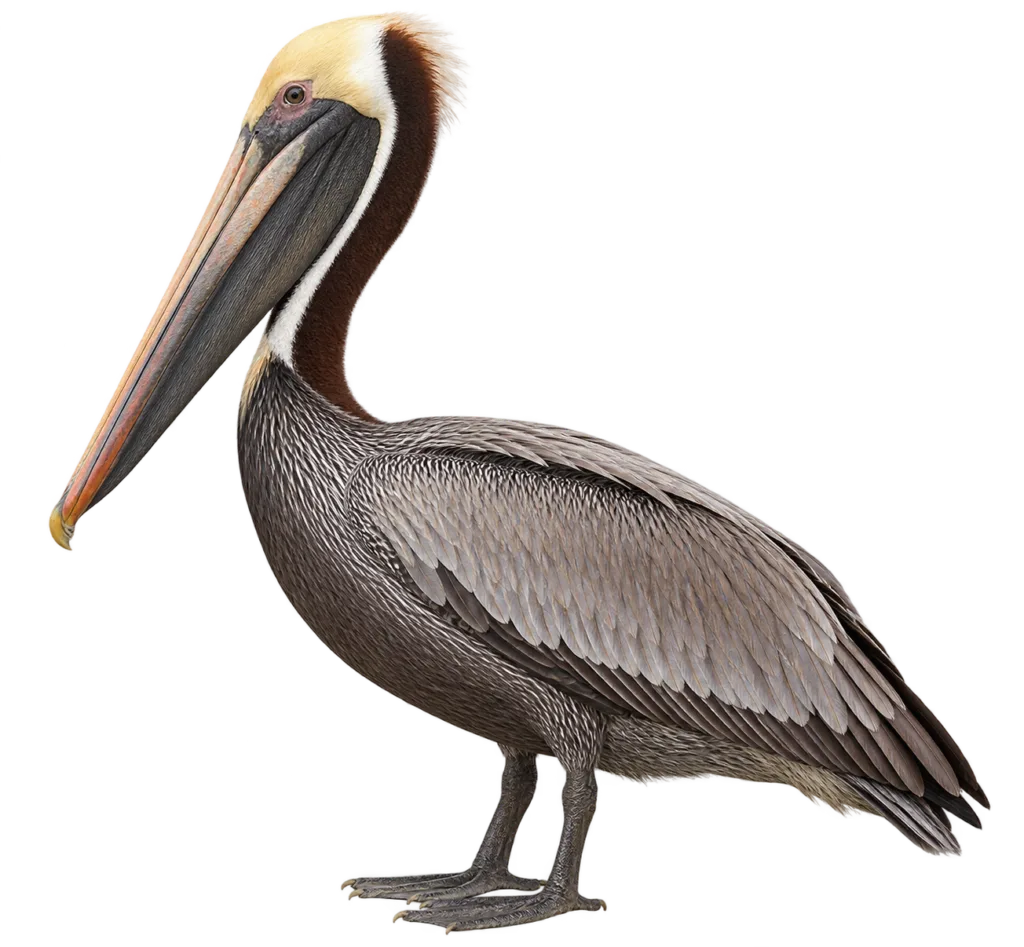
Brown Pelican
Pelecanus occidentalis
Size at a glance
How big is a Brown Pelican?
True-scale visual
Brown Pelican compared with a 175 cm person
When a transparent species asset and body-length data are available, BirdSize places the real bird asset and the fixed human reference on one mathematical centimetre scale.
Compare
Compare Brown Pelican with another bird
Search by common or scientific name.
Morphology
Detailed measurements
Taxonomy
Classification
The Brown Pelican (Pelecanus occidentalis) combines a heavy body with exceptionally long wings and a bill that makes up a large part of its visible profile. An adult may look compact while resting, then appear much larger as soon as the wings open. That change in silhouette is one reason its size is easier to understand by looking at individual structures rather than body length alone.
A Long-Bodied Bird With a Much Wider Flight Profile
Published measurements place adult Brown Pelicans at roughly 100–137 cm (39–54 in) in length, with a mass of about 2–5 kg (4.4–11 lb). Wingspan is around 200 cm (79 in) in widely used measurement references, while some large individuals exceed seven feet across the wings.
The wingspan therefore extends far beyond the dimensions suggested by the bird when it is standing or floating. Brown Pelicans have very long, broad wings, and the wings can look slightly bowed during gliding. The combination produces the broad flight silhouette associated with pelicans even though the body itself is much narrower.
Body mass has a broad range because it is affected by sex, individual size and condition. Structural measurements such as bill length and overall body length are more useful for understanding why two healthy adults may still look noticeably different in size.
The Bill Accounts for an Unusually Large Part of the Silhouette
The Brown Pelican’s bill measures about 25–38 cm (10–15 in). It projects well beyond the head and is paired with a large expandable throat pouch beneath the lower mandible. Together, these structures create a front-heavy outline that can make the bird appear longer than its torso alone would suggest.
The pouch is flexible rather than a fixed extension of body size. Its shape changes during feeding, while the long upper and lower portions of the bill provide the stable structural length. This distinction matters when judging size from photographs, since an expanded pouch can make the head and bill region look much deeper than it does at rest.
The bill is also one of the areas where male and female size differences are detectable. Published morphometric summaries indicate that male bills average about 10% longer than female bills.
Male and Female Brown Pelicans Overlap in Size
Male and female Brown Pelicans have broadly similar plumage, so the larger sex is not marked by an obvious difference in color. Size provides more information, although the overlap between individuals means that sex usually cannot be determined confidently just by looking at a single bird.
Males average larger. Reported measurements indicate that they can be about 15–20% heavier than females, while their wingspan averages roughly 3–6% greater. The difference is especially noticeable in the bill and overall bulk of large males.
Size Overlap Matters
Sexual size differences describe averages, not two separate size classes. A large female can overlap with a smaller male, so apparent body size by itself is not a dependable way to sex a Brown Pelican in the field.
Posture Can Make the Same Bird Look Much Shorter
A Brown Pelican rarely displays its full dimensions in a simple straight line. When resting, the neck can curve and retract toward the body while the long bill points forward. On the water, much of the lower body sits close to the surface, further reducing the amount of the bird that is visually exposed.
The proportions change dramatically in flight. Brown Pelicans fly with the neck folded back rather than fully extended, concentrating the head, neck and torso into a relatively short central shape. At the same time, the broad wings extend to roughly two meters from tip to tip. The result is a bird that looks much wider in the air than its resting profile suggests.
Gliding emphasizes this shape even more. The long wings remain extended while the compact body and short-looking folded neck occupy only a small part of the entire span. Slow, deep wingbeats also make the individual wing length easier to see than when the bird is perched.
Regional Birds Are Not All the Same Size
Brown Pelican size also varies geographically. Birds associated with the Pacific Coast tend to be larger, while adults along the Atlantic and Gulf coasts are described as slightly smaller. The California form has likewise been distinguished from the eastern form partly by its larger size.
This geographic variation means that a single measurement should not be treated as the expected size of every Brown Pelican. The species-level ranges cover birds from different populations as well as both sexes, which helps explain the wide spread in reported body length and mass.
Regional plumage differences can make these forms look even more distinct during the breeding season, but color does not change their underlying dimensions. For size assessment, the more useful features remain the long bill, heavy body, broad wings and folded-neck flight profile.
Data
Measurement sources
- Data status
- Measured
- Size measurements
- Cornell Lab of Ornithology – All About Birds
- Morphology source
- AVONET — Tobias et al. (2022)
- Morphology dataset
- AVONET v7 — BirdLife taxonomy
- Morphology dataset license
- CC BY 4.0
Full source links, dataset definitions, licensing details and measurement methodology are maintained on the Data Sources & Methodology page.