Bird size profile
Budgerigar
Melopsittacus undulatus
Size at a glance
How big is a Budgerigar?
Compare
Compare Budgerigar with another bird
Search by common or scientific name.
Morphology
Detailed measurements
Taxonomy
Classification
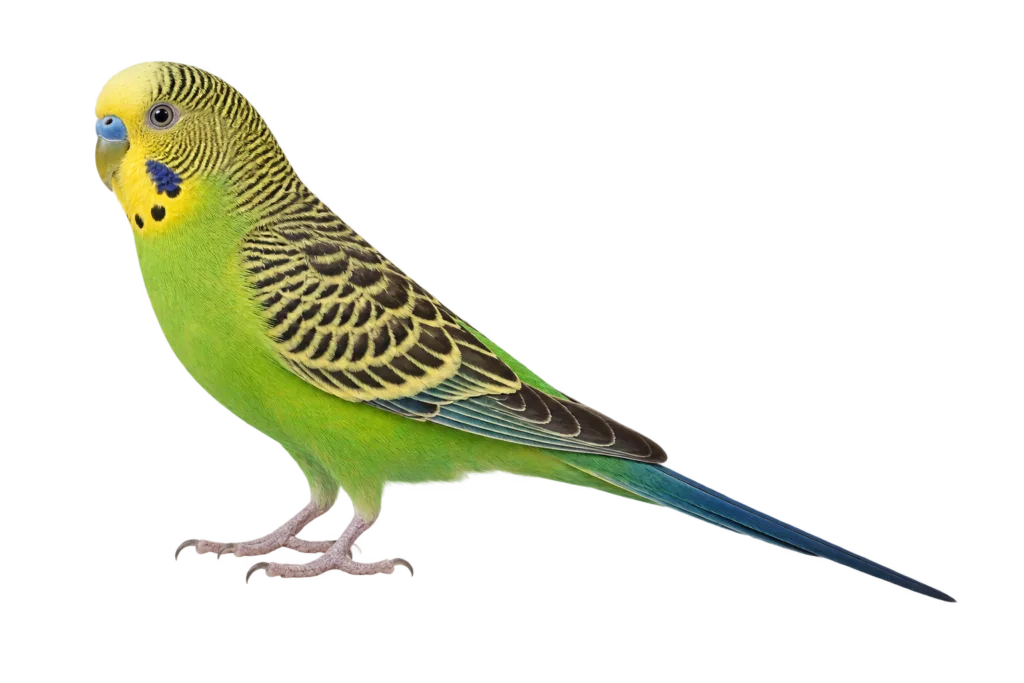
The Budgerigar (Melopsittacus undulatus) is a small parrot with a compact body and a remarkably long, tapered tail. That combination matters when judging its size: much of the bird’s visible length comes from feathers extending well beyond the body rather than from a large torso.
Why a Budgerigar Looks Longer Than It Is Bulky
Adult Budgerigars are usually described as roughly sparrow-sized in body mass, yet their outline is much more elongated. The head is rounded, the neck is visually short, and the body narrows into a long pointed tail. When perched upright, this tail contributes heavily to the bird’s head-to-tail measurement.
This is why total length alone can give the wrong impression of bulk. A Budgerigar measuring around 18 cm from the front of the head to the tail tip does not have an 18 cm-long body. The feathered tail occupies a large part of that dimension.
Published total length normally includes the tail. It should not be interpreted as trunk length, standing height, wing length, or wingspan.
Published Measurements Are Not Identical
Reliable references give slightly different measurements for the species rather than one universal figure. The difference is useful to preserve because the sources may represent different birds, populations, measurement practices, or captive contexts.
| Reference | Total Length | Body Mass | Wingspan |
|---|---|---|---|
| Australian Museum | 17–18 cm | — | — |
| World Parrot Trust | 18–20 cm | 22–32 g | — |
| Audubon Field Guide | 16–19 cm | 30–40 g | 28–36 cm |
The values should therefore be read as documented reference ranges rather than collapsed into a newly calculated species average. Body mass is especially sensitive to the individual bird’s build and condition, while linear measurements depend on exactly what anatomical points were measured.
Wing Length and Wingspan Measure Different Things
A Budgerigar’s folded wing is much shorter than its full wingspan. Morphological datasets reported through Featherbase give a wing length of about 93–97 mm for a small sample. In that measurement method, the wing is measured from the carpal joint to the tip of the longest primary feather.
That figure cannot be substituted for wingspan. Wingspan measures the distance from one extended wingtip to the other across the bird, which is why published wingspan values are much larger.
The wings themselves are tapered rather than broad and rounded. This shape fits the Budgerigar’s slender outline and helps distinguish its proportions from small parrots with shorter tails and heavier-looking wings.
The Tail Dominates the Bird’s Proportions
Feather measurements make the unusual proportion especially clear. Recorded central tail feathers can exceed 10 cm in length, with Featherbase specimens listing the longest rectrices at about 109.5–123.5 mm.
Those feathers form the narrow point visible behind a perched Budgerigar. A bird with the tail hidden, damaged, growing during molt, or viewed at an angle can therefore appear much shorter than a fully feathered adult shown in clean side profile.
The tail should also remain visually narrow. Making it too broad changes the apparent mass of the rear half of the bird even when the head-to-tail length remains correct.
A Small Bill Sits Inside a Rounded Head Profile
The Budgerigar has the hooked bill expected of a parrot, but it is small relative to the head and partly surrounded by facial feathering. The cere—the fleshy area containing the nostrils—sits immediately above the upper bill and forms a noticeable part of the face.
Adult wild-type birds have a yellow face, green body, dark scalloped barring across the upper plumage, blue-violet cheek patches, and a blue-green tail. The natural pattern can make the head and upper body look visually busy, but it does not indicate a heavier build.
Adult males and females are better distinguished by features such as cere coloration than by trying to judge sex from total body size. Captive breeding has also produced many white, blue, yellow, grey, mauve, olive, and other color forms, so plumage color alone is a poor guide to the species’ original wild appearance.
What Defines the Budgerigar’s Size Visually
For size comparisons, the most characteristic adult profile is therefore not simply a small parrot scaled to a particular total length. It is a light, compact bird whose long tail stretches the silhouette, with close-folded wings and a relatively small bill completing the proportions.
Data
Measurement sources
- Data status
- Measured
- Size measurements
- AVONET — Tobias et al. (2022)
- Morphology source
- AVONET — Tobias et al. (2022)
- Morphology dataset
- AVONET v7 — BirdLife taxonomy
- Morphology dataset license
- CC BY 4.0
Full source links, dataset definitions, licensing details and measurement methodology are maintained on the Data Sources & Methodology page.