Bird size profile
Burrowing Owl
Athene cunicularia
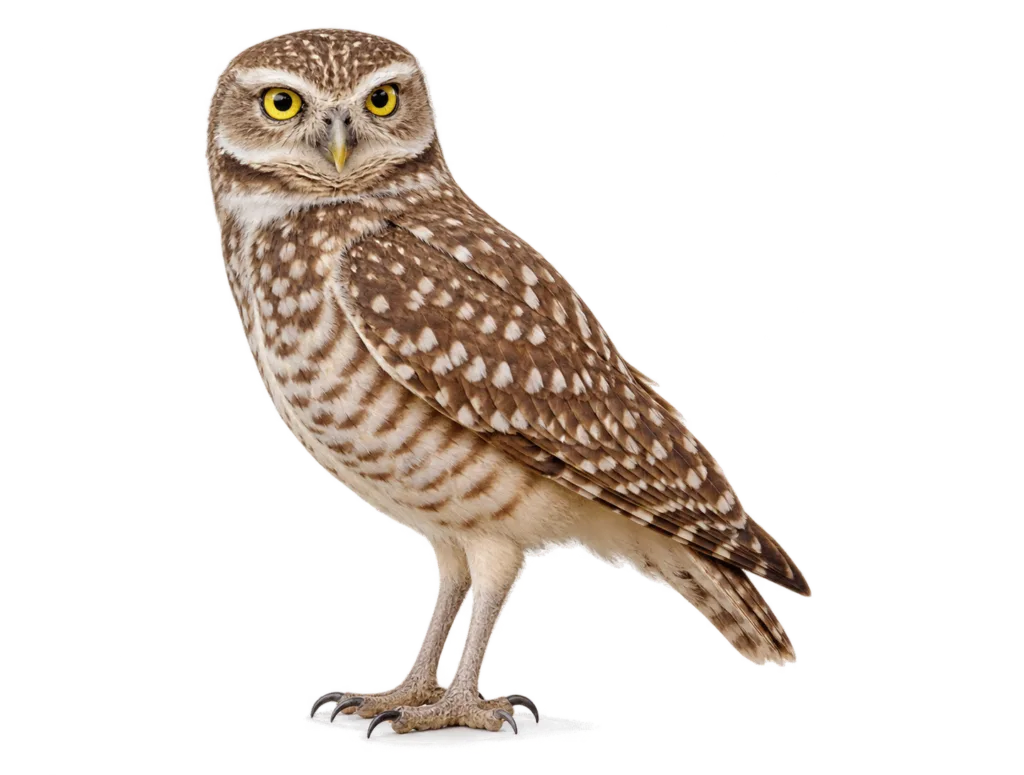
Size at a glance
How big is a Burrowing Owl?
True-scale visual
Burrowing Owl compared with a 175 cm person
When a transparent species asset and body-length data are available, BirdSize places the real bird asset and the fixed human reference on one mathematical centimetre scale.
Compare
Compare Burrowing Owl with another bird
Search by common or scientific name.
Morphology
Detailed measurements
Taxonomy
Classification
The Burrowing Owl (Athene cunicularia) is a small owl with proportions that can make it look taller and leggier than its body size suggests. Adults are generally about 19–25 cm (7.5–9.8 in) long, with a wingspan near 51–61 cm (20–24 in). The compact body, unusually exposed legs, short tail, and relatively long wings create a silhouette unlike that of most familiar owls.
Why the Burrowing Owl Looks So Long-Legged
The legs are one of the most distinctive parts of its build. Instead of being largely hidden beneath dense body feathers, the slender lower legs remain clearly visible when the owl stands upright. This gives a Burrowing Owl a tall, narrow stance even though the bird itself is small.
The tarsi are covered with short, hair-like feathers that become sparse toward the feet. In one study of adult Burrowing Owls, average tarsometatarsus length was about 54 mm in males and 51 mm in females. Those measurements are only a few centimeters, but they form a large visual part of a bird whose total length is roughly two dozen centimeters.
The stance changes the impression further. Burrowing Owls often stand with the body raised above the ground rather than sitting low with the legs concealed. When the bird stretches or watches its surroundings from a burrow mound, the legs can make up a striking share of the visible profile.
A Compact Body With Long Wings and a Short Tail
The body is compact, while the head is rounded and lacks ear tufts. The tail is short. The wings, by contrast, are relatively long and rounded, so the bird looks much broader in flight than it does while standing.
A wingspan of roughly 51–61 cm means the opened wings can span more than twice the bird’s body length. That contrast is easy to miss when an owl is standing with its wings folded tightly along its sides.
Body length measures the bird along its body, while wingspan measures the distance from one wingtip to the other with the wings extended. A Burrowing Owl can therefore be only about 20–25 cm long while spanning more than half a meter in flight.
The short tail also affects its proportions. Adult tail feathers measured in one field sample averaged about 80 mm in males and 77 mm in females. With comparatively long wings folded over a short tail, the rear of the bird remains compact rather than elongated.
Body Mass Varies More Than the Silhouette Suggests
Many identification references place a typical adult near 150–170 g (5.3–6 oz), although broader datasets include adults outside that narrow range. Body mass can shift with condition, geography, season, and reproductive state, so a single weight should not be treated as a fixed value for every individual.
This matters especially when male and female Burrowing Owls are compared. The species does not show the strong pattern of larger females seen in many other owls. The sexes overlap extensively in size, and body mass alone is not a dependable way to identify sex.
| Adult Measurement | Male Mean | Female Mean | What the Sample Shows |
|---|---|---|---|
| Body mass | 146 g | 156 g | Females were heavier on average in this sample |
| Wing chord | 163 mm | 159 mm | Males had slightly longer folded wings |
| Tail feather length | 80 mm | 77 mm | Males averaged slightly longer |
| Tarsometatarsus | 54 mm | 51 mm | Males averaged slightly longer legs |
These figures come from one adult population rather than a universal measurement standard. They illustrate an unusual pattern: females may be heavier at some times of year, while males can average slightly longer in several linear measurements. The differences are modest compared with the overlap between individuals.
Female mass is especially sensitive to breeding condition. Researchers measuring adults have noted that weights around the egg-laying period can make females appear more different from males than skeletal and feather measurements suggest.
Head Shape Keeps the Bird Looking Small
The head is rounded without projecting feather tufts. Bright yellow eyes, pale eyebrow markings, and a white throat patch draw attention to the face, but the head does not create the tall, horned outline seen in tufted owls.
The bill is short and partly concealed by facial feathers. As a result, the face appears broad compared with the visible bill, while the long legs pull the eye downward. The combination produces the characteristic Burrowing Owl shape: rounded above, compact through the body, and narrow below.
Adult upperparts are brown with pale spotting. The breast and belly develop brown barring over a pale or buff background. These markings break up the body outline and can make the torso look less solid than its actual build.
Juveniles Have a Cleaner, Less Barred Appearance
Young Burrowing Owls share the same basic long-legged structure, but their plumage can make their body proportions look different. Juveniles are generally plainer below, with much less of the heavy barring seen on adults. Their upperparts also show fewer of the pale spots that give adults a more mottled appearance.
This smoother color pattern can make a juvenile look more compact and uniform even when its basic body shape is already recognizable. As adult plumage develops, stronger spotting and barring add visual texture without changing the defining proportions of long legs, short tail, rounded head, and relatively long wings.
Data
Measurement sources
- Data status
- Measured
- Size measurements
- Cornell Lab of Ornithology – All About Birds
- Morphology source
- AVONET — Tobias et al. (2022)
- Morphology dataset
- AVONET v7 — BirdLife taxonomy
- Morphology dataset license
- CC BY 4.0
Full source links, dataset definitions, licensing details and measurement methodology are maintained on the Data Sources & Methodology page.