Bird size profile
California Condor
Gymnogyps californianus
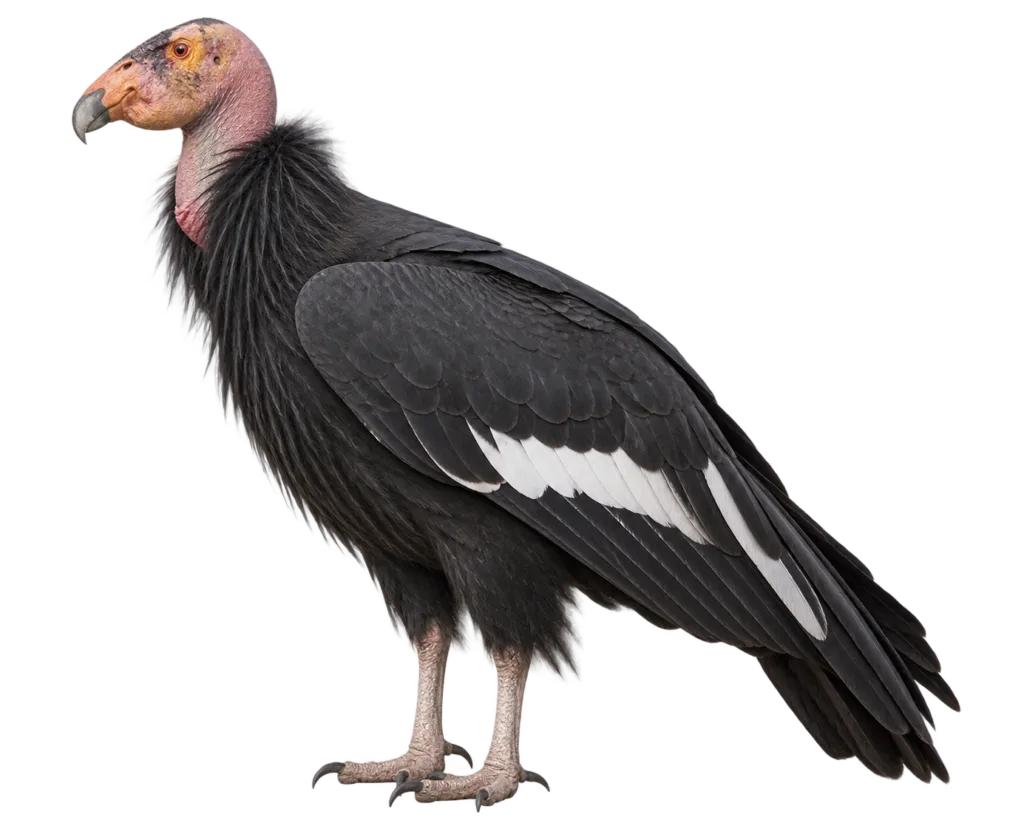
Size at a glance
How big is a California Condor?
Compare
Compare California Condor with another bird
Search by common or scientific name.
Morphology
Detailed measurements
Taxonomy
Classification
The California Condor (Gymnogyps californianus) combines a heavy body with exceptionally long, broad wings. Its wingspan is the measurement that most clearly defines its scale: an adult can approach 3 meters from wingtip to wingtip, while the body itself is much more compact than that spread suggests.
How Large Is a California Condor?
Published measurements vary somewhat between sources and study populations. Cornell Lab measurements place adult body length at about 117–134 cm (46.1–52.8 in), weight at 7.0–9.9 kg (15.4–21.8 lb), and wingspan at about 277 cm (109.1 in).
U.S. Fish and Wildlife Service material gives a broader overall range of roughly 109–140 cm (43–55 in) in length, 2.49–3.0 m (8.2–9.8 ft) in wingspan, and 7–14.1 kg (15–31 lb) in weight. The agency’s California Condor Recovery Program uses about 9.5 feet for wingspan and 17–25 pounds for adult weight.
Claims of wingspans well beyond 3 meters occasionally appear, but the U.S. Fish and Wildlife Service notes that measurements exceeding 3 meters have not been verified. For a size reference page, treating approximately 3 meters as the upper end of the verified wingspan range avoids overstating the bird’s dimensions.
The Wings Dominate Its Proportions
A California Condor’s body length is a little over a meter, yet its fully extended wings can span more than twice that distance. This creates the species’ characteristic proportions: very long, broad wings attached to a relatively compact body.
The outer primary feathers separate visibly in flight, producing the fingered wingtips common among large soaring birds. The broad inner wing provides a large lifting surface. California Condors rely heavily on rising air, including thermal and slope-generated updrafts, rather than maintaining long flights through constant flapping.
The scale of the wing also affects movement on the ground. Launching a bird of this mass requires more room and energy than launching a small bird. Condors often use cliffs, slopes, and elevated perches where they can enter moving air more easily. Once airborne, the same large wing area that makes takeoff demanding allows extended soaring with relatively little flapping.
Body Height and Standing Appearance
An adult California Condor can stand roughly 3 to 3.5 feet tall. That standing height does not represent a separate body-length measurement: posture, neck position, and leg position all affect how tall an individual appears.
At rest, the folded wings cover much of the body and give the bird a deep, heavy profile. In flight, that impression changes. The extended wings become the dominant feature, while the body and tail occupy a relatively small portion of the overall silhouette.
Head, Bill, and Feet Are Built Differently From a Hunting Raptor
The head and upper neck carry very few feathers. In adults, the exposed skin can show pink, orange, yellowish, and reddish tones, while younger birds have much darker heads. A collar of dark feathers surrounds the base of the neck.
The bill is large, hooked, and powerful enough to tear carrion. The feet have a different structure from those of raptors that seize live prey. California Condor claws are comparatively straight and blunt, and the hind toe is only weakly developed. The middle toe is elongated. These proportions make the feet better suited to standing and walking than to gripping prey with sharp talons.
This distinction matters when judging the bird’s physical build. Large wings, a hooked bill, and a heavy body can make the condor look raptor-like, but its feet reflect its specialization as a scavenger rather than an aerial hunter.
Males and Females Are Similar in Overall Form
Male and female California Condors share the same basic plumage pattern and body proportions. Males tend to be slightly larger, reversing the size pattern seen in many birds of prey where females are the larger sex.
The difference is modest enough that apparent size alone is not a dependable way to determine the sex of a free-flying individual. Posture, viewing distance, body condition, and perspective can easily produce larger visual differences than the average male–female size gap.
Adult Proportions Arrive Before Full Adult Color
Young condors become very large birds well before they acquire the clean adult plumage pattern. Immatures have darker heads and mottled gray areas beneath the wings rather than the sharply defined white underwing patches of mature birds.
Full adult appearance develops slowly, with mature coloration generally reached at about six to eight years of age. As a result, a nearly adult-sized condor can still show obvious immature plumage. Size and plumage age should therefore be treated as separate characteristics rather than assuming that a large individual must already have complete adult coloration.
Data
Measurement sources
- Data status
- Measured
- Size measurements
- AVONET — Tobias et al. (2022)
- Morphology source
- AVONET — Tobias et al. (2022)
- Morphology dataset
- AVONET v7 — BirdLife taxonomy
- Morphology dataset license
- CC BY 4.0
Full source links, dataset definitions, licensing details and measurement methodology are maintained on the Data Sources & Methodology page.