Bird size profile
Canada Goose
Branta canadensis
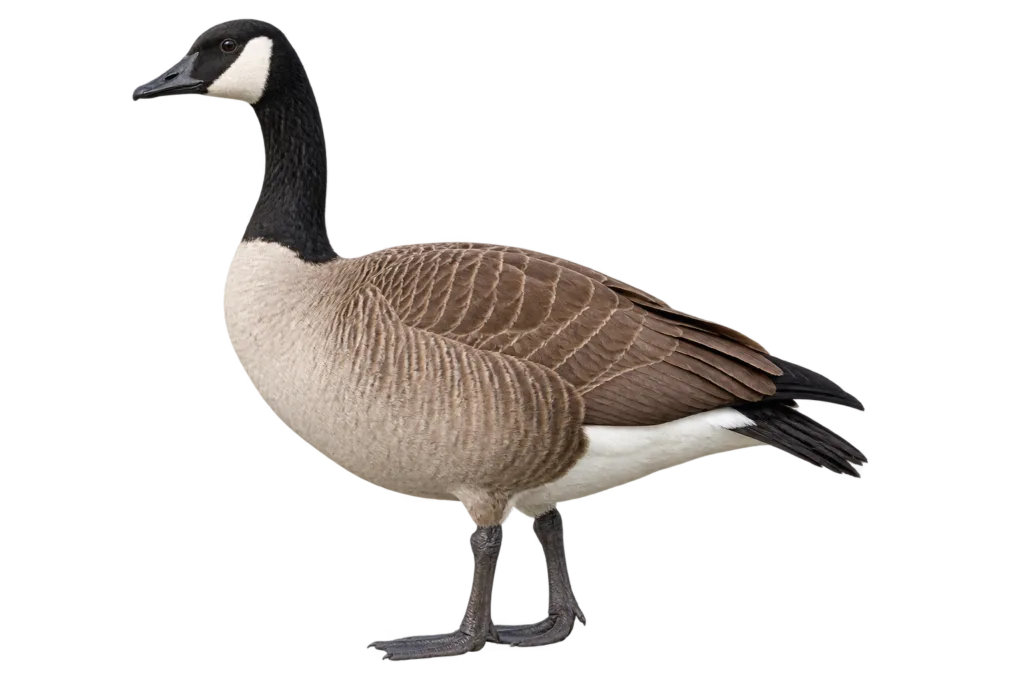
Size at a glance
How big is a Canada Goose?
True-scale visual
Canada Goose compared with a 175 cm person
When a transparent species asset and body-length data are available, BirdSize places the real bird asset and the fixed human reference on one mathematical centimetre scale.
Compare
Compare Canada Goose with another bird
Search by common or scientific name.
Morphology
Detailed measurements
Taxonomy
Classification
Canada Geese cover an unusually broad size range for a familiar waterbird. Adults are commonly listed at 76–110 cm (29.9–43.3 in) in body length, with a 127–170 cm (50.0–66.9 in) wingspan and a mass of roughly 3–9 kg (6.6–19.8 lb). The spread is real: geographic forms of Branta canadensis differ noticeably in build, while males also tend to be larger than females.
Why Canada Goose Size Varies So Much
A Canada Goose seen on an urban lawn can look much heavier and longer-bodied than another bird carrying the same species name elsewhere in North America. This is one reason a single “average Canada Goose” measurement can be misleading.
Body size varies geographically. Canada Geese generally become smaller toward the north, and several recognized forms differ in overall dimensions. The maxima form, commonly called the Giant Canada Goose, sits at the large end of the species. The Lesser Canada Goose, B. c. parvipes, is much smaller.
This variation affects more than weight. Larger birds tend to have longer wings, heads, bills and other structural measurements, although the ranges overlap enough that a single measurement does not reliably identify every form.
The familiar 76–110 cm length and 3–9 kg mass figures should not be interpreted as the normal variation of one local flock. They combine birds from a species with substantial geographic size variation.
Length Is Not Standing Height
The long neck creates an easy measurement trap. The standard length reported for Canada Geese is a body-length measurement, not the vertical distance from the ground to the top of an upright bird’s head.
A goose can also hold its neck nearly vertical, stretch it forward, lower it while feeding or pull it back toward the body. Its visible height therefore changes considerably without any change in the bird’s actual body size.
For the same reason, the published 76–110 cm length range should not be converted into a standing-height range. A reliable vertical height would need to come from a measurement specifically defined that way.
Wingspan Shows a Different Side of Its Size
At rest, much of a Canada Goose’s wing is folded against its broad body. In flight, the scale changes dramatically. A typical species-level wingspan range of 127–170 cm (50.0–66.9 in) means the largest normally measured birds can spread their wings to around 1.7 metres from tip to tip.
Wingspan and body length describe separate dimensions. They should not be substituted for one another, and the length of one folded wing is not the same measurement as full wingspan.
This distinction matters when comparing photographs. A standing goose may appear compact because its wings are folded, while the same individual can occupy a much wider visual area once airborne.
Males Are Usually Bigger, but Plumage Does Not Reveal Sex
Male and female Canada Geese look very similar in coloration. Both have the familiar black head and neck, white cheek patch and brown body. Size provides a clue, but not a clean dividing line.
Live-bird biometric data from Britain illustrate the difference. In that dataset, adult males averaged about 4.27 kg, while adult females averaged about 3.67 kg. Mean measured wing length was also greater in males, at about 541 mm compared with roughly 506 mm in females.
Those values describe that sampled population rather than every Canada Goose across the species’ range. A female from a large-bodied population can outweigh a male from a smaller one, so apparent size alone is not a dependable way to sex an isolated bird.
Why Some Older Sources Give Much Smaller Canada Goose Weights
Historical Canada Goose measurements need to be read with their taxonomy in mind. Several small northern forms were once classified within Branta canadensis. In 2004, the four smallest forms were separated as the Cackling Goose, Branta hutchinsii.
Older literature can therefore show Canada Goose body masses far below the ranges used by many current identification references. For example, historical treatments included birds around 1.4 kg under the Canada Goose name. That does not mean a modern 3–9 kg reference range is necessarily contradictory; the species boundary changed.
The same issue helps explain unusually wide ranges found in older tables and wildlife documents. Measurements collected before the split may combine birds that are now assigned to two species.
Current North American taxonomy recognizes Branta canadensis and Branta hutchinsii separately. Old measurements that include former small Canada Goose forms should not automatically be merged into a modern Canada Goose size range.
Extreme Records Are Not Typical Adult Size
Another source of conflicting numbers is the use of exceptional specimens. Very large Canada Geese have been reported above the upper limit used in ordinary species references, including an exceptional Giant Canada Goose reported at 10.9 kg.
Such a record is useful for showing what an unusually large individual has reached, but it should not replace the normal measurement range. For practical size comparison, a verified species range or population-specific measurement is more informative than the largest specimen ever reported.
Size Helps Separate Canada and Cackling Geese, but Only to a Point
Cackling Geese often give the impression of miniature Canada Geese because the two share the black neck, white cheek patch and brown body pattern. A typical Cackling Goose is more compact, with a shorter neck and smaller bill.
There is still overlap. Small Canada Geese can approach the size of larger Cackling Geese, and posture can make the problem harder. A Canada Goose resting with its neck pulled inward may temporarily look much shorter-necked than it does while alert.
Proportions become more useful in these borderline cases. Cackling Geese tend to show a shorter, stubbier bill, a more abrupt forehead and a shorter-necked overall shape. Canada Geese usually look longer through the neck and bill, with a more gradually sloping head profile. Size remains useful, but it works best together with those structural features.
Data
Measurement sources
- Data status
- Measured
- Size measurements
- Cornell Lab of Ornithology – All About Birds
- Morphology source
- AVONET — Tobias et al. (2022)
- Morphology dataset
- AVONET v7 — BirdLife taxonomy
- Morphology dataset license
- CC BY 4.0
Full source links, dataset definitions, licensing details and measurement methodology are maintained on the Data Sources & Methodology page.