Bird size profile
Chinstrap Penguin
Pygoscelis antarcticus
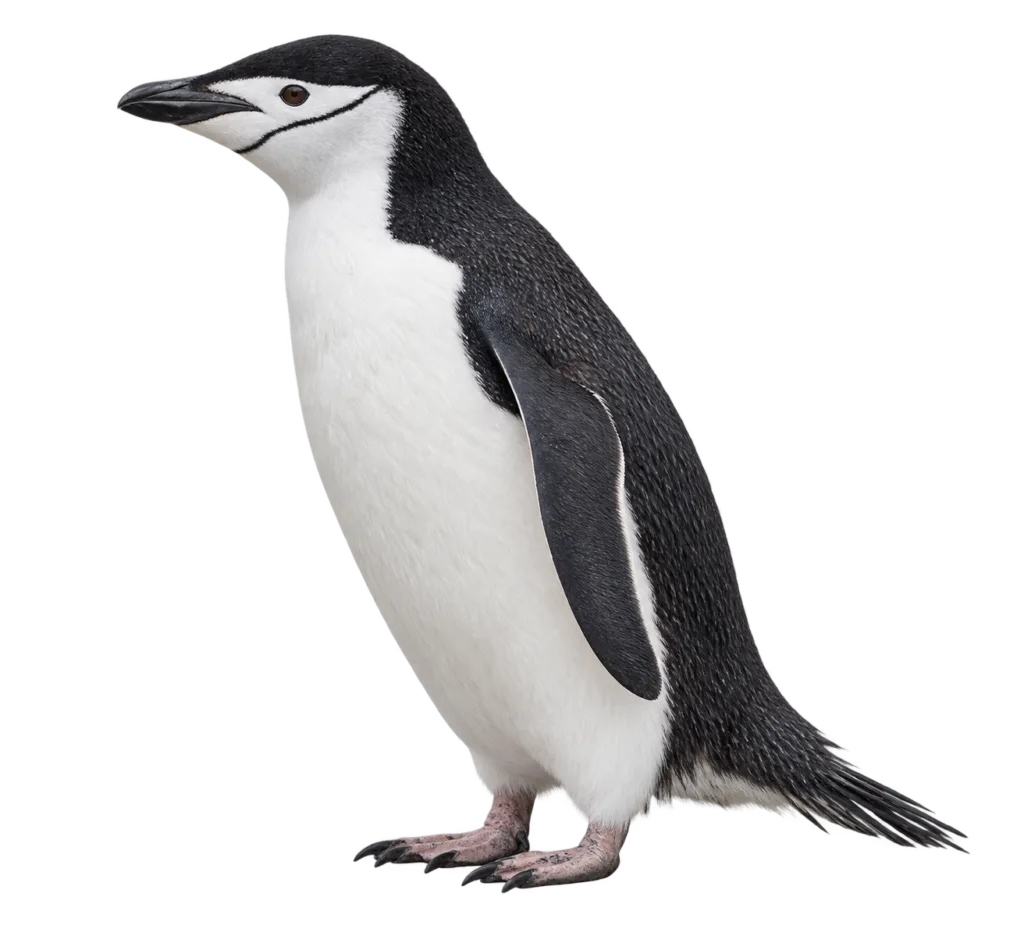
Size at a glance
How big is a Chinstrap Penguin?
Compare
Compare Chinstrap Penguin with another bird
Search by common or scientific name.
Morphology
Detailed measurements
Taxonomy
Classification
The Chinstrap Penguin (Pygoscelis antarcticus) is a medium-sized penguin with a compact body, long dark tail, narrow black bill, and a thin band of black feathers running beneath the chin. Adults stand about 71 cm (28 in) tall, while body mass commonly falls between 3.5 and 5.5 kg (7.7–12.1 lb). Weight is less fixed than height because it changes with sex, breeding stage, feeding conditions, and the annual moult.
Adult Size and Body Mass
A height near 71 cm gives a useful sense of the Chinstrap Penguin’s standing size, but weight needs more context. An adult may gain or lose a noticeable amount of mass during different parts of the year. For that reason, a single quoted weight should not be treated as a permanent body measurement.
Long-term measurements from breeding birds at Signy Island show why sex and season matter. Penguins weighed as they returned to the colony averaged about 4.6 kg for males and 4.5 kg for females. Those figures describe birds at a particular stage of the breeding cycle rather than a universal weight for every adult.
Males and Females Differ More in Measurements Than in Appearance
Male and female Chinstrap Penguins have the same basic plumage pattern, so sex is not reliably obvious from coloration alone. Males tend to be larger, especially in bill dimensions, while differences in flipper length are smaller.
A study of breeding adults on King George Island measured bill length, bill depth, flipper length, and middle toe length in molecularly sexed birds. Every measured dimension was larger on average in males.
| Measurement | Male Mean | Female Mean |
|---|---|---|
| Bill length | 50.6 mm | 45.3 mm |
| Bill depth | 19.6 mm | 17.5 mm |
| Flipper length | 196.9 mm | 192.9 mm |
| Middle toe length | 89.9 mm | 87.3 mm |
The difference is strongest in the bill. In the same sample, male bills averaged more than 5 mm longer and about 2 mm deeper than female bills. Flipper length overlapped much more closely between the sexes, so no single external measurement guarantees an individual’s sex.
Flipper Length Is Not a Wingspan
Penguin wings are highly modified into stiff flippers used for underwater propulsion. Morphological studies therefore commonly record flipper length rather than treating the bird like a flying species with an extended wingspan.
Adult Chinstrap Penguins measured on King George Island had mean flipper lengths of roughly 193–197 mm, depending on sex. This is a linear measurement of one flipper, not the distance from one flipper tip to the other.
Height, flipper length, bill length, and body mass describe different parts of the bird. They should not be converted into one another or combined to invent an unreported body dimension.
The Chinstrap’s Shape Is Built Around Swimming
The body is streamlined, with a broad chest that narrows toward the tail. The flippers are flattened and comparatively rigid, providing thrust underwater rather than lift in the air. Short legs place the feet well toward the rear of the body, a position that helps with swimming but produces the upright posture and waddling gait seen on land.
The tail is noticeably long and black. The upper surfaces of the flippers are dark, while the undersides are white. Pinkish to orange feet contrast with black soles, and the iris is reddish-brown.
The defining facial feature is the narrow black feather band extending below the cheeks and chin. Because much of the face and throat remain white, this line appears unusually sharp on an adult bird and can be visible even when the rest of the body is partly obscured.
Young Birds Reach Near-Adult Flipper Size Before Independence
Chinstrap Penguin chicks change rapidly during the short period between hatching and fledging. Growth studies have recorded flipper lengths around 190 mm or more near fledging, placing the flipper close to adult dimensions before the young bird becomes fully independent.
Body mass does not follow exactly the same pattern as a rigid structural measurement. A chick may approach several kilograms before fledging, while later body condition depends on feeding success and the energetic demands of independent life. This makes flipper length useful for describing structural growth, while mass provides more information about condition at the time of measurement.
Why Published Weight Figures Can Differ
Different reliable sources can report different Chinstrap Penguin weights without contradicting one another. Penguins store and use substantial energy reserves during breeding and moulting, so the same adult does not maintain one constant mass throughout the year.
Location and sampling method also matter. A dataset based on birds arriving at a breeding colony describes a different biological moment from measurements made during incubation, chick rearing, or moult. Sex adds another small shift because males are generally heavier.
For general size reference, the 3.5–5.5 kg adult range captures normal variation more usefully than a single exact figure. More detailed measurements are best interpreted with their population, sex, and stage of the annual cycle kept attached to them.
Data
Measurement sources
- Data status
- Measured
- Size measurements
- AVONET — Tobias et al. (2022)
- Morphology source
- AVONET — Tobias et al. (2022)
- Morphology dataset
- AVONET v7 — BirdLife taxonomy
- Morphology dataset license
- CC BY 4.0
Full source links, dataset definitions, licensing details and measurement methodology are maintained on the Data Sources & Methodology page.