Bird size profile
Cockatiel
Nymphicus hollandicus
Size at a glance
How big is a Cockatiel?
Compare
Compare Cockatiel with another bird
Search by common or scientific name.
Morphology
Detailed measurements
Taxonomy
Classification
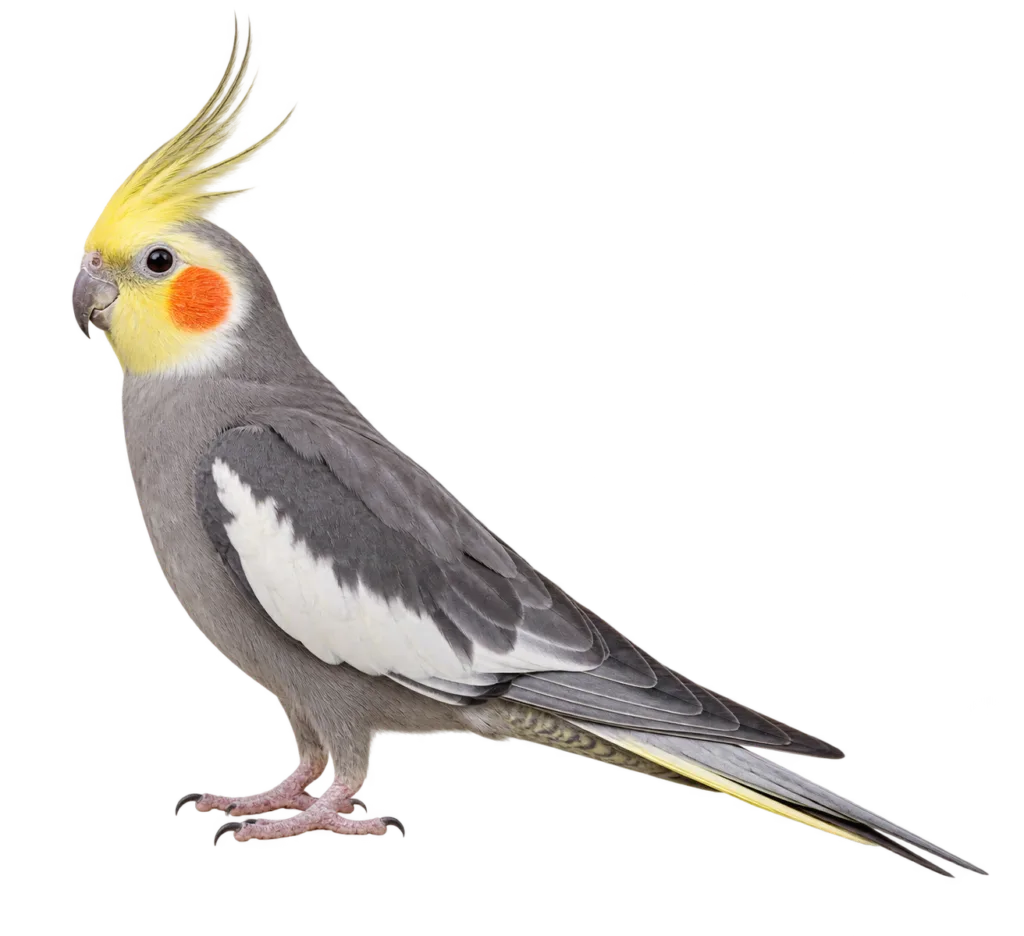
An adult Cockatiel (Nymphicus hollandicus) is usually about 30–33 cm (12–13 in) long, yet its body mass is commonly around the weight of a small piece of fruit. Much of that apparent size comes from the species’ exceptionally long, tapered tail rather than a large or heavy body.
Why Cockatiels Look Larger Than Their Weight Suggests
Cockatiels have a slim build, relatively narrow wings and a long pointed tail. Museum descriptions place adult body length at about 30–33 cm, while field measurements of wild adults show weights mostly around 70–102 g. The combination creates a bird that looks much longer than its mass might suggest.
The tail is the main reason. Individual tail measurements from Australian bird-banding data reach roughly 14–18 cm in adults. In proportion to total length, that means the tail can account for close to half of the visible bird.
A Cockatiel described as 32 cm long does not have a 32 cm body. Standard total-length figures include the long tail feathers, which extend well beyond the bird’s compact torso.
The Tail Changes How Cockatiel Size Should Be Read
The Cockatiel has one of the most stretched-looking silhouettes among familiar companion parrots. Its central tail feathers form a long taper behind the body rather than the shorter, broader tail associated with many other parrots.
Adult males measured in Australian field data had tail lengths of 143–178 mm. Adult females measured 136–166 mm. These ranges overlap, but they show how much of the bird’s total profile is created by feathers behind the body.
This also explains why two Cockatiels with similar body mass can appear different in length. Tail-feather condition, individual variation and posture can change the visible outline without indicating a comparable difference in body size.
Male and Female Measurements Overlap Heavily
Wild adult males can reach slightly higher maximum wing and tail measurements than females, but the ranges overlap too much for body size to serve as a dependable way to determine sex.
| Measurement | Adult Male | Adult Female |
|---|---|---|
| Wing | 164–181 mm | 162–175 mm |
| Tail | 143–178 mm | 136–166 mm |
| Weight | 70–102 g | 78–100 g |
The weight data make the overlap especially clear. A female at 90 g and a male at 90 g both fall comfortably within recorded adult ranges. Even the wing measurements share much of the same interval.
In wild-type adults, plumage provides more visible differences after mature coloration develops. Adult males usually show a brighter yellow face and stronger orange cheek patch, while females retain more grey on the face and typically show barring beneath the tail. Many captive colour mutations alter these visual cues, but they do not make overall body size a reliable substitute.
Wing Length Is Not the Same as Wingspan
Cockatiel measurement records often list a wing value of roughly 16–18 cm. This can easily be mistaken for wingspan, but it represents a measurement of one folded wing rather than the distance between the tips of both fully extended wings.
A folded-wing measurement should not be doubled to manufacture a wingspan figure. Wing shape, joints, feather angles and the position of the body all affect the span of an open bird. The two measurements describe different physical dimensions.
For the same reason, total length, tail length, wing length and wingspan should remain separate measurements. A Cockatiel’s unusually long tail makes that distinction especially useful because total length alone can give an exaggerated impression of body bulk.
Why Published Pet Cockatiel Weights Differ
Companion-bird references do not all give exactly the same adult weight range. Veterinary material commonly places Cockatiels near 80–95 g, while some avicultural references use a broader range that extends to about 120 g.
These figures are not measurements of one uniform population. Wild field records, companion birds and selectively bred captive lines can represent different groups, and individual birds naturally vary in build. A broad species-level range therefore should not be interpreted as a single target weight that every adult must match.
Total length varies in published material as well. Australian museum records commonly describe the species at 30–33 cm, while some captive-bird references extend the upper end slightly farther. The most stable feature across these descriptions is not an exact centimetre value but the Cockatiel’s proportion: a relatively small, light body paired with a remarkably long tail.
A Small Cockatoo With an Unusual Silhouette
Although its narrow body and pointed tail can make it resemble a small parrot, Nymphicus hollandicus belongs to the cockatoo family, Cacatuidae. It is far lighter and more slender than the larger cockatoos most often associated with that family.
The erectable crest adds height when raised, while the long tail adds length behind the body. Neither should be confused with body bulk. A Cockatiel standing upright can therefore have a tall, elongated outline while still weighing only around a tenth of a kilogram.
Data
Measurement sources
- Data status
- Measured
- Size measurements
- AVONET — Tobias et al. (2022)
- Morphology source
- AVONET — Tobias et al. (2022)
- Morphology dataset
- AVONET v7 — BirdLife taxonomy
- Morphology dataset license
- CC BY 4.0
Full source links, dataset definitions, licensing details and measurement methodology are maintained on the Data Sources & Methodology page.