Bird size profile
Common Cuckoo
Cuculus canorus
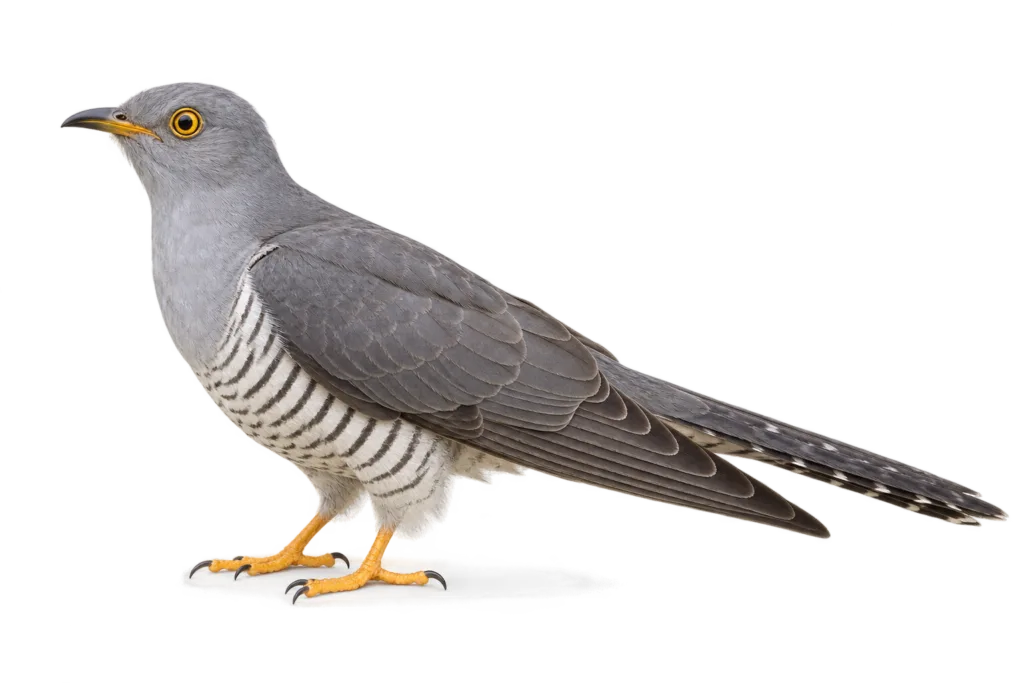
Size at a glance
How big is a Common Cuckoo?
Compare
Compare Common Cuckoo with another bird
Search by common or scientific name.
Morphology
Detailed measurements
Taxonomy
Classification
The Common Cuckoo (Cuculus canorus) is a medium-sized bird with a slim body, pointed wings and a long tail. Adults are commonly listed at about 32–36 cm (12.6–14.2 in) in body length with a 54–60 cm (21.3–23.6 in) wingspan. Those measurements describe a bird that looks longer and more angular than its body mass alone might suggest.
Length, Wingspan and Body Mass
Most field references place adult Common Cuckoos within a fairly narrow body-length range. The wingspan is much wider than the bird’s head-to-tail length because the wings are elongated and pointed rather than short and rounded.
The adult mass figure above is a measured sample average, not a fixed weight for every bird. Body mass changes among individuals and can vary with sex, season and condition. The same applies to wing measurements: a population sample is more informative than treating one number as a universal value.
Male and Female Size Overlap More Than Their Averages Suggest
Biometric records from live birds in Britain and Ireland show a modest size difference between the sexes. Adult males had a longer mean wing measurement and a higher mean body mass than adult females in the available sample. The ranges overlap, however, so size by itself is not a dependable way to sex an individual Common Cuckoo.
| Group | Mean Wing Length | Mean Body Mass |
|---|---|---|
| Adult female | 211.9 mm | 107.2 g |
| Adult male | 222.3 mm | 119.9 g |
| All adults | 218.2 mm | 114.3 g |
| Juvenile | 198.8 mm | 92.1 g |
The biometric wing values above are measurements of one wing taken from live birds using a flattened-chord method. They should not be read as half of the bird’s wingspan or converted into a wingspan estimate. Wingspan is measured across both extended wings and is a different physical measurement.
The underlying biometric sample also shows why averages should be used carefully. Female and male wing lengths overlap, as do their body weights. A relatively large female can therefore fall within the same measured range as a smaller male.
The Long-Tailed Shape Changes How Large the Bird Looks
The Common Cuckoo has a narrow-bodied profile with a long, rounded tail and pointed wings. This combination stretches the outline of the bird without adding the bulk associated with a heavy-bodied species. In flight, the result can look surprisingly raptor-like at a distance.
Regular wingbeats, pointed wings and the grey barred pattern of many adults can reinforce the superficial resemblance to a small hawk. The structure is still distinctly cuckoo-like on a good view: the bill is slender and slightly downcurved, the tail is long, and perched birds often hold the wings somewhat lowered while the tail angles upward.
Plumage Can Change the Apparent Shape Without Changing the Bird’s Basic Build
Adult males are grey above, with grey on the head, throat and upper breast. The lower underparts are pale with dark transverse barring. The tail is dark with pale spotting and tips, while the eye area, bill base and feet show yellow tones.
Adult females occur in two color forms. Grey females can resemble males closely, though many show warmer or rufous tones around the breast or neck. Rufous females are much more obvious, with cinnamon-brown plumage crossed by darker bars. The difference is a color polymorphism rather than a separate size class or sex.
Genomic research published in 2024 found that the grey-versus-rufous difference in adult female Common Cuckoos maps to the female-restricted W chromosome. Adult males remain grey, while females can carry either adult plumage form. The finding helps explain why this visible dimorphism is tied specifically to females rather than representing ordinary individual color variation shared equally by both sexes.
Because grey females and males can be extremely similar, plumage does not always provide a simple answer to sex. A grey bird with typical proportions may remain difficult to assign confidently without a clear view of the relevant plumage details.
Juveniles Combine Different Biometrics With a More Patterned Plumage
Juveniles in biometric samples averaged a shorter wing measurement and lower body mass than adults. That does not mean every young bird is visibly smaller in the field, but it shows that age can affect measured size as well as plumage.
Young Common Cuckoos are also more heavily patterned than typical grey adults. Pale feather margins, barring across the upperparts and a conspicuous pale or white patch on the nape are useful juvenile features. Both greyish and rufous-brown juvenile plumages occur, so a brown cuckoo should not automatically be assumed to be an adult rufous female.
The combination of a long tail, pointed wings, slim trunk and juvenile feather pattern is more dependable than color alone when age is uncertain. As the bird matures, the cleaner adult plumage makes the underlying shape easier to read.
Data
Measurement sources
- Data status
- Measured
- Size measurements
- AVONET — Tobias et al. (2022)
- Morphology source
- AVONET — Tobias et al. (2022)
- Morphology dataset
- AVONET v7 — BirdLife taxonomy
- Morphology dataset license
- CC BY 4.0
Full source links, dataset definitions, licensing details and measurement methodology are maintained on the Data Sources & Methodology page.