Bird size profile
Common Kingfisher
Alcedo atthis
Size at a glance
How big is a Common Kingfisher?
Compare
Compare Common Kingfisher with another bird
Search by common or scientific name.
Morphology
Detailed measurements
Taxonomy
Classification
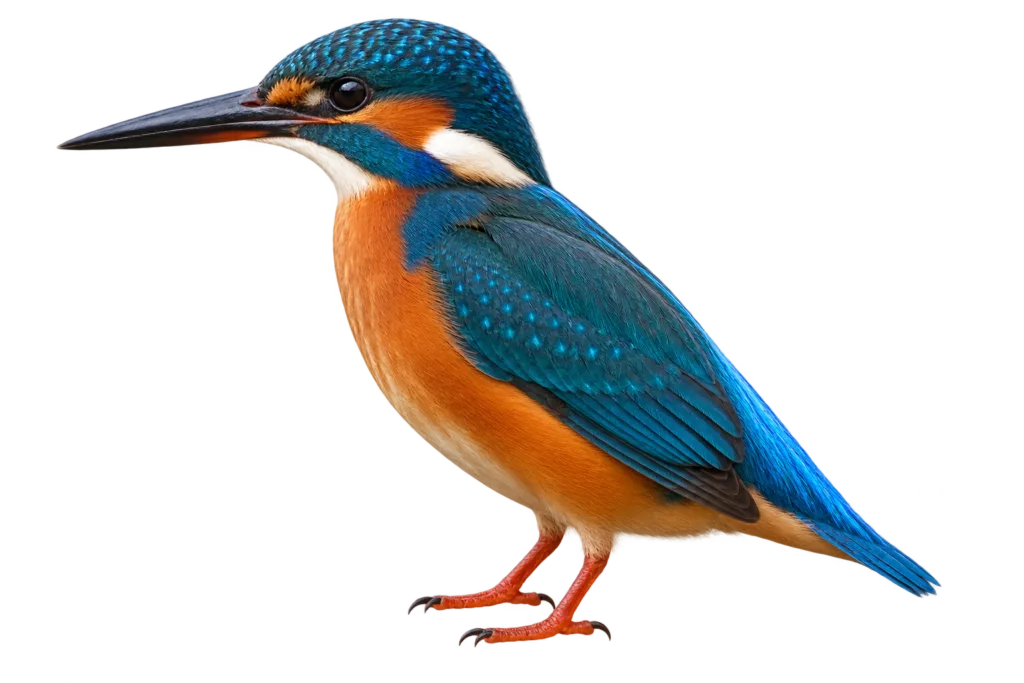
The Common Kingfisher (Alcedo atthis) is a compact bird with an unusually long, pointed bill and a short tail. Adults are typically about 16–17 cm long, with a wingspan of roughly 24–26 cm and a body mass commonly in the mid-30s to mid-40s grams. Those figures describe a small bird, but its proportions make the silhouette quite different from that of a similarly short-bodied songbird.
Why Its Shape Matters as Much as Total Length
Total body length is measured from the tip of the bill to the end of the tail. That matters especially for the Common Kingfisher because the bill contributes a conspicuous part of the bird’s front-to-back profile.
The body itself is compact. The head appears large, the neck is visually short, and the tail projects only a small distance beyond the folded wings. In a side view, much of the apparent length comes from the straight bill rather than from an elongated torso or tail.
This combination can make a perched kingfisher look almost front-heavy. When the bird crouches, the body may appear even shorter because the legs are small and often partly hidden beneath the plumage.
Wing Length and Wingspan Describe Different Measurements
Common Kingfisher measurements can look contradictory when ringing data and general bird profiles are placed side by side. They are usually measuring different things.
A wingspan of around 24–26 cm describes the distance from one wingtip to the other when both wings are extended. By contrast, biometric records from handled birds often give a wing length close to 79 mm. That is a measurement of one folded wing, not the full span across the bird.
A recorded wing length of about 79 mm and a wingspan near 25 cm can both be correct. They describe different physical measurements and should not be converted into one another as though they were interchangeable.
The relatively short, rounded-looking wings fit the bird’s compact outline when perched. In flight they create a much broader profile, so the difference between resting length and flying width is visually pronounced.
Male and Female Measurements Overlap Closely
Common Kingfishers do not show a large male-female size split. Large ringing samples show only small average differences, with extensive overlap between the sexes.
| Adult Group | Average Wing Length | Average Body Mass |
|---|---|---|
| Female | 79.2 mm | 40.4 g |
| Male | 78.6 mm | 38.1 g |
Females average slightly heavier in these data, while the difference in wing length is less than one millimetre. Individual variation is much greater than the small gap between the two averages, so body size alone is not a dependable way to determine sex.
The bill is more useful. Adult males normally have an all-dark bill, while adult females show orange-red coloration on much of the lower mandible. That distinction changes the appearance of the head without creating a meaningful difference in the bird’s basic body proportions.
A Fully Grown Juvenile Can Already Look Adult-Sized
Juvenile Common Kingfishers can be misleading if size is used as the main age clue. BTO biometric data give juveniles an average wing length of 78.8 mm, the same reported average as adults in that dataset. Their average recorded mass is lower, at about 36.3 g compared with 39.1 g for adults.
Age is therefore more apparent in coloration and feather condition than in simple body length. Young birds tend to look duller, with greener or less intense upperparts, darker-looking feet and a bill that has not yet developed the fully adult appearance.
Research on ringed Common Kingfishers has also found that the bill continues to differ with age. In one long-running dataset, adult birds had a longer average bill than first-year birds. The difference is modest, but it reinforces why two kingfishers with almost identical wing dimensions may not have exactly the same head profile.
Posture Can Change the Apparent Size
A perched Common Kingfisher often holds the body upright with the bill projecting almost horizontally. From the side, this exposes the full bill length and produces the familiar elongated front profile.
The same bird can look much more compact when it lowers the head, compresses its feathers or faces toward the observer. A frontal view hides much of the bill’s length and nearly all of the short tail, leaving the rounded head and chest to dominate the outline.
Feather position also changes apparent bulk without changing skeletal size or mass. Relaxed plumage creates a rounder body, while flattened feathers give a narrower profile. These shifts are especially noticeable in a bird whose underlying body is already compact.
The Bill Dominates the Common Kingfisher Profile
The long bill is not simply an identification feature. It strongly affects how the species’ measurements should be interpreted. A 16–17 cm total length includes a projecting structure that visually extends far beyond the compact head and torso.
Behind the bill, the proportions remain concentrated: a large-looking head, compact body, short legs and short tail. With the wings folded, little of the bird’s measured length is created by an extended rear profile. With the wings open, however, the roughly quarter-metre span temporarily makes the bird look much broader than its resting silhouette suggests.
Data
Measurement sources
- Data status
- Measured
- Size measurements
- AVONET — Tobias et al. (2022)
- Morphology source
- AVONET — Tobias et al. (2022)
- Morphology dataset
- AVONET v7 — BirdLife taxonomy
- Morphology dataset license
- CC BY 4.0
Full source links, dataset definitions, licensing details and measurement methodology are maintained on the Data Sources & Methodology page.