Bird size profile
Common Ostrich
Struthio camelus
Size at a glance
How big is a Common Ostrich?
Compare
Compare Common Ostrich with another bird
Search by common or scientific name.
Morphology
Detailed measurements
Taxonomy
Classification
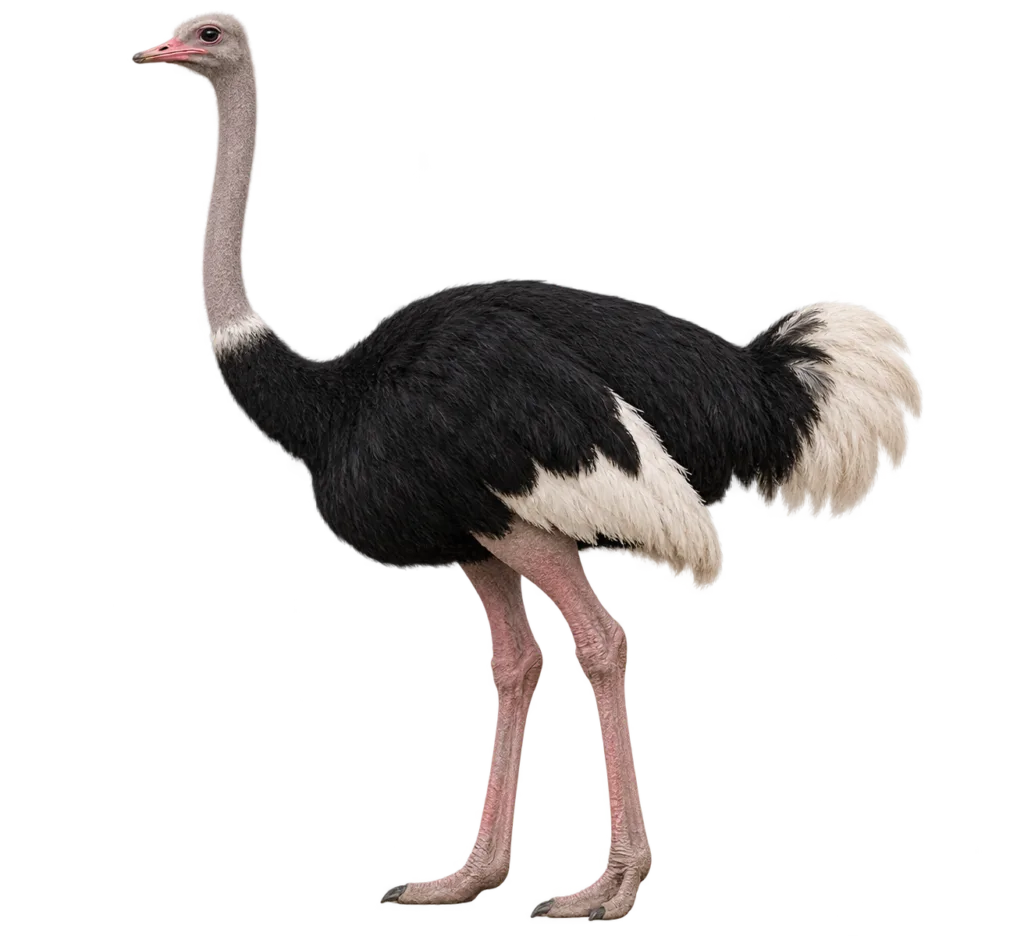
The Common Ostrich, Struthio camelus, is the tallest and heaviest living bird. Adult size is striking because much of its height comes from an unusually long neck and legs rather than from an equally massive torso. Large males can approach 2.8 m (9 ft) in standing height, while adult body mass commonly falls around 90–136 kg (198–300 lb), with some populations and individuals reaching higher weights.
What Makes an Ostrich Look So Large?
Standing height gives the Common Ostrich a very different visual scale from most other birds. The compact, rounded body sits high above the ground on long legs, while the neck adds another large section above the shoulders. As a result, total height can make an ostrich appear even larger than its body mass alone suggests.
This distinction matters when comparing ostriches with other large birds. A bird can have a heavy body without approaching the ostrich’s standing height. The ostrich combines both traits: it is exceptionally tall and also carries far more mass than any living flying bird.
Ostrich height is normally measured from the ground to the top of the head while the bird is standing. The value includes the legs and extended neck, so it should not be treated as a head-to-tail body-length measurement.
Male and Female Size Is Not Identical
Adult males generally reach the upper end of the species’ height range, while females tend to be shorter. Individual size still varies, so sex does not divide adults into two perfectly separate measurement groups.
The difference is also visible without measuring the bird. Mature males usually develop predominantly black body plumage with contrasting white wing and tail feathers. Adult females are generally grayish-brown or brown. These plumage differences make sex easier to judge in mature birds and help put a particular height or mass measurement into context.
Subspecies and individual condition add further variation. The North African ostrich, Struthio camelus camelus, includes some exceptionally tall birds, while the southern African form, Struthio camelus australis, includes very heavy individuals. For that reason, a single maximum figure should not be treated as the normal size of every Common Ostrich.
The Legs Account for More Than Height
The long hind limbs are not simply supports for a tall body. They form a highly specialized running system. Ostriches have powerful proximal leg muscles combined with elongated lower limb elements and long tendons. This arrangement helps a very heavy bird move efficiently at speeds that would be unusual for an animal with its body mass.
Common Ostriches have been recorded running continuously at roughly 48–59 km/h (30–37 mph), with sprint speeds around 69 km/h (43 mph). Their size therefore does not produce the slow, heavy gait that might be expected from the world’s heaviest living bird.
Research on ostrich growth also shows that leg dimensions do not simply enlarge in perfect proportion with body mass. As young birds grow, several hind-limb segments become proportionally longer, helping create the distinctive long-legged adult form.
Only Two Toes Support Each Foot
The Common Ostrich is unusual among living birds in having only two functional toes on each foot. The larger third toe carries much of the load, while the smaller fourth toe also contributes to stability and foot placement.
Pressure studies show that the roles of these toes change with speed. During slower movement, the smaller toe can help adjust balance near the beginning of a step. During running, pressure becomes more concentrated, and the claw of the large toe contributes traction as the foot pushes away from the ground.
The ankle and foot are also held in an extremely elevated, digitigrade arrangement. The ostrich therefore moves with much of its distal limb raised above the ground rather than placing a broad foot flat against the surface. This helps explain why such long legs can remain effective during rapid, sustained running.
A Large Body Without Flight Anatomy
The wings are conspicuous, but their proportions and structure differ from those of a large flying bird. An ostrich does not need the enormous flight muscles required to lift a body weighing well over 100 kg. Its sternum lacks the large keel that anchors the main flight muscles in strong flying birds.
The wings instead serve other functions. Ostriches spread and move them during displays, use them in body control while moving, and fan them during heat management. Their presence therefore should not be interpreted as evidence that the bird is simply an oversized version of a flying species.
The body feathers reinforce that difference. Ostrich plumage is loose and soft compared with the tightly structured aerodynamic feathers needed to form a rigid flight surface. The resulting silhouette can make the torso look particularly full even though much of the bird’s extreme vertical dimension comes from bare or lightly feathered legs and neck.
The Head Is Small, but the Eyes Are Exceptionally Large
The head looks remarkably small in relation to the full height of an adult ostrich. Within that small head, however, the eyes are enormous. An ostrich eye is about 5 cm (2 in) across, among the largest eyes found in living terrestrial vertebrates and the largest of any living bird.
This creates another unusual proportion: a very tall animal with a relatively small head but exceptionally large visual organs. The long neck positions those eyes high above the ground, giving the bird a broad view across open habitat without requiring a large, heavy skull.
Young Ostriches Reach Adult Scale Rapidly
Adult measurements can be misleading when applied to younger birds because ostriches grow at an unusually fast rate. Chicks may gain roughly 30 cm (1 ft) of height per month during early growth and can approach the physical size of adults within about six months, although full maturity comes later.
This rapid development produces major changes in body proportions over a short period. Legs lengthen, body mass rises sharply, and juvenile plumage is gradually replaced. Age is therefore important when a measured ostrich falls well below the normal adult range; a smaller bird is not necessarily a small adult.
Common Ostrich and Somali Ostrich Are Separate Species
Measurements labeled simply “ostrich” do not always refer to the same species. Modern classifications generally recognize the Common Ostrich, Struthio camelus, and Somali Ostrich, Struthio molybdophanes, as separate living species.
This distinction is especially relevant when older measurements are used. The Somali Ostrich was historically treated as a subspecies of Struthio camelus, so older datasets and publications may combine birds that are separated in current taxonomy. Species identification should therefore be checked before using an old record as a Common Ostrich size measurement.
Data
Measurement sources
- Data status
- Measured
- Size measurements
- AVONET — Tobias et al. (2022)
- Morphology source
- AVONET — Tobias et al. (2022)
- Morphology dataset
- AVONET v7 — BirdLife taxonomy
- Morphology dataset license
- CC BY 4.0
Full source links, dataset definitions, licensing details and measurement methodology are maintained on the Data Sources & Methodology page.