Bird size profile
Cooper’s Hawk
Astur cooperii
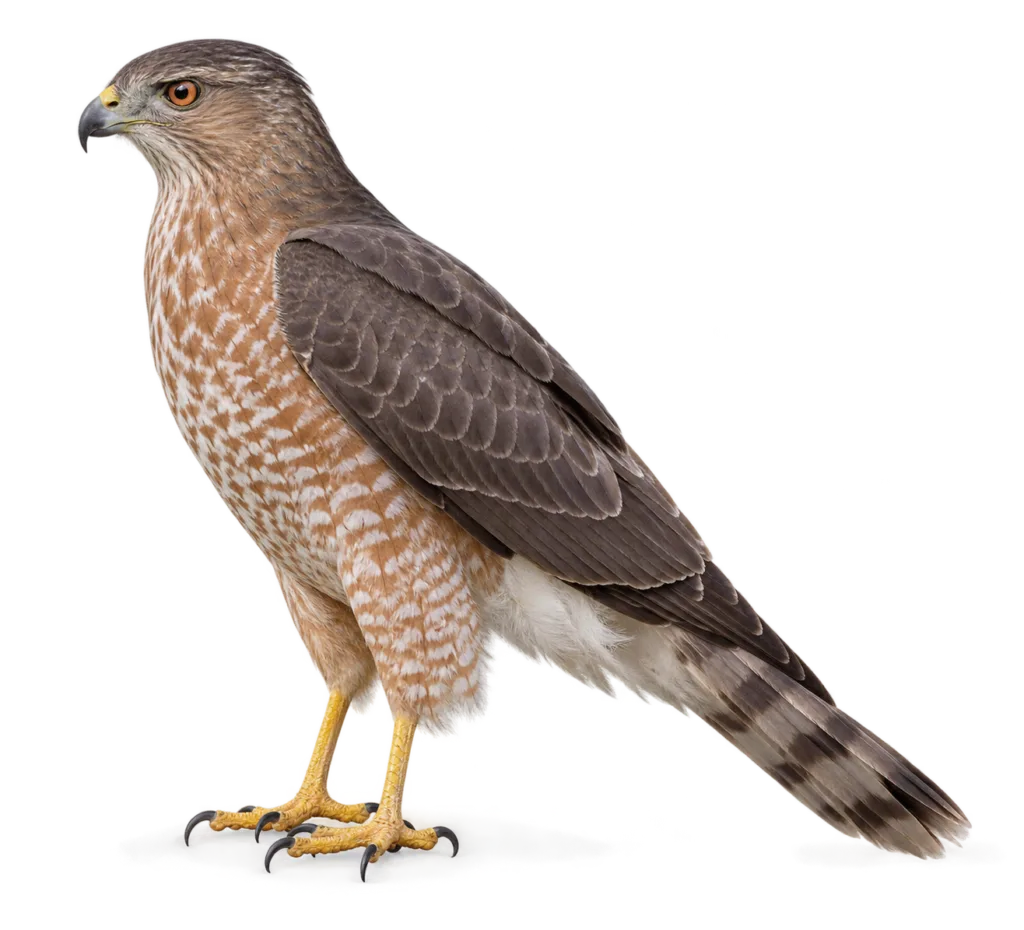
Size at a glance
How big is a Cooper’s Hawk?
True-scale visual
Cooper’s Hawk compared with a 175 cm person
When a transparent species asset and body-length data are available, BirdSize places the real bird asset and the fixed human reference on one mathematical centimetre scale.
Compare
Compare Cooper’s Hawk with another bird
Search by common or scientific name.
Taxonomy
Classification
Cooper’s Hawk is a medium-sized, long-tailed hawk whose apparent size can vary more than expected within a single species. Adult females are distinctly larger and heavier than males, while western populations tend to run smaller than many eastern populations. The bird’s proportions also matter: a long tail, relatively short rounded wings, and a head that projects well beyond the wings give it a stretched profile even when the body itself is not especially large.
Male and Female Cooper’s Hawks Occupy Different Size Ranges
Sex is one of the main reasons published Cooper’s Hawk measurements cover such a broad range. Females reach the upper end of nearly every major body measurement, especially mass and total length.
| Measurement | Male | Female |
|---|---|---|
| Total length | 37–39 cm (14.6–15.3 in) | 42–45 cm (16.5–17.7 in) |
| Body mass | 220–410 g (7.8–14.5 oz) | 330–680 g (11.6–24.0 oz) |
| Wingspan | 62–90 cm (24.4–35.4 in) | 75–90 cm (29.5–35.4 in) |
The contrast is strongest in body mass. A large female can weigh well over twice as much as a small male. Wingspan is less useful by itself because the male and female ranges overlap considerably.
This pattern is known as reversed sexual size dimorphism: the female is larger rather than the male. Cooper’s Hawk shows this difference strongly among North American raptors. The sexes otherwise retain the same basic body plan, so size rather than a radically different shape separates them.
The Tail Accounts for Much of the Hawk’s Long Appearance
Total length does not describe the proportions of a Cooper’s Hawk particularly well on its own. A large part of that length comes from the tail. The species has a relatively compact body paired with short, rounded wings and an unusually long tail.
These proportions help explain why two hawks with similar total lengths can look very different in flight. A measurement taken from bill tip to tail tip gives the tail considerable influence, while wing chord and body mass describe different parts of the bird’s structure.
Wing Chord and Tail Length Reveal the Female Size Advantage
Measurements from breeding adults provide a closer look at the skeletal and feather dimensions behind the visible size difference. In one northern population study, adult males from British Columbia averaged a wing chord of about 227 mm, compared with about 257 mm in females. Wisconsin birds averaged about 237 mm in males and 267 mm in females.
Tail measurements showed a similar separation. British Columbia males averaged about 183 mm in tail length and females about 209 mm. Wisconsin averages were roughly 185 mm for males and 210 mm for females.
Wing chord is a direct measurement of the folded wing and is not the same as wingspan. Tail length is also measured separately from total body length. Values from these methods should not be substituted for one another.
Geography Adds Another Layer of Size Variation
Sex does not explain all of the variation. Research on breeding populations across northern North America found measurable geographic differences in body mass, wing chord, tail length, tarsus diameter, hallux length, and other traits.
Among four studied populations stretching from coastal British Columbia to Wisconsin, the smallest birds occurred toward the western end of the sampling area, while the largest average body masses occurred in Wisconsin. Breeding males in British Columbia averaged about 296 g in one dataset, compared with about 327 g in Wisconsin. Females from the same samples averaged about 526 g and 580 g, respectively.
This geographic pattern means that two healthy adult Cooper’s Hawks of the same sex do not necessarily have the same expected mass or linear measurements. Population-level differences are real enough that a single species-wide average can hide useful information.
The pattern is not simply a matter of latitude. Work on northern populations has documented an east-to-west change in body size and has examined possible links with local prey size, habitat structure, migration, and population history.
Body Shape Is More Stable Than Body Weight
Mass can vary with sex, region, individual condition, and sampling population, but the characteristic Cooper’s Hawk outline remains much more recognizable. The combination of a long tail, rounded wing tips, fairly broad shoulders, and projecting head is retained across the species.
The legs and feet are also proportioned for capturing birds. Long toes and curved talons form part of the same predatory morphology, while the hooked bill is relatively compact compared with the bird’s head and body. These structures contribute less to visible body length than the tail, yet they are useful anatomical measurements in population studies.
Adult plumage changes the visual impression without changing the underlying proportions. Adults are blue-gray above with reddish barring below, while immature birds are browner and vertically streaked beneath. Both age groups retain the long-tailed, rounded-winged silhouette.
Why Published Cooper’s Hawk Measurements Do Not Always Match
Different measurement ranges are not necessarily contradictory. Some references report broad values from across North America, while others describe a particular sex, age group, breeding population, or research sample. A regional study of live adults can therefore produce a narrower range than a species account combining records from many locations.
- Sex: females are markedly larger and heavier than males.
- Region: western and eastern populations can differ in average body size.
- Measurement type: total length, wing chord, wingspan, tail length, and tarsus measurements describe different dimensions.
- Sample design: measurements from breeding adults may differ from datasets containing birds of several ages or seasons.
Body mass deserves particular care because it has the broadest overlap with condition and population differences. Linear structures such as wing chord and tail length usually provide a more stable description of physical dimensions, while mass gives additional information about how large and heavy an individual actually is.
The Scientific Name Has Recently Changed
Older books, research papers, and databases commonly list the Cooper’s Hawk as Accipiter cooperii. Current American Ornithological Society taxonomy places the species in the genus Astur, making the accepted name Astur cooperii.
The change reflects newer work on evolutionary relationships within the hawk family rather than a change in the bird’s physical definition. Historical measurements published under Accipiter cooperii still refer to the same species and remain relevant when comparing body size and morphology.
Data
Measurement sources
- Data status
- Measured
- Size measurements
- Cornell Lab of Ornithology – All About Birds
Full source links, dataset definitions, licensing details and measurement methodology are maintained on the Data Sources & Methodology page.