Bird size profile
Downy Woodpecker
Dryobates pubescens
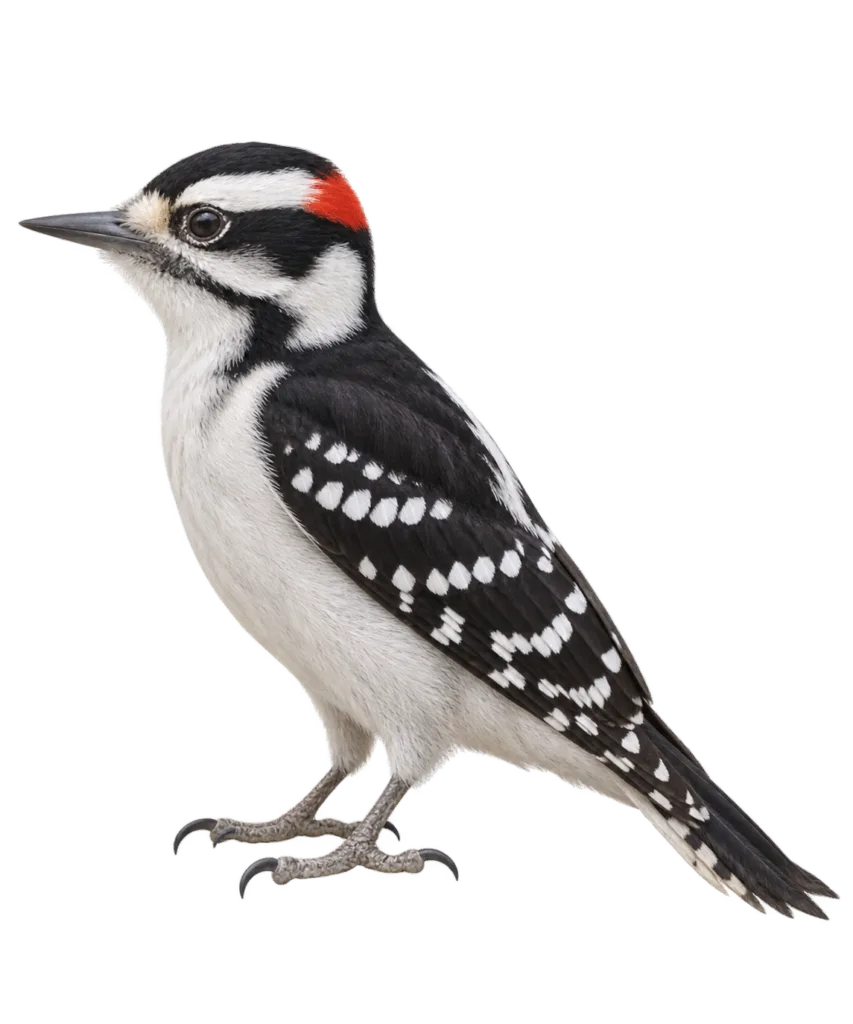
Size at a glance
How big is a Downy Woodpecker?
True-scale visual
Downy Woodpecker compared with a 175 cm person
When a transparent species asset and body-length data are available, BirdSize places the real bird asset and the fixed human reference on one mathematical centimetre scale.
Compare
Compare Downy Woodpecker with another bird
Search by common or scientific name.
Morphology
Detailed measurements
Taxonomy
Classification
The Downy Woodpecker (Dryobates pubescens) packs the typical climbing build of a woodpecker into a very small body. Adults are commonly about 14–17 cm (5.5–6.7 in) long and weigh roughly 21–28 g (0.7–1.0 oz), with a wingspan near 25–30 cm (9.8–11.8 in). Its size is only part of the picture, however. The short bill, compact head, stiff tail and ability to work on unusually slender surfaces give the species a distinctive set of proportions.
A Compact Woodpecker With a Noticeably Short Bill
The Downy Woodpecker has a blocky head and fairly broad shoulders, but its bill is short relative to the rest of the head. Viewed from the side, the bill is clearly shorter than the head depth. This proportion often says more about the bird’s shape than an isolated bill measurement does.
The bill is straight, dark and chisel-like. It is suited to tapping, probing and shallow excavation, yet the bird does not look heavily front-weighted. The relatively small bill helps preserve the compact appearance of the head even when the bird is stretched upright against bark.
Reading the proportions
A Downy Woodpecker can look longer when it is upright on a trunk and much rounder when its feathers are fluffed. The bill-to-head relationship remains comparatively stable, making proportion more useful than apparent body bulk when judging shape.
The body itself is short and sturdy rather than slender. When perched vertically, the shoulders sit away from the trunk while the tail reaches back to form a brace. On a horizontal twig, the same bird can appear much more compact because the body is no longer stretched between its feet and tail.
Small Size Changes Where the Bird Can Feed
The Downy Woodpecker’s low body mass allows it to use places that would not support a much heavier woodpecker. It regularly moves onto narrow branches, weed stems and other flexible vegetation while searching for insects. It can also hang or work sideways instead of remaining upright on a large trunk.
This is one reason body size has a practical meaning beyond a length figure. A bird weighing little more than 20 g can place its feet on relatively thin substrates without bending them as strongly as a larger woodpecker would. Downies can therefore search portions of plants that are physically unavailable to heavier bark-foraging birds.
Males and females can also divide their feeding space. Males are often recorded using smaller branches and weed stems more frequently, while females may spend more time on larger branches and trunks. The distinction can vary with season and location, so it should not be treated as a fixed rule for identifying sex.
The Tail Functions as Part of the Climbing Structure
A Downy Woodpecker does not cling to a trunk with its feet alone. Its tail forms a third support point. The bird leans backward until the stiff tail feathers contact the surface, creating a stable position for climbing, probing and striking wood.
The central tail feathers are especially stiff. Their shafts and structure resist bending under repeated contact with bark. This makes the apparent tail length more important functionally than it might seem from a simple body measurement.
This support system also helps explain the bird’s characteristic posture. A Downy often appears to lean away from a trunk rather than lying flat against it. The feet anchor the front of the body while the tail supports the rear, leaving room for the head and neck to move during foraging.
Body Size Varies Across the Range
A single measurement does not describe every Downy Woodpecker across North America. Geographic variation is well documented. Birds from northern areas and higher elevations tend to be larger, while populations farther south and at lower elevations tend to be smaller.
Measurements of museum specimens have shown this pattern particularly clearly in wing length. Historical geographic studies found a gradual increase in average wing size from southern to northern populations rather than a sharp boundary between two body sizes. More recent genetic and geographic work continues to recognize broad regional variation in the species.
Plumage changes geographically as well. Eastern birds generally show more white in the wings, while western populations tend to be darker and have reduced white spotting. Birds along the Pacific coast can appear washed with gray or brownish gray below. These color differences can alter the visual impression of size even when two individuals have similar structural measurements.
Why published measurements can differ
Values collected from different populations do not have to match exactly. A bird measured in a southern population may naturally fall toward the smaller end of the species range, while a northern bird may fall toward the larger end. Published ranges are more useful than treating one average as the size of every individual.
Sex and Age Alter the Head Pattern More Than the Basic Shape
Adult males and females share the same compact structural form. Standard field measurements are often presented for both sexes together rather than as sharply separated male and female size classes.
The clearest adult difference is in the head plumage. Adult males have a small red patch on the rear of the head, while adult females lack it. Both retain the black-and-white facial pattern, pale underparts, white central back and spotted black wings associated with the species.
Juveniles can temporarily change the expected placement of red. Young birds may have red feathering on the crown rather than the adult male’s small patch at the back of the head. The amount varies, and young females may show little or no red. This juvenile pattern is replaced as the young bird molts into later plumage.
The outer tail feathers add another useful structural detail. They are largely white but usually carry black spots or bars. Because the tail is frequently pressed against bark, these markings may be partly hidden while the bird is climbing and become easier to see when the tail is spread or viewed from below.
Why Apparent Size Changes So Much in the Field
A Downy Woodpecker rarely holds a neutral measuring posture. It stretches upward while climbing, compresses its body while perched, hangs beneath branches and sometimes balances on thin stems. Feather position can make the chest and belly look either smooth and narrow or rounded and full.
Distance creates another problem. A small bird high on a thick trunk can appear larger because the observer has few reliable scale references. On a feeder, narrow twig or plant stem, its small body becomes much easier to judge.
For that reason, the most useful view of Downy Woodpecker size comes from several features working together: a body generally within the 14–17 cm range, low mass, a short bill relative to the head, a compact trunk-climbing build and a stiff tail used as a brace. Those proportions remain recognizable even when posture, feathers and geographic variation change the bird’s apparent dimensions.
Data
Measurement sources
- Data status
- Measured
- Size measurements
- Cornell Lab of Ornithology – All About Birds
- Morphology source
- AVONET — Tobias et al. (2022)
- Morphology dataset
- AVONET v7 — BirdLife taxonomy
- Morphology dataset license
- CC BY 4.0
Full source links, dataset definitions, licensing details and measurement methodology are maintained on the Data Sources & Methodology page.