Bird size profile
Eastern Screech-Owl
Megascops asio
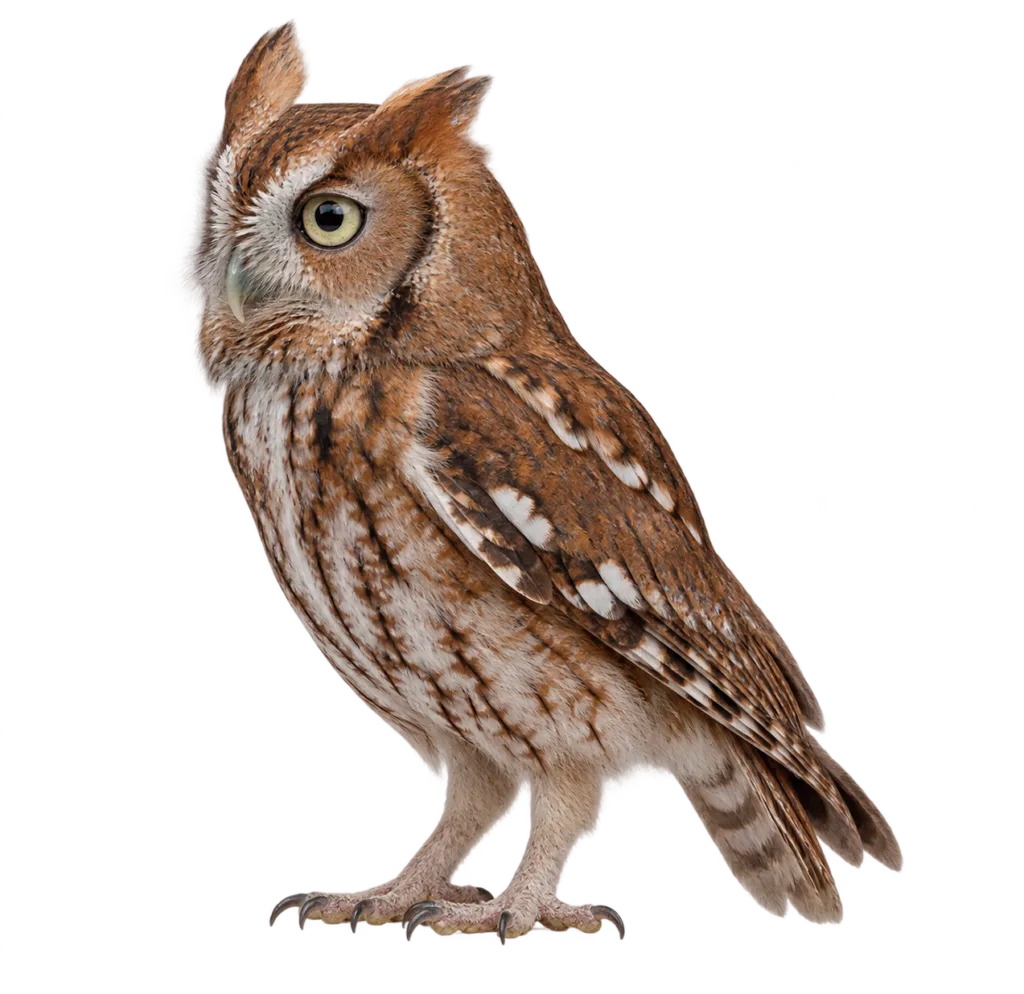
Size at a glance
How big is an Eastern Screech-Owl?
Compare
Compare Eastern Screech-Owl with another bird
Search by common or scientific name.
Morphology
Detailed measurements
Taxonomy
Classification
The Eastern Screech-Owl (Megascops asio) is a compact, heavy-bodied owl whose apparent size can change sharply with posture. Published measurements place adults at about 16–25 cm (6.3–9.8 in) long, with a 48–61 cm (18.9–24.0 in) wingspan and a body mass of roughly 121–244 g (4.3–8.6 oz). Those broad ranges reflect more than ordinary individual variation: females tend to be larger than males, populations vary geographically, and body mass changes more readily than skeletal or feather measurements.
Understanding the Eastern Screech-Owl’s Size Range
A single Eastern Screech-Owl should not be expected to fall near the midpoint of every range. An individual can be relatively heavy without being exceptionally long, while another can have long flight feathers but a lower body mass. Length, mass and wingspan describe different parts of the bird’s size.
The species is also built in a way that makes body length less intuitive than it may seem. It has a large head, a short neck, a stocky trunk and a short, square-ended tail. Much of its visual bulk is concentrated around the head and body rather than stretched along a long neck or tail.
Females Tend to Be Larger Than Males
Eastern Screech-Owls show reversed sexual size dimorphism, the pattern seen in many birds of prey in which the female is the larger sex. The difference is especially clear in body mass, although males and females overlap enough that size alone does not identify every bird reliably.
A morphometric study of 77 adult Eastern Screech-Owls found the following averages in its measured sample:
| Measurement | Males | Females |
|---|---|---|
| Body mass | 171.0 g | 202.1 g |
| Total length | 20.0 cm | 20.8 cm |
| Wing measurement | 162.9 mm | 169.9 mm |
| Tail | 80.4 mm | 85.2 mm |
| Bill | 22.9 mm | 23.6 mm |
The mass difference in that sample was much more obvious than the difference in total body length. This helps explain why a male and female perched together can look nearly alike in height even though the female carries noticeably more mass.
Male and female measurement ranges overlap. Body mass can also vary with condition and other short-term factors, so an unusually heavy male or light female may fall into the range more often associated with the other sex.
Wingspan and Wing Length Describe Different Measurements
The Eastern Screech-Owl’s 48–61 cm wingspan is the distance from one wingtip to the other when both wings are extended. It should not be confused with wing length or wing chord, which measures one folded wing from the wrist area toward the tip of the longest primary.
Sexed morphometric data illustrate the difference. Average wing measurements in one adult sample were about 162.9 mm in males and 169.9 mm in females. These numbers are far smaller than the bird’s wingspan because only one wing is being measured.
The distinction matters when measurements from field studies, museum specimens and general bird profiles are compared. A value described simply as “wing length” cannot be substituted for wingspan.
Its Shape Makes a Small Owl Look Substantial
Eastern Screech-Owls have rounded wings, a short square tail and a large head that appears to merge directly into the body. This compact outline gives the bird a heavier appearance than its length alone suggests.
The pointed feather tufts on the head add another source of visual variation. When raised, they lengthen the outline of the head and create the familiar horned silhouette. When flattened, the same owl looks much rounder. The tufts are feathers rather than the owl’s actual ears, so their position does not change any anatomical head measurement.
Feather position also affects apparent body width. A resting owl with loose plumage can look broad and almost spherical. With its feathers held close to the body, especially when pressed against the edge of a tree cavity, it can look unexpectedly narrow. Photographs therefore give a poor estimate of body mass unless there is a dependable scale reference.
Color Morph Does Not Indicate a Different Size Form
Adults occur most often in gray or rufous plumage, with intermediate brownish birds also present. These color forms can make individuals look surprisingly different, but they are still the same species and should not be interpreted as separate size classes.
Gray birds are finely patterned with dark streaks and barring over a gray background. Rufous birds replace much of that gray with reddish brown. Both retain the compact structure, yellow eyes, short tail and characteristic head shape of the species.
Color is also a poor shortcut for determining sex. Both males and females occur in the major color forms. A red individual is not inherently a female, and a gray individual is not inherently a male.
Juveniles add another visual complication. Young Eastern Screech-Owls are fluffier and show fine barring across much of the plumage. Their softer feathering can exaggerate apparent body size even though they have not yet acquired the cleaner structural appearance of an adult.
Geography Helps Explain Why Published Measurements Are Broad
Eastern Screech-Owls occur across a large part of eastern and central North America, and body size is not identical throughout that range. Geographic studies describe a broad tendency toward smaller birds in southern portions of the range and larger birds farther north and west.
This variation means measurements collected in one region should not automatically be treated as exact averages for the entire species. A local study can produce a narrower range than a species-wide reference simply because it samples one population rather than birds from many parts of the range.
Sex and geography can act together. A large female from a larger-bodied population may sit well above the species midpoint, while a male from a smaller-bodied population can occupy the lower end of published measurements. That natural variation helps account for the wide 16–25 cm length and 121–244 g mass ranges reported for the species as a whole.
What Each Measurement Actually Tells About the Owl
| Measurement | What It Represents | What Can Affect It |
|---|---|---|
| Body length | Distance from the bill tip to the end of the tail | Tail length, posture and measurement technique |
| Body mass | The bird’s weight at the time it is measured | Sex, geographic population and body condition |
| Wingspan | Total width across both fully extended wings | Wing size and how the wings are extended during measurement |
| Wing chord or wing length | A measurement of one wing rather than the full span | Sex, population and the exact measurement method |
| Tail length | Length of the tail feathers from their base to the tip | Sex, feather wear and individual variation |
Body mass is especially different from the linear measurements. A bird can gain or lose grams without any change in wing or tail length. For that reason, two Eastern Screech-Owls with nearly identical feather measurements do not have to weigh the same.
The species’ compact proportions can also distort casual estimates. A perched bird may appear almost all head and body because very little neck is visible and the tail projects only a short distance. Once the wings open, the same small owl occupies a span approaching half a meter or more.
Data
Measurement sources
- Data status
- Measured
- Size measurements
- AVONET — Tobias et al. (2022)
- Morphology source
- AVONET — Tobias et al. (2022)
- Morphology dataset
- AVONET v7 — BirdLife taxonomy
- Morphology dataset license
- CC BY 4.0
Full source links, dataset definitions, licensing details and measurement methodology are maintained on the Data Sources & Methodology page.