Bird size profile
Emu
Dromaius novaehollandiae
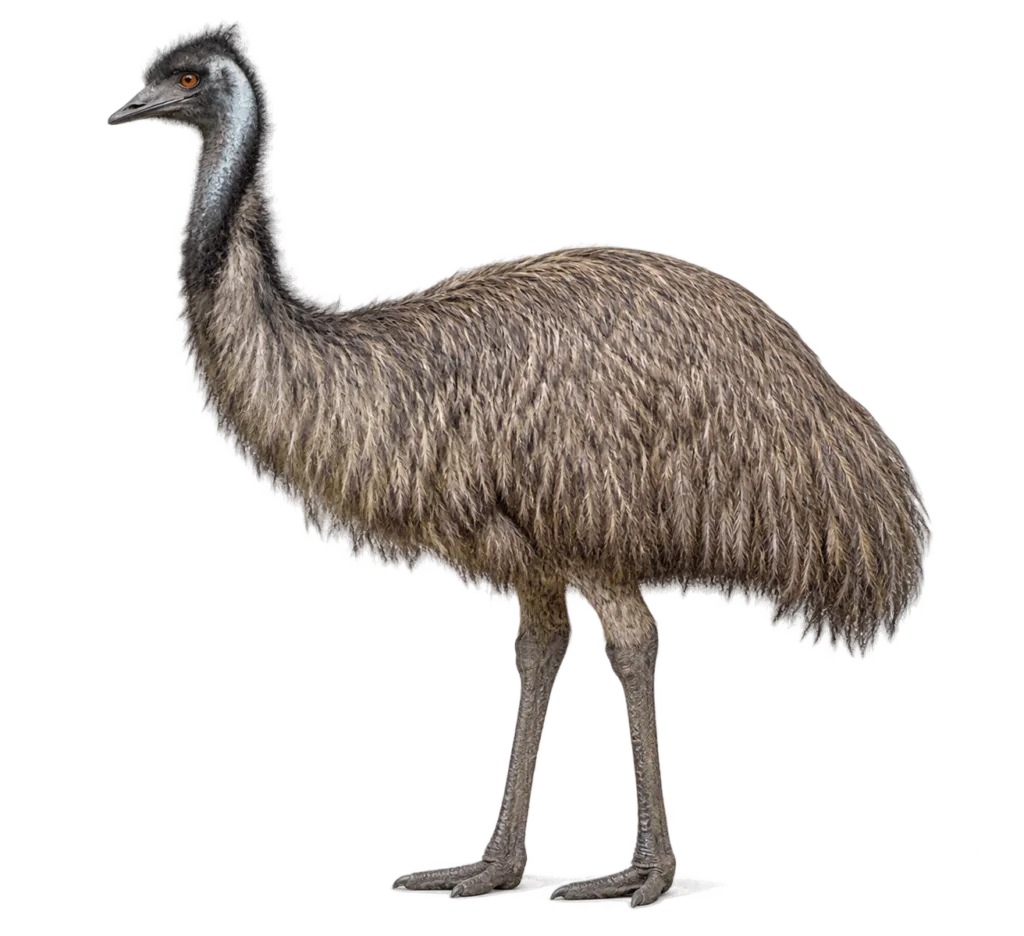
Size at a glance
How big is an Emu?
Compare
Compare Emu with another bird
Search by common or scientific name.
Morphology
Detailed measurements
Taxonomy
Classification
The emu, Dromaius novaehollandiae, is Australia’s tallest native bird and one of the tallest living birds anywhere. An adult standing upright is commonly about 1.6 to 1.9 m (5.2 to 6.2 ft) tall, with some descriptions extending the upper end to around 2 m. Much of that height comes from the long legs and neck rather than a large, heavy trunk.
How Tall Does an Emu Get?
Standing height is the most useful measurement for describing the scale of an emu. Australian Museum records place adults at roughly 1.6 to 1.9 m when erect, while other zoological references give an average near 1.75 m and maximum figures close to 1.9 m. References that round the upper limit commonly describe the species as reaching about 2 m.
Height is not completely fixed even for the same individual. An emu can stretch its neck and hold the body more erect, or lower its head and neck while feeding or moving. Measurements described as standing height therefore should not be confused with a straight anatomical length measured along the body.
Body Mass Varies More Than Height
Adult emu weights differ noticeably among published references. Some zoological datasets describe adults around 36–40 kg (79–88 lb), while other institutional records give adult males around 50–55 kg and females several kilograms heavier. Broad descriptions may place large adults close to 60 kg.
Body mass is more variable than standing height. Sex, age, body condition, season, captive management and the population being measured can all affect the number on a scale. A weight from one study population should not be treated as a fixed mass for every adult emu.
The difference between height and mass is important when judging the bird visually. An emu can stand nearly as tall as a person while remaining far lighter than its height might suggest. The body itself is relatively compact, with the legs and neck accounting for much of the vertical dimension.
The Emu’s Height Comes From Its Running Anatomy
The emu is built for terrestrial movement. Its long pelvic limbs raise the body well above the ground, while the neck adds another large part of its standing profile. The torso can appear broad because of the feathers, but the underlying form is much narrower than the outer plumage suggests.
Long Legs and Three-Toed Feet
Each emu foot has three toes pointing forward. This differs from the two-toed foot of an ostrich and is one of the clearest structural features of the emu’s lower limb. The long legs support a cursorial, or running-adapted, lifestyle.
Biomechanical research on emu pelvic limbs has also shown how the leg muscles, tendons and bones change as the bird grows while preserving the same basic form of bipedal locomotion. The adult’s towering appearance is therefore not simply the result of overall enlargement. Much of the growth is tied to an increasingly large locomotor system capable of carrying a much heavier body.
Wings Are Tiny Relative to the Body
An adult emu may stand well over 1.5 m tall, yet its wings are reduced to small appendages. Smithsonian records describe them as less than about 20 cm (8 in) long. This extreme difference between total body height and wing size is one of the most unusual proportions in the species.
The wings can move, but they do not generate flight. The emu’s body plan places far more anatomical emphasis on the hind limbs than on the forelimbs.
Shaggy Feathers Change the Apparent Body Shape
An emu’s grey-brown body covering does not form the smooth aerodynamic surface seen on many flying birds. The feathers hang loosely and give the trunk a shaggy, rounded outline. As a result, photographs can make the body look much thicker than the underlying frame.
Emu contour feathers also have an unusual structure. A follicle produces a feather in which the shaft divides into two rachises of roughly similar length. The barbs do not interlock into the firm vane typical of a flight feather. The resulting plumage is loose and hair-like in appearance.
Feather color can also change in appearance through wear and sun exposure. Fresh plumage may look darker, while prolonged exposure can produce a paler brown tone. These color differences do not indicate a change in structural size.
Female Emus Can Be Larger, but Size Alone Does Not Reliably Identify Sex
Females are often described as somewhat larger or heavier than males. Some institutional figures place females several kilograms above males on average. The distinction is not consistent enough, however, to identify an individual bird simply by judging its height or weight.
Research on captive emus has found populations in which male and female body weights overlap closely, while other datasets show greater mass in females. External appearance is similarly overlapping. Both sexes share the same long-legged body plan and broadly similar brown plumage.
A very large emu is not automatically female, and a smaller adult is not automatically male. Body measurements are useful for population-level patterns but are unreliable as a stand-alone method for determining the sex of a particular bird.
Adult females may also appear broader across the body, especially during the breeding period, but posture, plumage and body condition can alter this impression. Vocal and reproductive characteristics can provide more useful context than size alone.
Emus Undergo an Enormous Increase in Size After Hatching
A newly hatched emu is only a fraction of its eventual adult size. Reported hatchling masses are commonly around 440–500 g (15.5–17.6 oz). Adults weigh tens of kilograms, so body mass can increase roughly eighty-fold between hatching and maturity.
Experimental work on emu development has found that hatchling size is related to egg size. Larger eggs can produce heavier and structurally larger chicks, including differences in measurements such as the tibiotarsus and culmen. These early differences do not create a separate adult body form, but they show that size variation begins before the chick leaves the egg.
Young emus also look proportionally different from adults. Chicks have striped plumage, and their thin bodies make the legs appear especially prominent. As they grow, the trunk gains mass, the juvenile pattern disappears and shaggy brown adult plumage changes the visible proportions of the body.
Emus approach much of their adult stature relatively quickly. Australian Museum information describes young birds as nearly fully grown by about one year, although reproductive maturity comes later. The result is a bird that changes from a sub-kilogram striped hatchling to one of the tallest living birds within a relatively short part of its lifespan.
Why an Emu Can Look Different in Photographs and Measurements
Emu size is unusually easy to misjudge from a single image. The neck may be fully extended or strongly curved, the body feathers can lie differently, and the legs may be partly hidden by vegetation. Camera perspective can further exaggerate either height or body bulk.
- Standing posture changes the vertical distance from the ground to the top of the head.
- Feather condition changes the apparent width and depth of the torso.
- Age affects both absolute size and body proportions.
- Body condition can alter mass without producing an equally obvious change in standing height.
- Sex can influence average mass, but male and female size ranges overlap.
For that reason, standing height, body mass and anatomical measurements should remain separate measurements rather than being treated as interchangeable descriptions of size. An emu near 1.8 m tall may fall within a broad range of body weights, while two adults of similar mass can still differ in stance, feather volume and visible height.
Data
Measurement sources
- Data status
- Measured
- Size measurements
- AVONET — Tobias et al. (2022)
- Morphology source
- AVONET — Tobias et al. (2022)
- Morphology dataset
- AVONET v7 — BirdLife taxonomy
- Morphology dataset license
- CC BY 4.0
Full source links, dataset definitions, licensing details and measurement methodology are maintained on the Data Sources & Methodology page.