Bird size profile
Eurasian Eagle-Owl
Bubo bubo
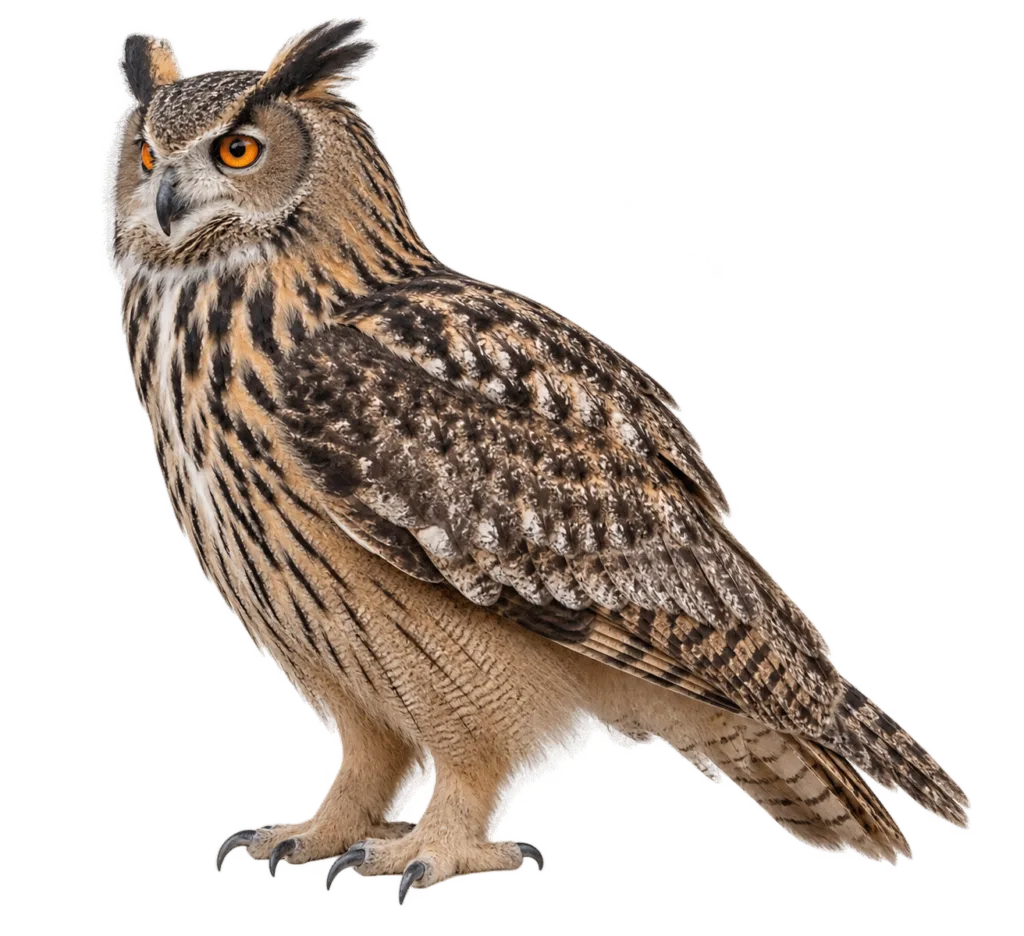
Size at a glance
How big is an Eurasian Eagle-Owl?
Compare
Compare Eurasian Eagle-Owl with another bird
Search by common or scientific name.
Morphology
Detailed measurements
Taxonomy
Classification
The Eurasian Eagle-Owl (Bubo bubo) is built on a much larger scale than most owls, but its size is not captured well by one headline number. Adult measurements vary with sex, population, geography, and the measurement method used. Its broad wings, deep body, large head, feathered legs, and heavy feet also make the bird look bulkier than total length alone suggests.
Its Size Range Is Wider Than a Single Figure Suggests
Published references commonly place adult Eurasian Eagle-Owls at roughly 58–71 cm (23–28 in) in total length, with some regional references extending the upper end to about 75 cm. Wingspan is much greater than body length, commonly falling around 1.5–2.0 m (4.9–6.6 ft) in broad species-level references.
Body mass varies even more. A range of about 1.6–4.2 kg (3.5–9.3 lb) appears in species references that combine birds of different sexes and populations. That large interval is not simply measurement noise. Females are normally larger and heavier, and geographically separated populations do not all have the same body dimensions.
A global species range can combine measurements from many populations, while a national bird database may describe only birds occurring within that region. Sex ratios and the exact definition of a measurement can also shift the reported range. A narrower regional figure does not necessarily conflict with a broader species-wide one.
Females Carry More of the Species’ Mass
The Eurasian Eagle-Owl shows reversed sexual size dimorphism: females are larger than males. Plumage does not provide an equally clear sex difference, so a solitary bird is not reliably sexed just by appearance.
The contrast is especially noticeable in body mass. Hungarian bird data list males at about 1.8–2.8 kg and females at about 2.3–4.2 kg. These are regional figures rather than universal limits, but they show how strongly the two sexes can differ while still overlapping.
The difference is also visible in measured wild birds. In a Swedish sample that excluded emaciated individuals, females averaged about 30% heavier than males. Body condition and season can alter an individual’s mass, so weight should not be treated as a fixed structural measurement in the same way as forearm or bone length.
The Sex Difference Extends Beyond Weight
A morphometric study of 31 sexed Eurasian Eagle-Owls examined external measurements rather than relying on body mass alone. Females had larger mean values for several parts of the body, including the folded wing, forearm, tail, and a major claw measurement.
| Measurement | Male Mean | Female Mean |
|---|---|---|
| Folded wing | 434.1 mm | 455.5 mm |
| Forearm | 187.3 mm | 199.5 mm |
| Tail | 240.8 mm | 254.6 mm |
| First-claw measurement | 44.3 mm | 48.6 mm |
These values came from a defined study sample and should not be turned into global minimum or maximum values. Their value is in showing that female size is expressed across several structures rather than only through extra body weight. The study also found forearm, tail, claw, and other external dimensions useful when distinguishing sex in measured birds.
A Broad, Heavy Shape Adds to the Impression of Size
Body proportions make the Eurasian Eagle-Owl look especially substantial when perched. The head is large, the trunk is deep, and the prominent feather tufts extend the outline above the crown. Those tufts are feathers rather than external ears.
The face is framed by dark-edged tawny plumage, while the underparts are paler and heavily streaked, with finer markings lower on the body. The combination of a large head, upright posture, thick body, and long ear tufts can make a perched bird appear taller than its skeletal dimensions alone would suggest.
In flight the proportions become easier to read. The broad wings dominate the silhouette, while the body appears compact relative to the full span. The ear tufts are much less useful as a shape cue once the bird is airborne.
Wingspan and Wing Length Describe Different Things
Measurement sources sometimes list both a wingspan and a wing measurement, and the two should not be mixed. Wingspan is the distance from one wingtip to the other when both wings are extended. A published wing length or folded-wing measurement describes one wing using a defined anatomical or field-measurement method.
For example, one Eurasian Eagle-Owl reference gives a single-wing length of about 405–515 mm, while species-level wingspan references are around 1.5–2.0 m. Doubling the single-wing figure would not produce a valid wingspan because the width of the body, wing curvature, feather position, and measurement technique are not represented by that calculation.
Total length, wingspan, folded wing, forearm, tail, and body mass are separate measurements. Values from one category should remain in that category rather than being converted into missing measurements.
Geography Can Shift the Expected Measurements
Bubo bubo occupies a very large Eurasian range, and body dimensions are not uniform across it. Morphometric references from different regions report different wing dimensions and body masses, reflecting geographic variation as well as sex.
This is why an adult that falls outside a familiar regional average is not automatically unusually large or small for the species. A measurement is more informative when the bird’s locality and sex are known and when it is compared with data collected using the same method.
Feather condition matters as well. Folded-wing and tail measurements can change with molt, wear, or damage, whereas skeletal dimensions are less affected by feather condition. For a measured Eurasian Eagle-Owl, recording the exact measurement definition alongside the value is therefore as important as recording the number itself.
Data
Measurement sources
- Data status
- Measured
- Size measurements
- AVONET — Tobias et al. (2022)
- Morphology source
- AVONET — Tobias et al. (2022)
- Morphology dataset
- AVONET v7 — BirdLife taxonomy
- Morphology dataset license
- CC BY 4.0
Full source links, dataset definitions, licensing details and measurement methodology are maintained on the Data Sources & Methodology page.