Bird size profile
Eurasian Kestrel
Falco tinnunculus
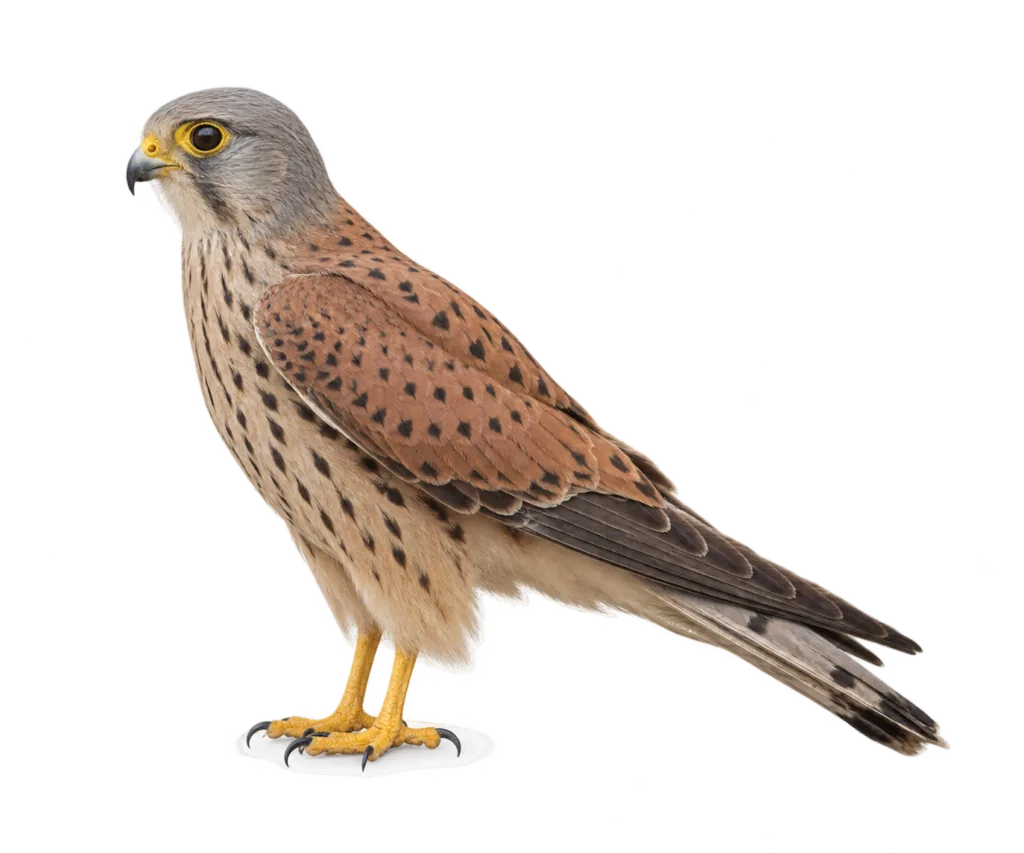
Size at a glance
How big is an Eurasian Kestrel?
Compare
Compare Eurasian Kestrel with another bird
Search by common or scientific name.
Morphology
Detailed measurements
Taxonomy
Classification
The Eurasian Kestrel (Falco tinnunculus) is a small falcon with a body shape that can make it look larger in flight than its mass suggests. Its pointed wings, relatively long tail and light frame produce a stretched silhouette, especially when the bird is hovering with the tail spread.
Published measurements also reveal an important feature that is less obvious from overall length alone: females are larger than males, but the difference is much stronger in body mass than in wing length. That distinction helps explain why two adult kestrels can have similar-looking proportions while differing noticeably in weight.
A Falcon Whose Length Comes Partly From Its Tail
Typical field measurements place the Eurasian Kestrel at roughly 32–35 cm in total length, with a wingspan of about 71–80 cm. These dimensions describe a bird with a fairly compact body surrounded by much longer flight surfaces.
The tail is especially important to the kestrel’s proportions. It extends well beyond the folded wings when the bird is perched and becomes broader when spread during flight. This gives the species a more elongated appearance than body mass alone would suggest.
Females Are Heavier More Than They Are Longer-Winged
Live-bird measurements from Britain and Ireland show the Eurasian Kestrel’s reversed sexual size dimorphism clearly. Adult females averaged 252.8 mm in flattened wing chord, compared with 243.8 mm in males. The difference between those means is 9 mm, or about 3.7% relative to the male mean.
The separation is much larger in body mass. Females in the same biometric dataset averaged 220.5 g, while males averaged 195.9 g. That is a difference of 24.6 g, with the female mean about 12.6% higher.
| Adult Group | Mean Wing Chord | Measured Wing Range | Mean Body Mass | Body-Mass 5th–95th Percentiles |
|---|---|---|---|---|
| Female | 252.8 mm | 235–265 mm | 220.5 g | 159–281 g |
| Male | 243.8 mm | 232–256 mm | 195.9 g | 164–245 g |
| All adults | 247.4 mm | 233–262 mm | 205.5 g | 160–273 g |
This pattern means sex cannot be judged reliably from size alone. The wing measurements overlap substantially, and even body-mass distributions overlap. Plumage becomes more useful in adult birds: males usually show a grey head and grey upper tail, while females are browner and have more extensively barred tails.
Why Wing Chord and Wingspan Should Not Be Mixed
A Eurasian Kestrel may be listed with a wingspan of more than 70 cm while biometric records give a wing measurement near 25 cm. These figures do not conflict because they describe different dimensions.
Wingspan measures the bird from one extended wingtip to the other. Wing chord measures a single folded wing from the wrist area toward the longest primary. In the BTO biometric data, wing length is recorded as maximum flattened chord.
The distinction matters when comparing kestrel records. A field guide may provide overall length, wingspan and a general weight range, while a ringing dataset may report wing chord and live body mass for individual sex or age classes. Combining those numbers as though they were measured in the same way can create misleading size comparisons.
Body Mass Is More Variable Than the Bird’s Frame
Wing length represents a relatively stable structural dimension once a kestrel is fully grown. Body mass is more changeable. Food intake, season, reproductive condition and other short-term influences can alter weight without changing the underlying length of the wings, tail or skeletal frame.
This helps explain why broad species descriptions and live-bird datasets do not always give identical weight limits. A general identification reference may place kestrels around 156–252 g, while larger biometric samples can include adults outside that interval. In the BTO records, the central 90% of measured adult weights extended from about 160 to 273 g, with females showing the broader and heavier distribution.
Female mass can also change around breeding. Research on Eurasian Kestrels has recorded increases in female body mass associated with the period leading into egg laying. A single weight therefore describes the condition of an individual bird at a particular time as well as its underlying body size.
The Hovering Silhouette Shows How the Parts Work Together
The Eurasian Kestrel’s familiar wind-hovering behaviour makes its proportions unusually easy to see. The tail opens and changes angle, the pointed wings continually adjust their shape, and the body can remain in nearly the same position relative to the ground while the bird searches below.
The long tail is not simply extra length added behind the body. It acts as a controllable aerodynamic surface. Small changes in tail spread and orientation work with adjustments of the wings as the kestrel balances lift, drag and pitching forces. The result is the characteristic profile of a narrow-winged falcon suspended over open ground.
Feather structure reflects the demands placed on these flight surfaces. A comparative study of flight-feather mechanics found that the outer primary examined in Falco tinnunculus had particularly high specific bending stiffness after body mass was taken into account. The researchers linked this property to the mechanical forces associated with the kestrel’s hovering flight style.
The combination of low body mass, pointed wings, a long controllable tail and mechanically capable primary feathers is therefore more informative than any single length measurement. Those proportions define the physical form behind the Eurasian Kestrel’s distinctive flight behaviour.
Data
Measurement sources
- Data status
- Measured
- Size measurements
- AVONET — Tobias et al. (2022)
- Morphology source
- AVONET — Tobias et al. (2022)
- Morphology dataset
- AVONET v7 — BirdLife taxonomy
- Morphology dataset license
- CC BY 4.0
Full source links, dataset definitions, licensing details and measurement methodology are maintained on the Data Sources & Methodology page.