Bird size profile
Galah
Eolophus roseicapilla
Size at a glance
How big is a Galah?
Compare
Compare Galah with another bird
Search by common or scientific name.
Morphology
Detailed measurements
Taxonomy
Classification
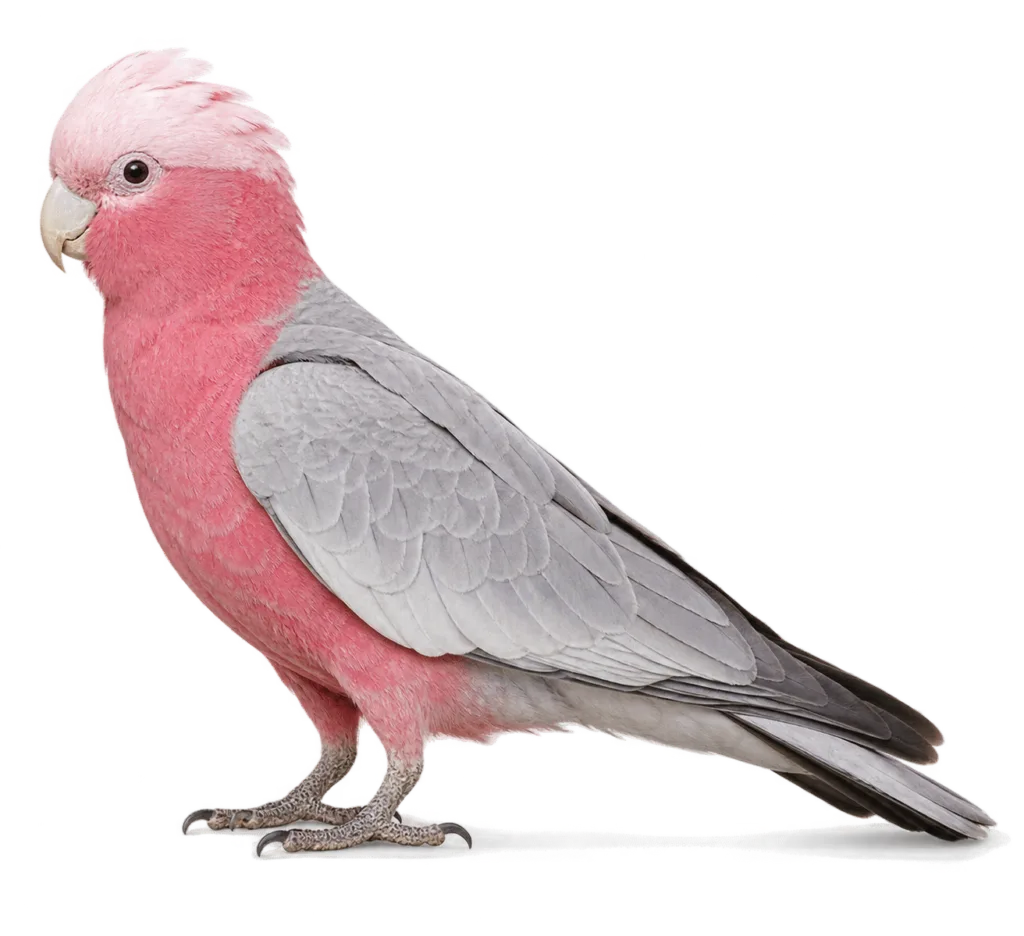
The Galah (Eolophus roseicapilla) is a compact Australian cockatoo about 35–36 cm (13.8–14.2 in) long. Its rounded head, short crest, deep hooked bill and fairly solid body give it a heavier appearance than its length alone may suggest. With the wings fully spread, the bird reaches roughly 75 cm (29.5 in) across.
Adult size is not identical across the species. Males tend to be heavier and have slightly longer wings and tails, but the ranges overlap enough that an individual Galah cannot be reliably sexed from body size alone. Region also matters, especially when body mass from different populations is compared.
Galah Body Measurements
Measurements taken from adult birds show where most of the size difference between the sexes appears. Total body length changes little, while mass and wing measurements show more separation.
| Measurement | Male | Female |
|---|---|---|
| Body length | About 350–360 mm | About 350–360 mm |
| Body weight | 273–380 g | 200–350 g |
| Wing chord | 256–279 mm | 244–274 mm |
| Tail length | 139–156 mm | 136–151 mm |
The weight ranges are particularly broad. Another published dataset gives average adult masses of about 345 g for males and 311 g for females. Measurements from Western Australian birds produced lower averages of about 327 g for males and 290 g for females. These figures show why a single body weight should not be treated as the normal weight of every Galah.
Wing chord is measured on a folded wing from the wrist joint to the end of the longest primary feather. A Galah wing chord of roughly 24–28 cm therefore does not conflict with a wingspan of about 75 cm. Wingspan measures the distance from one extended wingtip to the other.
Why the Galah Looks Compact
The Galah has a relatively short crest rather than a long projecting one. When the crest is lowered, the head keeps a smooth, rounded profile. Raising it changes the outline of the crown but does not add much apparent height to the bird.
The folded wings are long in relation to the body. Adult wing chords extend from about 244 mm at the lower end of the female range to 279 mm at the upper end of the male range. The grey flight feathers therefore form a large part of the visible side and back of a perched bird.
The tail is more moderate in length. Recorded adult measurements run from about 136 to 156 mm. Its fairly straight outline continues the grey upperparts and does not give the Galah the long-tailed shape seen in many smaller Australian parrots.
The bill is pale, strongly curved and broad at its base. Together with the rounded head and full chest, it reinforces the stocky cockatoo profile. Grey legs are fairly short and are often partly hidden by the lower body feathers when the bird is resting.
Male and Female Galahs Overlap in Size
Male Galahs are generally the larger sex, but the difference is modest rather than absolute. A male wing chord can reach about 279 mm compared with about 274 mm in females, while male tails extend to around 156 mm compared with 151 mm in females. The lower and middle parts of these ranges overlap extensively.
Eye colour is therefore more useful than size when distinguishing mature males and females. The plumage pattern itself is very similar between the sexes. Both carry the familiar rose-pink face, neck and underparts with grey wings, back and tail.
Body mass should be used with even more care. The published female range reaches 350 g, while some males fall below 300 g. A heavy female can therefore outweigh a light male. Population, condition and the individual bird all affect where it falls within the recorded range.
Juveniles Can Look Different Without Being Much Smaller
Young Galahs are often easier to distinguish by feather and eye characteristics than by overall proportions. Juveniles have duller plumage, with more grey mixed through areas that become cleaner pink in adults. The crown and crest can also look greyer.
The eyes add another age clue. Young birds may have brown irises rather than the more obvious adult female pink-to-red iris. Their bare eye rings are also smoother and paler than those of mature birds. This means the adult iris difference between the sexes is less useful when dealing with an immature Galah.
A juvenile that has nearly reached adult body dimensions can still look less bold in colour and slightly softer in outline because of its plumage. Apparent size in a photograph can therefore be misleading when age, posture and feather condition are unknown.
Regional Forms Add Some Variation
Three subspecies are currently recognized in widely used bird taxonomies: E. r. roseicapilla in western Australia, E. r. albiceps in the east and E. r. kuhli across northern Australia.
The differences are not mainly about dramatic changes in body proportions. Crest colour and shape, plumage tone and the appearance of the bare skin around the eye vary among the regional forms. Northern kuhli is also described as somewhat smaller than the other forms.
This regional variation helps explain why measurements collected in one part of Australia do not always match averages from another population. Western Australian weight data, for example, give lower mean masses than some broader datasets even though the birds still fall within the normal Galah size class.
Reading Galah Size in the Field
A perched Galah presents a compact outline: rounded head, short crest, solid chest, long folded wings and a medium-length tail. When it takes flight, the visual impression changes. The wings open to roughly 75 cm across, making the bird appear much larger than its 35–36 cm body length suggests.
Posture can alter the apparent dimensions even before the wings open. A raised crest increases the height of the head, loose body feathers make the chest look fuller, and a crouched bird can hide much of its legs. For measurement-based identification, fixed features such as body length, wing chord and tail length are more useful than apparent size in a single pose.
Data
Measurement sources
- Data status
- Measured
- Size measurements
- AVONET — Tobias et al. (2022)
- Morphology source
- AVONET — Tobias et al. (2022)
- Morphology dataset
- AVONET v7 — BirdLife taxonomy
- Morphology dataset license
- CC BY 4.0
Full source links, dataset definitions, licensing details and measurement methodology are maintained on the Data Sources & Methodology page.