Bird size profile
Gentoo Penguin
Pygoscelis papua
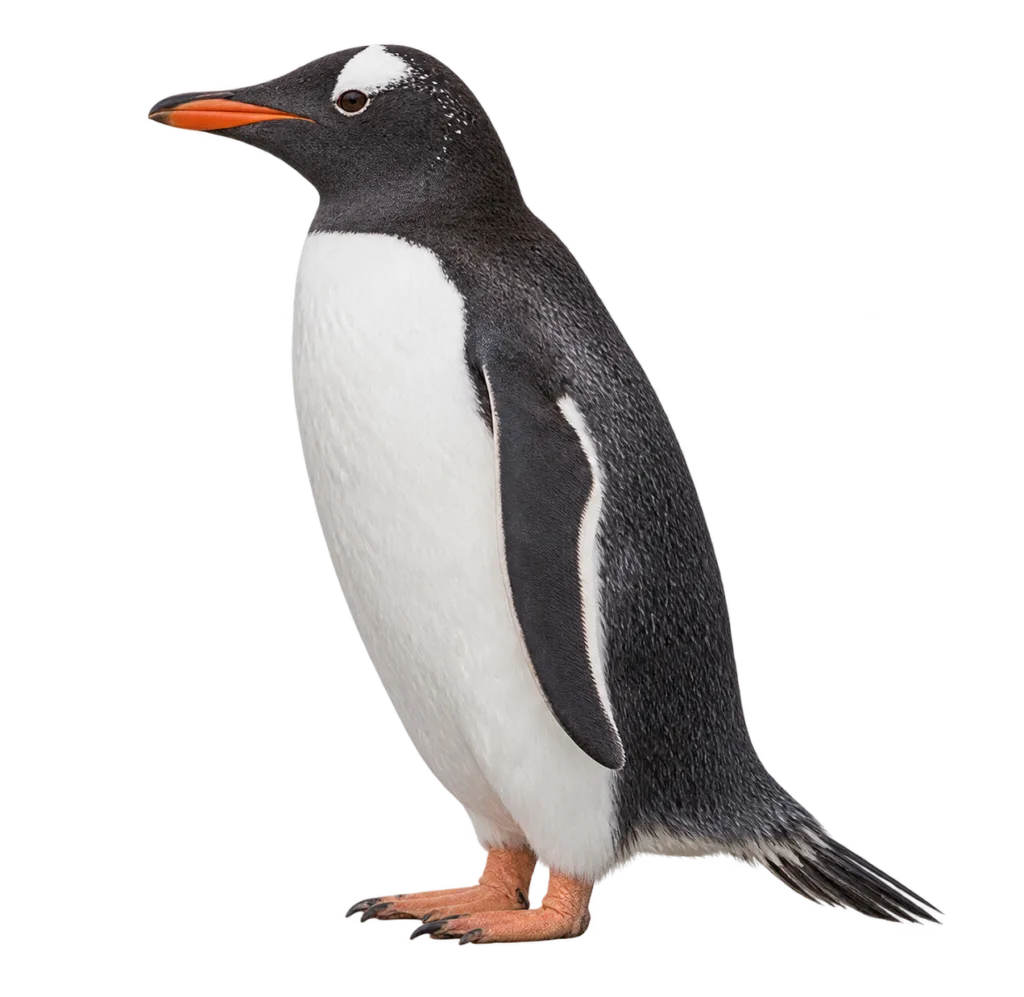
Size at a glance
How big is a Gentoo Penguin?
Compare
Compare Gentoo Penguin with another bird
Search by common or scientific name.
Morphology
Detailed measurements
Taxonomy
Classification
The Gentoo Penguin, Pygoscelis papua, is a tall, sturdy penguin with a body shape that can look deceptively uniform from one colony to another. Published size figures span a broad range because body mass changes through the breeding cycle and because gentoo populations from different parts of the Southern Ocean are not identical in body size. A useful general reference for adults is about 75 cm in standing height, while adult mass commonly falls around 5–8 kg.
Why Gentoo Penguin Size Is Not One Fixed Number
A single height or weight cannot describe every adult gentoo well. Birds from different geographic populations vary in skeletal dimensions, bill proportions and other measurements. Antarctic Peninsula birds tend to be smaller, while birds from the Falkland Islands are among the larger forms measured in morphological studies.
This geographic variation matters when interpreting unusually low or high published measurements. The numbers may describe different breeding populations rather than conflicting measurements of an otherwise uniform bird.
The Gentoo Silhouette Is Tall, Deep-Bodied and Rear-Heavy
On land, the gentoo has a fairly long upright profile, a full chest and abdomen, and relatively large feet set toward the rear of the body. That rearward leg position is part of the familiar penguin stance: the torso remains almost vertical while the bird walks.
The flippers are narrow and flattened rather than wing-shaped in the form seen in flying birds. When held beside the body they add little to the apparent width of a standing gentoo, so most of its visible bulk comes from the torso. The head is comparatively compact, followed by a short neck that blends smoothly into the chest.
Body mass also affects appearance. A heavier adult can look much broader through the lower chest and abdomen without becoming noticeably taller. This is one reason visual estimates of gentoo size can be misleading when birds are viewed separately rather than measured.
The Brush Tail Changes the Bird’s Visible Length
One of the most useful structural features of a gentoo is its conspicuous tail. The genus name Pygoscelis refers to the brush-tailed penguins, and the gentoo has a particularly noticeable cluster of stiff tail feathers projecting behind the body.
The tail often points backward and slightly downward while the bird is walking. It can therefore make a side-view bird appear longer than expected from its upright height alone. This distinction matters when comparing published figures described as height, body length or total length. Those terms should not automatically be treated as interchangeable measurements.
Standing height describes the vertical size of an upright bird. Total-length measurements may follow a different anatomical reference and can include structures such as the bill or tail. A value should be kept with the measurement definition used by its original dataset.
Male and Female Gentoos Overlap Strongly in Size
Males tend to be larger than females, but the difference is not large enough to make sex obvious from body size alone. Monitoring information from Antarctic gentoo colonies places adult males around 5.5–6.5 kg and adult females around 5.0–6.0 kg. The overlap between those ranges is substantial.
Bill and flipper measurements can also differ between the sexes on average, yet individual variation reduces their usefulness as simple visual sex markers. Research using known-sex birds has found that morphology by itself leaves many individuals in an overlapping middle range.
Geographic Form Has a Measurable Effect on Gentoo Proportions
Gentoo Penguins occur across a wide arc of sub-Antarctic islands and the Antarctic Peninsula, and their isolation among breeding regions has produced measurable morphological variation. Modern studies have found differences not only in general size but also in structures such as the culmen, tarsus, toes and parts of the flipper.
Research comparing major geographic lineages found the Falkland population larger across many measurements, while birds from the South Shetland Islands and western Antarctic Peninsula occupied the smaller end of the measured range. South Georgia and Indian Ocean populations often fell between those extremes.
This variation has become especially relevant to gentoo taxonomy. Genetic and morphological work published in 2020 argued that several regional lineages could merit species status. A broader genomic and morphological study published in 2026 again proposed recognizing four gentoo species. Major reference systems have not all adopted the same treatment, so Gentoo Penguin and Pygoscelis papua may still be used in a broad sense in many datasets.
A measurement from an Antarctic Peninsula bird should not automatically be treated as a universal value for every population traditionally placed under Pygoscelis papua. Geographic origin is useful context whenever a study reports detailed morphometrics.
Bill, Feet and Head Markings Shape the Gentoo Profile
The bill is moderately long and pointed, with strong orange to red-orange coloration and a dark tip. Its length and depth contribute noticeably to the side profile of the head. Bill dimensions also vary geographically, which is one reason detailed studies record the culmen and bill depth separately rather than describing the bill with a single size figure.
The feet are broad and orange-pink to orange. Their size is easy to notice because the lower legs are short and much of each foot remains visible when the bird stands. On uneven rock, snow or beach substrate, the wide foot spreads the bird’s weight across a larger contact area.
The head carries the gentoo’s most recognizable plumage feature: a white patch above and behind each eye that meets across the top of the head. Adults otherwise have a dark head and back with a sharply contrasting white underside. A narrow pale edge along parts of the flipper can also be visible at close range.
Body Mass Can Change Without a Change in Structural Size
Weight should be interpreted differently from measurements based on bones or external body dimensions. An adult’s skeletal size is stable, but mass can rise or fall as energy reserves change. Breeding stage, feeding success and molt can therefore affect a recorded weight without altering the bird’s height, bill length or limb dimensions.
This is why a mass range is usually more informative than treating one average as the expected weight of every adult. An adult near 5 kg and another approaching 8 kg can both fall within published gentoo values even though their body condition, sex or geographic origin may differ.
Young birds introduce another layer of variation. Long-term monitoring of gentoo chicks has recorded fledging masses around the same general scale as some adults, showing why body mass alone cannot describe age or mature body structure. Plumage, proportions and developmental stage remain necessary when interpreting the size of an immature bird.
How Gentoo Measurements Should Be Read
| Measurement | What It Describes | Interpretation |
|---|---|---|
| Standing height | Vertical size of an upright bird | Useful for visual scale, but dependent on posture and measurement method. |
| Body mass | The bird’s weight at the time it is measured | Changes with sex, condition, breeding stage and location. |
| Culmen length | Length of the upper ridge of the bill | A standard morphometric measurement used in population and taxonomic work. |
| Flipper measurement | A defined dimension of the modified wing | The exact method matters; flipper length and flipper width are different measurements. |
| Tarsus or foot measurements | Dimensions of the lower limb or foot | Useful in detailed morphometric studies and in detecting geographic size variation. |
| Total length | Length recorded between specified anatomical endpoints | Should not be substituted for standing height unless the source defines the measurements as equivalent. |
The broad spread of published gentoo measurements is therefore biologically meaningful rather than a reason to choose one extreme as the definitive size. Population, sex, condition and measurement method all affect the number being reported, while the bird’s tall stance, deep body and prominent brush tail determine how that size appears in the field.
Data
Measurement sources
- Data status
- Measured
- Size measurements
- AVONET — Tobias et al. (2022)
- Morphology source
- AVONET — Tobias et al. (2022)
- Morphology dataset
- AVONET v7 — BirdLife taxonomy
- Morphology dataset license
- CC BY 4.0
Full source links, dataset definitions, licensing details and measurement methodology are maintained on the Data Sources & Methodology page.