Bird size profile
Giant Hummingbird
Patagona gigas
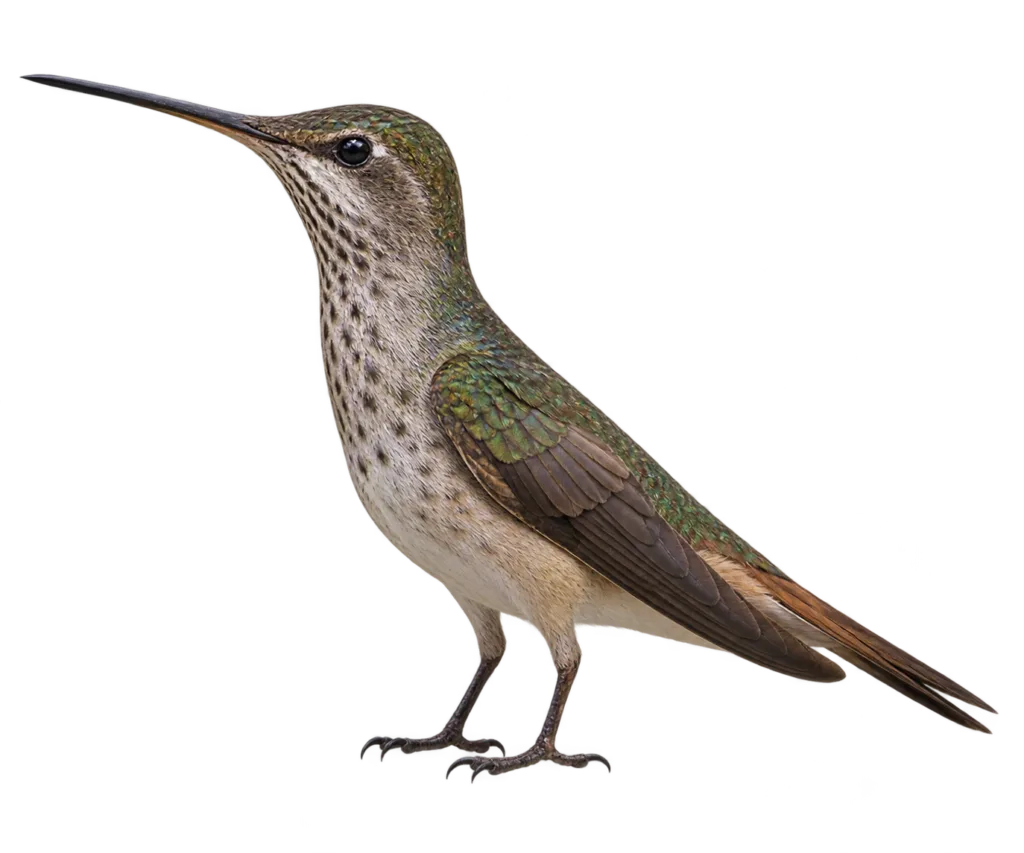
Size at a glance
How big is a Giant Hummingbird?
Compare
Compare Giant Hummingbird with another bird
Search by common or scientific name.
Morphology
Detailed measurements
Taxonomy
Classification
The name Giant Hummingbird has become more precise than it once was. Birds long grouped under Patagona gigas are now recognized as two closely related species: the Northern Giant Hummingbird, Patagona peruviana, and the Southern Giant Hummingbird, Patagona gigas. That change matters for any discussion of size because measurements collected under the older single-species treatment can combine birds that belong to different lineages.
Why “Giant Hummingbird” No Longer Means One Species
For much of ornithological history, giant hummingbirds from the Andes were treated as one species with northern and southern forms. Their appearance helped maintain that interpretation. Both are large, long-winged hummingbirds with subdued brown, cinnamon, grey and green tones, and the differences between individual birds can be subtle.
Genomic, migration, physiological and morphological research changed that picture. The northern and southern lineages were found to have diverged roughly 2.1 to 3.4 million years ago. Their movements also differ sharply. Northern Giant Hummingbirds are high-elevation residents, while Southern Giant Hummingbirds include populations that make long seasonal movements through the Andes.
The northern species was described as Patagona chaski in 2024. Later work revisited the older name peruviana, first published in 1893. Under zoological naming priority, Patagona peruviana is now used for the Northern Giant Hummingbird, while Patagona chaski is treated as a junior synonym. Patagona gigas remains the name of the Southern Giant Hummingbird.
Older books and databases may therefore use “Giant Hummingbird” for a much broader population than newer taxonomic treatments do. A measurement attached to that older name does not always reveal which modern species was actually measured.
The Largest Body Plan in the Hummingbird Family
Giant hummingbirds occupy the extreme upper end of hummingbird size. Their mass is measured in tens of grams rather than the few grams typical of many smaller hummingbirds, and their long wings, tail and bill make them look especially large in profile.
The Northern Giant Hummingbird is now regarded as the largest living hummingbird species. Measurements from recent studies show that northern birds average larger than Southern Giant Hummingbirds in several external dimensions, including bill length, wing chord, tail length and tarsus length.
The difference is not a simple matter of one species always being visibly bigger. Measurements overlap extensively. The average differences in bill, wing and tail dimensions are often only a few millimetres, and the two species have strongly overlapping body-mass distributions.
This is why a long wing or unusually large individual cannot, by itself, establish whether a bird belongs to the northern or southern species.
A Long, Light Shape Rather Than a Bulky One
The word “giant” can give the wrong impression of the bird’s proportions. Giant hummingbirds are not heavy-bodied birds with short appendages. Much of their apparent size comes from an elongated structure: a long straight bill, long wings and an extended tail surrounding a relatively light body.
These proportions also explain why total length can be misleading when judging how much a bird actually weighs. A long bill and tail can add centimetres without adding much mass.
Large Wings Change the Look of Its Flight
Giant hummingbirds retain the hovering ability associated with the family, but their wing movement looks different from that of many small hummingbirds. Reported hovering rates are around 15 wingbeats per second, slow enough for the individual wing strokes to be easier to perceive than the blur produced by much smaller species.
Their elongated wings also permit brief gliding, an unusual behavior among hummingbirds. This gives a flying Giant Hummingbird a different visual rhythm: bursts of active flapping can be interrupted by movement that looks more like conventional forward flight.
Wing size becomes especially relevant in the Andes. Air becomes thinner as elevation rises, reducing the amount of lift generated by each wing movement. Larger wing surfaces help compensate for that challenge. The northern species spends the year at high elevations, while tracked Southern Giant Hummingbirds have shown very large seasonal changes in elevation.
Why Published Measurements Do Not Always Match
Conflicting Giant Hummingbird measurements are not necessarily errors. Several sources of variation are mixed together in the historical record.
The identification problem is visible even in museum collections. A modern review of hundreds of specimens found many historical birds labelled as the northern form that actually belonged to the Southern Giant Hummingbird. This helps explain why some older geographical and measurement ranges appear cleaner than the newer evidence supports.
Modern measurements show a real average size difference between the two species, but not a sharp boundary. Even when males and females are analysed separately, external dimensions identify only a portion of individuals reliably. Size is therefore most useful as part of a broader identification rather than as a stand-alone test.
What the Species Split Changed About the Size Record
Before the split, Patagona gigas was routinely described simply as the world’s largest hummingbird. That statement now needs a taxonomic qualifier. The largest individuals belong to the northern lineage now called Patagona peruviana, making the Northern Giant Hummingbird the largest recognized hummingbird species. The Southern Giant Hummingbird, Patagona gigas, remains exceptionally large but averages slightly smaller in several structural measurements.
The distinction is more useful than replacing one old size figure with two rigid numbers. Giant hummingbirds vary individually, their measurement ranges overlap, and much of the older literature was assembled before researchers could reliably separate the two lineages. Current size data are best read with the species name, sex, measurement method and geographical origin kept attached to the original observation.
Data
Measurement sources
- Data status
- Measured
- Size measurements
- AVONET — Tobias et al. (2022)
- Morphology source
- AVONET — Tobias et al. (2022)
- Morphology dataset
- AVONET v7 — BirdLife taxonomy
- Morphology dataset license
- CC BY 4.0
Full source links, dataset definitions, licensing details and measurement methodology are maintained on the Data Sources & Methodology page.