Bird size profile
Gray Heron
Ardea cinerea
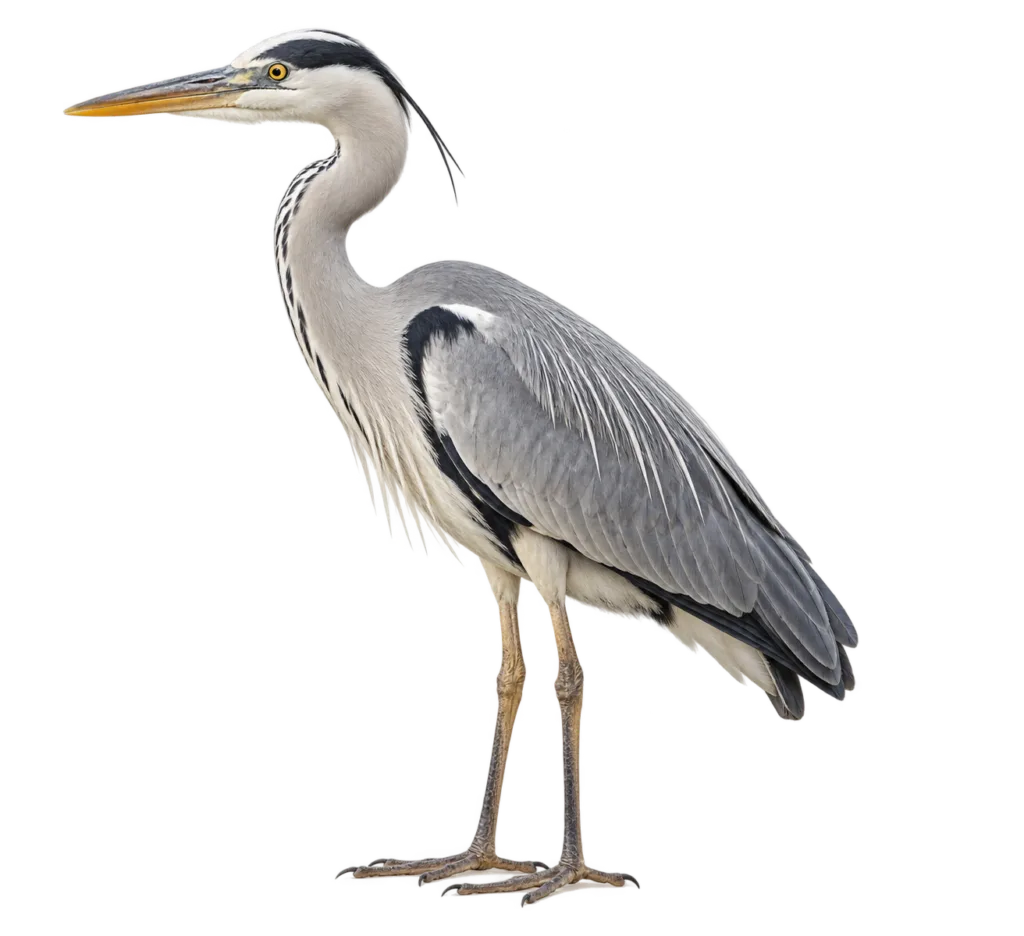
Size at a glance
How big is a Gray Heron?
Compare
Compare Gray Heron with another bird
Search by common or scientific name.
Morphology
Detailed measurements
Taxonomy
Classification
The Gray Heron (Ardea cinerea), also spelled Grey Heron in many international bird references, is a large, long-limbed heron whose proportions can make its size difficult to judge from a photograph or a distant view. Adult length is commonly given as about 90–98 cm (35–39 in), while the wings can span roughly 175–195 cm (69–77 in). Body mass is often around 1–2 kg (2.2–4.4 lb). These measurements describe very different parts of the bird, and its changing neck posture alters how large it appears.
Why 90–98 cm Does Not Equal Standing Height
Body length in a heron is not the same measurement as height from the feet to the top of the head. Standard bird length runs from the tip of the bill to the tip of the tail with the body positioned for measurement. A Gray Heron’s long neck contributes heavily to that figure.
The difference is easy to see in the field. While watching prey, a heron may extend its neck until the head sits well above the body. Moments later it can pull the neck back into a compact S-shaped position. The legs have not changed and the body has not changed, yet the bird’s apparent height can shrink sharply.
This flexibility is one reason that photographs are poor tools for estimating exact size. A bird with its neck fully extended can look much larger than one resting with its head drawn toward its shoulders.
A Near-Two-Metre Wingspan on a Much Shorter Body
The wings create a different sense of scale. A typical published wingspan of 175–195 cm means a large adult can approach two metres from wingtip to wingtip. The wings are broad and rounded rather than narrow, giving the flying bird a wide silhouette.
Gray Herons fly with the neck folded back and the long legs trailing behind the tail. This posture concentrates the head and neck close to the body while leaving the full width of the wings exposed. As a result, a bird that looks relatively slim while standing can appear much larger once airborne.
Published biometric studies may list the length of one folded or flattened wing in millimetres. That figure should not be doubled and treated as wingspan. A measured wing chord follows one wing, while wingspan is the full distance between the tips of both extended wings. The measuring positions and structures included are different.
Mass Varies More Than the Skeleton Suggests
A practical adult weight range is about 1,000–2,000 g, although datasets do not all produce identical limits. One specimen-based reference reports an average near 1.44 kg within a range extending a little above 2 kg.
Weight is naturally more variable than fixed structural measurements. Feeding condition, season, time of day and individual condition can all affect the number on a scale. A heavier Gray Heron therefore does not necessarily have proportionally longer wings, legs or bill.
The bird can also appear heavier than it is. Its deep folded wings, long scapular feathers and retracted neck produce a bulky outline when resting. When the neck is stretched and the body feathers lie flatter, the same individual looks considerably leaner.
Male and Female Size Overlap
Male and female Gray Herons have very similar plumage, so body size offers more information about sex than color does. Males tend to be larger on average, but the difference is modest and there is substantial overlap between the sexes.
Measurements are most useful at the extremes. An adult sexing reference uses a wing measurement above 475 mm or a bill above 125 mm as male-side measurements, while a wing below 430 mm or a bill below 109 mm falls at the female-side extreme. Intermediate birds cannot be assigned reliably from those measurements alone.
This makes visual sexing especially uncertain. Distance, posture and viewing angle can easily create a size difference larger than the average physical difference between a male and a female.
Why Published Gray Heron Measurements Differ
Not every reference uses exactly the same limits. Some sources give the species a broader body-length range of about 84–102 cm, while widely used European references commonly use 90–98 cm. Wingspan figures also vary, with 175–195 cm appearing frequently but broader datasets sometimes extending below that range.
These differences do not require one source to be wrong. Measurements may come from different geographic populations, age classes, sexes or sample sizes. Authors can also use different measurement techniques or combine records collected under different conditions.
For a general adult size reference, 90–98 cm in length, roughly 175–195 cm in wingspan and about 1–2 kg in mass describe the scale of the species well. Broader published limits are better treated as evidence of natural and methodological variation rather than as a single rigid boundary.
Proportions Explain the Gray Heron’s Apparent Size
The Gray Heron is built around reach rather than a deep, heavy torso. Much of its visible size comes from the long neck, long tarsi and toes, pointed bill and broad wings. The central body is comparatively compact when those structures are mentally removed.
The neck can remain folded while the bird walks and then extend rapidly when prey comes within range. Long legs allow the body to stay above shallow water, while the extended toes spread support over soft or uneven ground. The straight bill adds another long projection in front of the head.
This arrangement also explains why a single measurement never captures the bird particularly well. Length emphasizes the bill and neck, wingspan emphasizes the flight surface, and body mass describes a relatively lean body supported by unusually long appendages. The proportions, more than any one number, create the familiar tall and wide silhouette of Ardea cinerea.
Data
Measurement sources
- Data status
- Measured
- Size measurements
- AVONET — Tobias et al. (2022)
- Morphology source
- AVONET — Tobias et al. (2022)
- Morphology dataset
- AVONET v7 — BirdLife taxonomy
- Morphology dataset license
- CC BY 4.0
Full source links, dataset definitions, licensing details and measurement methodology are maintained on the Data Sources & Methodology page.