Bird size profile
Gray Parrot
Psittacus erithacus
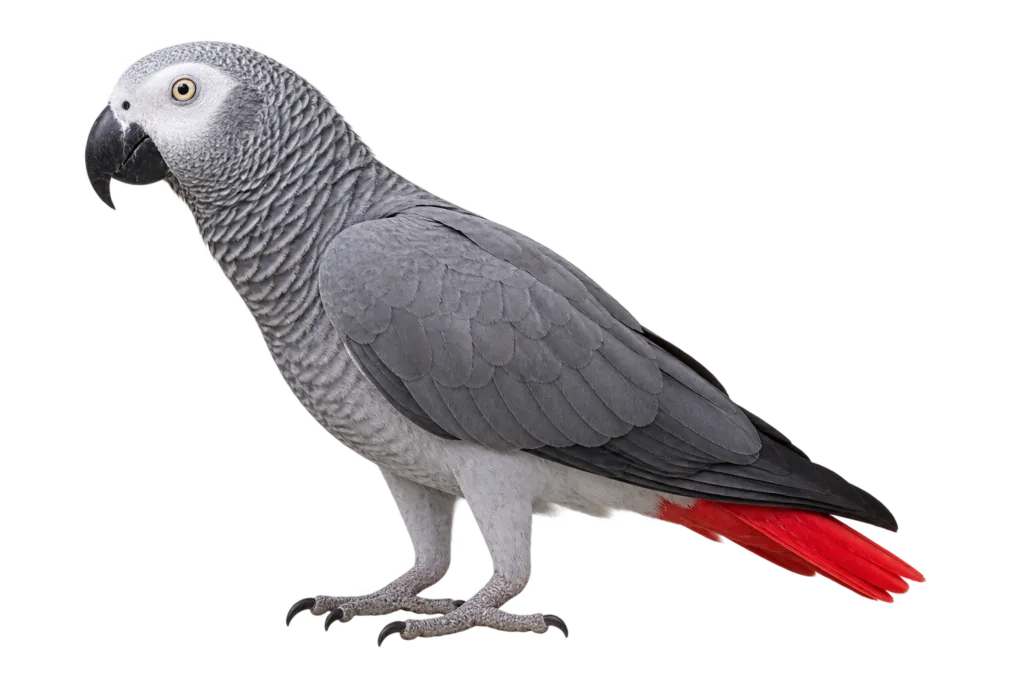
Size at a glance
How big is a Gray Parrot?
Compare
Compare Gray Parrot with another bird
Search by common or scientific name.
Morphology
Detailed measurements
Taxonomy
Classification
The Gray Parrot, Psittacus erithacus, is a compact, heavy-bodied parrot rather than a long, slender one. An adult is commonly reported at about 33 cm (13 in) in total length and around 400 g (14 oz) in body mass, while the spread wings span roughly 46–52 cm (18–20 in). Those figures describe different dimensions of the bird, and each reveals something different about its proportions.
Why a 33 cm Gray Parrot Looks Larger Than the Number Suggests
Total length measures the bird from the front of the head or bill area to the tip of the tail. For the Gray Parrot, much of that length belongs to a deep torso, broad head, and sturdy neck rather than an extended tail.
This gives the species a noticeably dense silhouette. The tail is fairly short compared with those of many long-tailed parrots, so a Gray Parrot can look more substantial than another bird of similar total length whose measurement includes many centimeters of narrow tail feathers.
The folded wings also cover a large portion of the sides and back. When perched, the bird therefore appears broad through the shoulder and chest instead of elongated. Its upright stance adds vertical height without making the body look thin.
A bird with a long tail can have a greater total length while carrying much less body mass. Gray Parrot size is better understood by looking at length together with weight and body proportions rather than treating length alone as a measure of how large the bird is.
Body Mass Shows How Solidly Built the Species Is
A reference weight near 400 g fits the Gray Parrot’s compact shape. The body is muscular and relatively full through the breast, while the head and bill are large in relation to total length.
Weight should not be interpreted as one fixed number for every adult. Individual birds vary, and published references may use a typical value, an average from a particular sample, or a wider observed range. Body condition, age, geographic population, and the way birds were sampled can also affect reported figures.
For size comparison purposes, the useful point is that the Gray Parrot belongs to a substantially heavier build than its 33 cm length might imply. A realistic scale model should therefore preserve body depth and head size rather than stretching the bird into a narrow profile to match its measured length.
The Wings Create a Wider Shape in Flight
Published references commonly place the Gray Parrot’s wingspan at approximately 46–52 cm (18–20 in). Wingspan is measured across the extended wings and should not be confused with the length of a single folded wing.
The difference matters because ornithological sources may also report measurements such as wing chord. Wing chord describes one wing and is taken in a different way. It cannot be substituted for full wingspan without introducing an artificial value.
With the wings folded, much of their length is visually compressed against the body. Once extended, the bird becomes much wider than its perched profile suggests, but it retains the broad, compact proportions typical of a strong-flying forest parrot.
The Head and Bill Account for Much of Its Visual Weight
The Gray Parrot has a large rounded head and a powerful black bill. The upper mandible curves strongly downward over the shorter lower mandible, creating a deeper facial profile than the pointed bill of many similarly sized birds.
A pale, largely bare facial area surrounds the eye and separates the bill visually from the gray plumage. In adults, the iris becomes pale to yellowish, while younger birds have darker eyes. These color changes alter the appearance of the face but do not change the basic heavy-headed proportions of the species.
The neck is relatively short and often hidden beneath the contour feathers. As a result, the head can appear to join almost directly to the body when the feathers are relaxed. A bird holding its neck extended may look longer and slimmer even though its actual skeletal dimensions have not changed.
Feet and Perching Posture Affect Apparent Height
Like other parrots, the Gray Parrot has zygodactyl feet, with two toes directed forward and two backward. The legs themselves are not especially long, and much of their upper portion can disappear beneath the belly feathers when the bird is standing normally.
This means photographs can give very different impressions of height. A relaxed bird may crouch low over a perch, while an alert bird can straighten its legs and body and appear noticeably taller. Feather position creates another source of visual variation: fluffed plumage increases apparent width without changing the bird’s underlying body size.
For accurate visual comparison, a neutral standing posture with settled feathers is more representative than a stretched, crouched, or heavily fluffed pose.
Gray Parrot and Timneh Measurements Should Not Be Combined
Older references often used “African grey parrot” broadly enough to include what is now recognized as the Timneh Parrot, Psittacus timneh. Modern bird classifications treat the Gray Parrot and Timneh Parrot as separate species. This matters in a size database because the Timneh is smaller.
The difference of only a few centimeters in reference length can appear modest on paper, but the lower body mass of the Timneh produces a visibly smaller bird. Measurements from older material that treated Timneh as a form of the Gray Parrot can therefore broaden or distort size ranges if they are transferred directly into a modern P. erithacus profile.
Why Gray Parrot Size Figures Vary Between References
Published measurements do not always represent the same thing. One source may provide a rounded species reference such as 33 cm and 400 g, while another may report measurements from individual birds or specimens. Neither approach automatically makes the other incorrect.
- Total length can vary slightly with posture and the condition of the tail feathers.
- Body mass varies naturally among individuals and can change over time.
- Wingspan requires the wings to be extended and is different from wing chord.
- Older measurements may include birds now assigned to the separate Timneh Parrot.
- Rounded reference figures are intended to describe normal species size rather than every possible individual.
For a scale comparison, the most representative Gray Parrot is therefore not an unusually large or small individual but an adult with the species’ normal compact proportions: a body around one-third of a meter in total length, substantial mass for that length, a broad head with a heavy bill, folded wings covering much of the torso, and a short scarlet tail.
Data
Measurement sources
- Data status
- Measured
- Size measurements
- AVONET — Tobias et al. (2022)
- Morphology source
- AVONET — Tobias et al. (2022)
- Morphology dataset
- AVONET v7 — BirdLife taxonomy
- Morphology dataset license
- CC BY 4.0
Full source links, dataset definitions, licensing details and measurement methodology are maintained on the Data Sources & Methodology page.