Bird size profile
Great Egret
Ardea alba
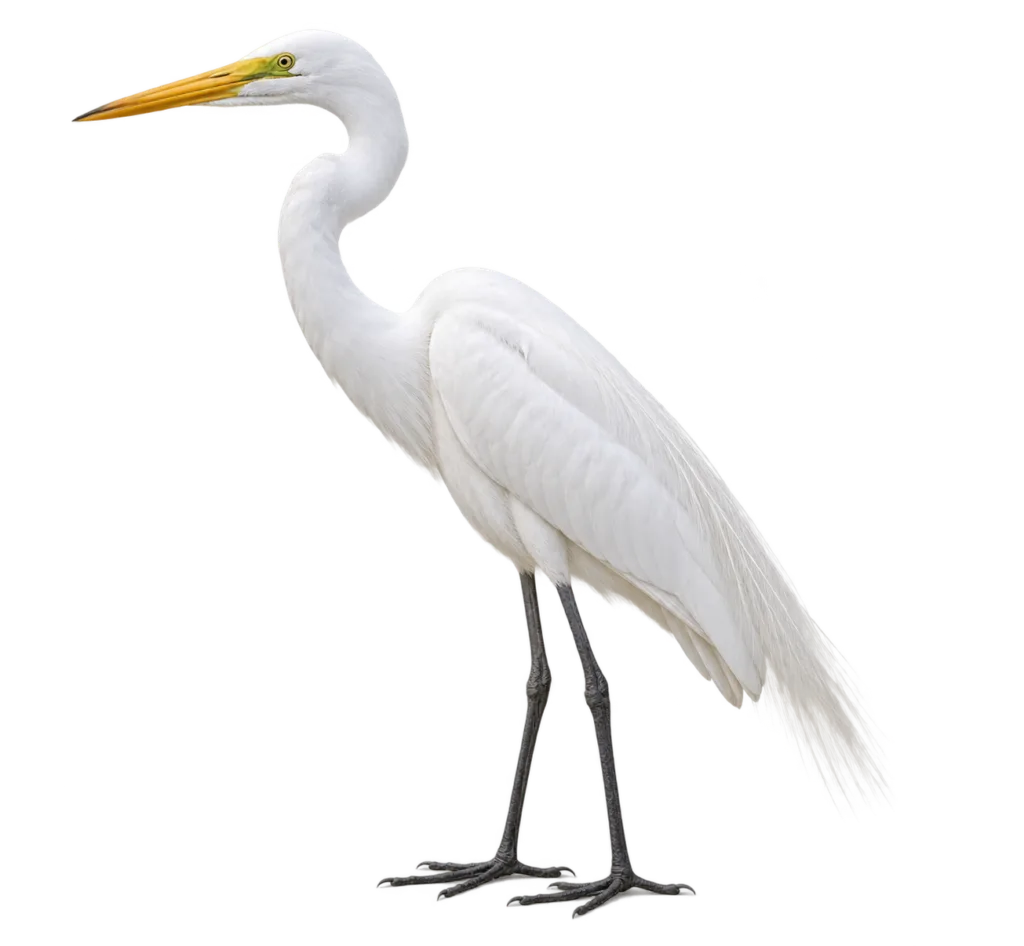
Size at a glance
How big is a Great Egret?
True-scale visual
Great Egret compared with a 175 cm person
When a transparent species asset and body-length data are available, BirdSize places the real bird asset and the fixed human reference on one mathematical centimetre scale.
Compare
Compare Great Egret with another bird
Search by common or scientific name.
Morphology
Detailed measurements
Taxonomy
Classification
The Great Egret, Ardea alba, has the proportions of a large heron compressed into an unusually slender white form. Its long neck, long legs, narrow body, and pointed bill make it look taller and more delicate than its mass alone would suggest. That impression changes sharply when the bird folds its neck for flight or spreads its broad wings.
A Large Bird Built Mostly From Length
Common measurements for Great Egrets in North America place body length at about 94–104 cm (37–41 in) and wingspan at roughly 131–145 cm (52–57 in). Body mass is often close to 1,000 g (2.2 lb), although weight varies among individuals, regions, seasons, and datasets.
Those figures describe a bird that is visually large without being heavy-bodied. Much of its apparent size comes from structures that add reach rather than bulk: the neck, bill, lower legs, and toes. The torso itself is relatively narrow. When the neck is fully extended, the bird can look strikingly tall; when the same neck is folded into its resting S-shape, the body appears far more compact.
Published body length and the height of a standing Great Egret are not interchangeable measurements. Neck posture changes constantly, so the distance from the ground to the top of the head can vary greatly even though the bird’s actual body dimensions have not changed.
The Neck Changes the Bird’s Apparent Size
The neck is one of the most distinctive parts of Great Egret morphology. It is long enough to form a deep S-shaped curve when relaxed, then extends rapidly during a feeding strike. This flexibility means photographs of two Great Egrets can give very different impressions of body length even when the birds are similar in actual size.
The head is relatively small compared with the total reach of the neck. From it projects a long, straight, spear-shaped bill. The combination produces a narrow front profile rather than the broad-headed appearance expected from a bird with such a large wingspan.
Long legs continue the same structural pattern. Much of the visible leg lies below the feathered body, placing the torso well above the ground or shallow water. Long toes spread the foot over a wider area and add further length without adding much visual bulk.
Its Flight Shape Looks Much Shorter
A Great Egret does not normally fly with its long neck stretched forward. Instead, the neck retracts and folds back toward the shoulders. This removes one of the bird’s longest visible dimensions from the silhouette.
The wings then become the dominant feature. They are broad and rounded, producing a span far greater than the apparent length of the compact body beneath them. The legs remain extended behind the short tail, often projecting clearly beyond it.
Breeding Plumes Change the Outline, Not the Body
Great Egrets remain white throughout the year, but breeding adults develop long ornamental feathers on the back. These fine plumes can extend beyond the tail and spread outward during display. They make a breeding bird look fuller and longer at the rear even though its skeletal dimensions have not changed.
Bare-part colors can also shift during the breeding period. The familiar yellow or yellow-orange bill seen in many non-breeding birds is not universal at that season. Depending on the regional population, breeding adults may show a dark or blackish bill, brighter green skin between the bill and eye, and temporary changes in leg coloration.
This geographic variation matters when judging morphology from photographs. A black bill or unusually colored legs on a breeding Great Egret does not necessarily indicate a different body type or a different-sized bird.
Males Average Larger Than Females
Male and female Great Egrets have very similar plumage, so there is no simple color pattern that separates the sexes. Measurements provide more information. Morphometric datasets show that males tend to average larger, including longer wings and bills and greater average mass in studied populations.
The difference is statistical rather than a clean visual boundary. A single bird cannot reliably be assigned a sex simply because it looks large or small. Geographic variation and individual variation can overlap with the normal size difference between the sexes.
Australian banding data also show longer average structural measurements in males, including the wing, bill, and tarsus. These measurements are useful within that population but should not be treated as universal cutoffs for every Great Egret across its broad range.
Regional Form Can Affect the Details
Ardea alba occurs across a very wide geographic area, and regional forms do not look identical in every detail. Differences are especially noticeable in breeding bill color, facial skin, and legs. Body measurements reported by regional authorities can also differ because they come from different populations, sample sizes, sexes, and measurement methods.
For that reason, a published wingspan or body-length range should be read as a description of the sampled population rather than an exact limit that every Great Egret must fit. North American references commonly give a length near 94–104 cm and a wingspan near 131–145 cm, while sources covering other regions may report somewhat different ranges.
The stable feature across these regional differences is the underlying form: an all-white, long-legged heron with a very long flexible neck, a long pointed bill, a slim torso, broad wings, and a short tail. Those proportions explain why the Great Egret can appear tall and narrow while standing, compact through the body in flight, and much broader once its wings are fully extended.
Data
Measurement sources
- Data status
- Measured
- Size measurements
- Cornell Lab of Ornithology – All About Birds
- Morphology source
- AVONET — Tobias et al. (2022)
- Morphology dataset
- AVONET v7 — BirdLife taxonomy
- Morphology dataset license
- CC BY 4.0
Full source links, dataset definitions, licensing details and measurement methodology are maintained on the Data Sources & Methodology page.