Bird size profile
Great Gray Owl
Strix nebulosa
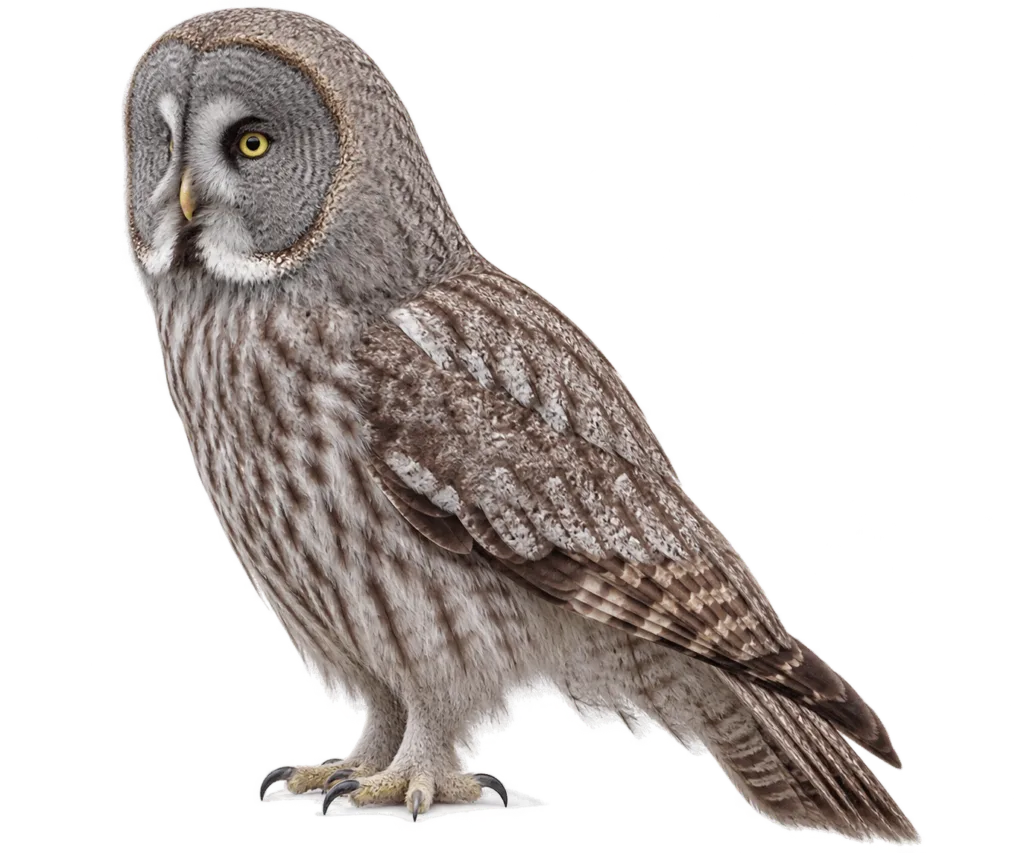
Size at a glance
How big is a Great Gray Owl?
Compare
Compare Great Gray Owl with another bird
Search by common or scientific name.
Morphology
Detailed measurements
Taxonomy
Classification
The Great Gray Owl (Strix nebulosa) is one of the tallest owls, but its visual bulk does not translate into unusually high body mass. A long tail, broad wings, an oversized facial disk, and deep plumage make the bird appear much heavier than the body hidden beneath its feathers.
Its Size Comes From Length and Wings More Than Weight
Standard measurements place adult Great Gray Owls at about 61–84 cm (24.0–33.1 in) in total length, with a 137–153 cm (53.9–60.2 in) wingspan. Reported body mass covers a much wider proportional range, roughly 700–1,700 g (24.7–60.0 oz).
These measurements explain an important feature of Great Gray Owl size: height and span create a much larger impression than mass alone. Much of the outline consists of feathers rather than a proportionally massive body.
Why the Body Looks So Large
The head is dominated by a broad, circular facial disk. The bill is small and partly concealed by facial feathers, which removes the projecting profile seen in many other large birds and makes the head look especially wide and round.
Dense body plumage adds more apparent volume. This effect is strongest around the neck, breast, flanks, and legs, where the true contours of the body are difficult to judge from an external view. The result is a tall, deep-bodied silhouette even though the owl can weigh well under 1 kg.
The tail adds another large part of the visible length. It is unusually long for the owl’s overall proportions and extends well beyond the folded wings when perched. In flight, the combination of the long tail and broad, rounded wings makes the bird’s linear dimensions especially obvious.
Females Average Larger Than Males, but Measurements Overlap
Great Gray Owls show female-biased size dimorphism. A morphometric study of 83 specimens from western and northern Finland found larger female averages across body mass and several structural measurements. The difference was clear at the group level, but individual males and females still overlapped.
| Measurement | Female Mean | Male Mean |
|---|---|---|
| Body mass | 1,065 g | 776 g |
| Forearm length | 147 mm | 138 mm |
| Wing measurement | 457 mm | 437 mm |
| Tail length | 307 mm | 292 mm |
Body mass showed especially broad variation. In that specimen series, females ranged from 680 to 1,489 g and males from 503 to 1,331 g. A heavy male can therefore outweigh a light female, so weight by itself does not provide a dependable way to determine sex.
Structural measurements also overlap, although not equally. Forearm length showed less overlap than wing length in the Finnish sample: males measured 123–148 mm and females 131–162 mm. Even this stronger difference leaves a shared interval between the sexes.
Female Great Gray Owls are larger on average, but there is no single body-mass or wing-length cutoff that cleanly separates every male from every female. Sex-specific averages describe populations better than they identify an isolated bird.
Wingspan and Wing Length Describe Different Dimensions
The Great Gray Owl’s wingspan can exceed 1.5 m, while morphometric studies may list a wing measurement of only about 40–49 cm. These figures are not conflicting measurements.
Wingspan measures the distance from one wingtip to the other with both wings extended. Wing chord or wing length measures a single wing from the wrist region toward the tip. Depending on the study, the wing may also be measured in its natural curve or flattened and straightened, so values from different datasets should not automatically be treated as identical measurements.
This distinction matters particularly for the Great Gray Owl because its full spread is one of the dimensions that makes the species appear enormous, while a single folded-wing measurement represents only one part of that span.
The Long Tail Changes How Total Length Should Be Read
Total length is not a direct measure of torso size. The Great Gray Owl gains a substantial part of its head-to-tail measurement from its elongated tail. In the Finnish morphometric sample, mean tail length was about 307 mm in females and 292 mm in males.
That tail length helps explain why a perched Great Gray Owl can rank among the tallest-looking owls without having the body mass expected from its height. Total length combines the head, body, and tail into one measurement, while weight reflects the actual mass of the entire bird.
The same principle applies to the head. The facial disk creates a very broad external profile, but much of that visible diameter consists of specialized feathers surrounding the face. The underlying skull is far smaller than the complete feathered outline suggests.
Body Mass Is the Most Changeable Major Size Measurement
Length measurements of bones and feathers are relatively stable once an adult has finished growing. Body mass can move much more noticeably with food supply, season, reproductive condition, and the physical condition of an individual bird.
This is why published Great Gray Owl weights can differ even when the sources are describing the same species correctly. A measured bird near the lower end of the weight range is not necessarily unusually short, and a heavier bird does not necessarily have proportionally longer wings or a longer tail.
For interpreting Great Gray Owl size, total length, wingspan, structural measurements, and body mass describe different parts of the animal. The species’ distinctive proportions become clearest when those measurements remain separate rather than being treated as interchangeable indicators of overall size.
Data
Measurement sources
- Data status
- Measured
- Size measurements
- AVONET — Tobias et al. (2022)
- Morphology source
- AVONET — Tobias et al. (2022)
- Morphology dataset
- AVONET v7 — BirdLife taxonomy
- Morphology dataset license
- CC BY 4.0
Full source links, dataset definitions, licensing details and measurement methodology are maintained on the Data Sources & Methodology page.