Bird size profile
Great Hornbill
Buceros bicornis
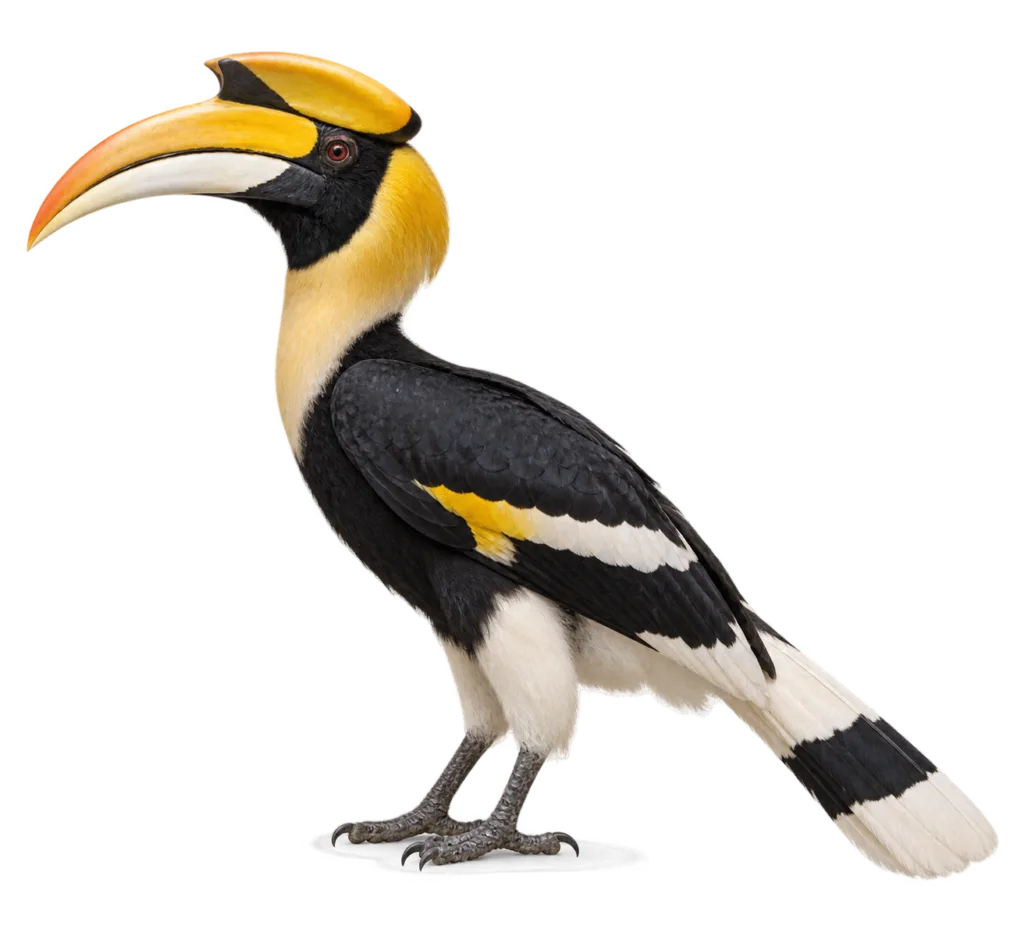
Size at a glance
How big is a Great Hornbill?
Compare
Compare Great Hornbill with another bird
Search by common or scientific name.
Morphology
Detailed measurements
Taxonomy
Classification
The Great Hornbill, Buceros bicornis, is built on an unusually large scale even among Asian hornbills. Its long body, broad wings, heavy bill and raised casque all contribute to that impression, but no single measurement describes the species well. Males and females differ in size, published total-length ranges are not identical, and the adult head profile takes years to develop.
Published Length Ranges Are Not Identical
Great Hornbill length is commonly given as about 95–120 cm in zoological profiles, with other accounts extending the upper end to roughly 130 cm. A species account from the IUCN Hornbill Specialist Group reports larger sex-specific ranges: 121–150 cm for males and 112–125 cm for females.
Why the ranges should stay separate
These figures come from different published datasets. Combining the lowest and highest values into a new 95–150 cm range would create a measurement range that none of those datasets actually reports.
The difference matters when interpreting a photographed or measured bird. A Great Hornbill near the lower end of one published range is not necessarily unusually small, and a large male may extend well beyond the length quoted in shorter general species profiles.
Male and Female Size Ranges Overlap
Male
121–150 cm
Mass: 2,610–3,900 g
Female
112–125 cm
Mass: 2,157–3,350 g
Males tend to be larger, but the ranges overlap. A bird measuring near 123 cm, for example, falls within published length ranges for both sexes. Mass overlaps as well, so size alone is not a dependable way to determine sex.
The head provides better visual clues. Adult males have red irises bordered by dark skin and generally carry a larger casque with black markings. Females have pale or white irises with reddish orbital skin and a smaller casque lacking the male’s black lines. These differences alter the apparent proportions of the head even when two birds have similar body dimensions.
The Casque Makes the Head Look Even Larger
The Great Hornbill’s bill is already massive, but the casque rising above it adds another dimension to the head. Seen from the front, the casque has a broad U-shaped form with paired ridges that project forward. This shape is behind the species name bicornis, meaning “two-horned.”
The casque is hollow rather than a solid horn. Its exact functions are still not fully settled. Display and communication have both been proposed, and males have been observed using the casque during aerial encounters.
The rest of the skeleton also reflects the demands of carrying such a large bill. The first two neck vertebrae are fused, providing extra support at the base of the head. The result is a bird whose front profile appears extremely heavy even though the casque itself is not a solid mass.
Color can change the perceived shape as well. Oil applied during preening stains the bill, casque and some pale feathers yellow to orange tones. The staining can make the bill-and-casque unit appear more continuous than its underlying structure would suggest.
Its Wingspan Extends Well Beyond Body Length
Published wingspan figures of about 151–178 cm place the Great Hornbill on a very different visual scale once the wings are open. The long wings can span substantially farther than the bird’s head-to-tail length, particularly when compared with the shorter total-length figures often given for the species.
Flight also makes the bird’s size unusually noticeable. Great Hornbills use strong wingbeats broken by glides, and the wings produce a loud rushing or whooshing sound. This is partly linked to their feather structure: they lack some of the small underwing coverts that normally cover the bases of the major flight feathers.
The combination of broad wings, intermittent gliding and audible wingbeats means that body length alone understates how large a Great Hornbill appears while crossing an open gap in the forest canopy.
The Adult Head Profile Develops Slowly
Young Great Hornbills do not begin life with the towering head structure seen in mature birds. Juveniles have blue-grey eyes and a much smaller bill with little or no developed casque.
The bill and casque continue developing as the bird matures, with the adult form taking about five years to develop. Age therefore changes the bird’s proportions as well as its coloration. A juvenile can have much of the adult body’s basic black-and-white pattern while still showing a noticeably smaller and smoother head profile.
Data
Measurement sources
- Data status
- Measured
- Size measurements
- AVONET — Tobias et al. (2022)
- Morphology source
- AVONET — Tobias et al. (2022)
- Morphology dataset
- AVONET v7 — BirdLife taxonomy
- Morphology dataset license
- CC BY 4.0
Full source links, dataset definitions, licensing details and measurement methodology are maintained on the Data Sources & Methodology page.