Bird size profile
Great White Pelican
Pelecanus onocrotalus
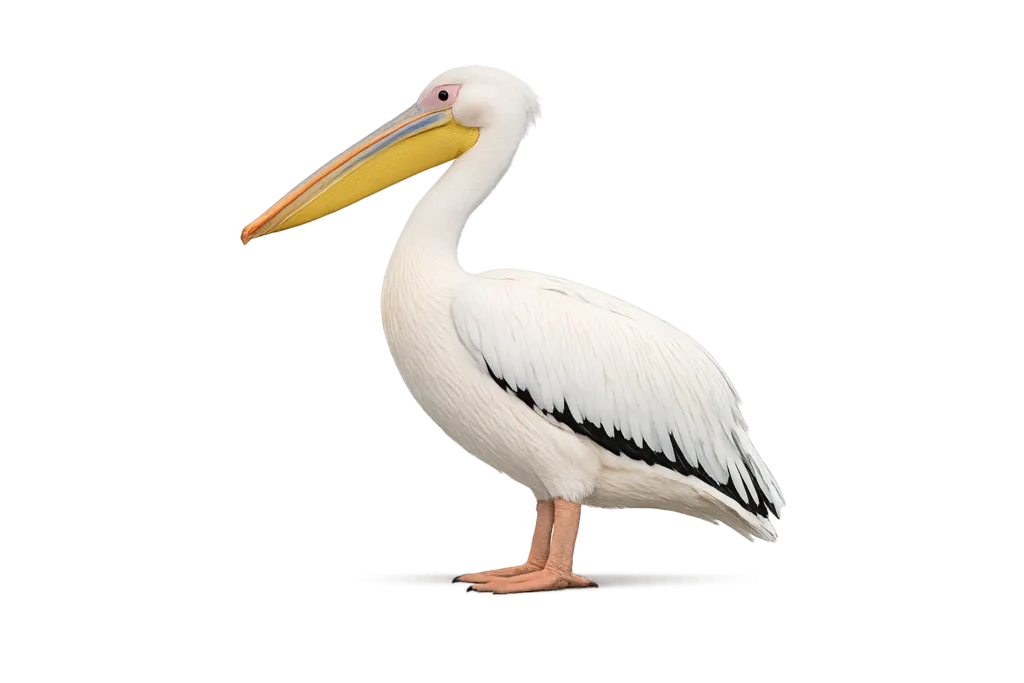
Size at a glance
How big is a Great White Pelican?
Compare
Compare Great White Pelican with another bird
Search by common or scientific name.
Morphology
Detailed measurements
Taxonomy
Classification
The Great White Pelican, Pelecanus onocrotalus, is a very large waterbird whose dimensions are dominated by long wings, a massive bill and a deep throat pouch. Adults commonly reach about 140–175 cm in total length, but that single range hides an important feature of the species: males are usually much heavier and have longer bills than females.
How Large Is a Great White Pelican?
Total length describes the bird from the tip of the bill to the end of the body and tail; it should not be read as standing height. A pelican on land looks much shorter because the neck can curve deeply and the body rests on relatively short legs.
The wings create an even larger outline. Current identification references commonly place the wingspan around 245–295 cm, while broader zoological datasets give ranges beginning near 226 cm and extending as high as 360 cm. Those figures should not be treated as interchangeable descriptions of a typical adult.
Published Great White Pelican measurements come from different datasets, regions and measurement traditions. Some field references use a narrower practical range, while older and broader compilations retain extreme values approaching 360 cm. A span near 2.5–3.0 m is a more useful picture of the size commonly represented in modern field references; 3.6 m is better understood as an upper literature value rather than an ordinary wingspan.
The species is generally treated as monotypic, without named subspecies. The spread in published measurements therefore should not be interpreted as a simple set of subspecies size differences. Sex, geographic samples and the way measurements were obtained can all affect the figures reported.
Males and Females Differ More Than the White Plumage Suggests
Both sexes have the same basic pelican shape, so sex is not always obvious from a distant bird. Measurements show a clearer separation. Adult males are markedly heavier and tend to have both longer bodies and longer bills.
Bill: about 34.7–47.1 cm
Bill: about 28.9–40.0 cm
The overlap in these ranges matters. A small male and a large female cannot always be separated by apparent body size alone. The difference becomes more convincing when overall bulk, bill length and head structure are considered together.
Mass also varies more than body length might suggest. Two adults with fairly similar outlines can differ considerably in weight because the larger male has a heavier body rather than simply a proportionally longer one.
The Bill Accounts for Much of the Bird’s Apparent Length
The bill is exceptionally long even for such a large bird. In large males it can approach 47 cm, while females generally have a shorter maximum. Beneath the lower mandible sits the expandable gular pouch, which makes the head look deeper and more massive than bill length alone suggests.
This structure can distort visual estimates of body size. A Great White Pelican extending its neck and bill may look dramatically longer than the same bird resting with the neck folded. Posture therefore changes the silhouette without changing the bird’s actual structural measurements.
The rest of the body is comparatively compact. The legs are short for a bird of this overall length, and the feet are fully webbed. Much of the species’ visual scale comes from the combination of its neck, bill and broad wings rather than exceptionally tall legs.
Its Full Size Is Most Obvious in Flight
On the water, the folded wings conceal much of the Great White Pelican’s scale. Once airborne, the long, broad wings make the bird appear much larger. Adults show black flight feathers against otherwise pale wings, producing a strong black-and-white pattern when the wings are fully extended.
The neck is not normally stretched straight ahead during sustained flight. It is drawn back toward the shoulders, shortening the visible front of the bird and concentrating the silhouette around the body. Slow wingbeats are mixed with gliding, and soaring birds can hold their broad wings almost motionless for extended periods.
The wing shape also explains why body length alone gives an incomplete impression of size. A bird roughly 1.5–1.75 m long can occupy close to three metres from wingtip to wingtip when fully spread.
Plumage and Age Can Change the Apparent Outline
Adult Great White Pelicans are predominantly white, with the dark flight feathers becoming most obvious when the wings open. During the breeding period the pale plumage can develop a pinkish cast, while the bare facial skin, bill and legs become more strongly coloured. Breeding adults may also show a short crest and a more pronounced forehead profile.
Juveniles are much browner and darker than adults. Their less uniform plumage can make the body look visually denser, even though colour does not represent a separate structural size class. As immature birds acquire more white plumage, their appearance gradually approaches the cleaner outline associated with adults.
For size identification, skeletal proportions and bill dimensions are therefore more dependable than colour intensity. Breeding condition, feather position and posture can alter the apparent shape, while the underlying long-billed, broad-winged proportions remain characteristic of Pelecanus onocrotalus.
Data
Measurement sources
- Data status
- Measured
- Size measurements
- AVONET — Tobias et al. (2022)
- Morphology source
- AVONET — Tobias et al. (2022)
- Morphology dataset
- AVONET v7 — BirdLife taxonomy
- Morphology dataset license
- CC BY 4.0
Full source links, dataset definitions, licensing details and measurement methodology are maintained on the Data Sources & Methodology page.