Bird size profile
Greater Roadrunner
Geococcyx californianus
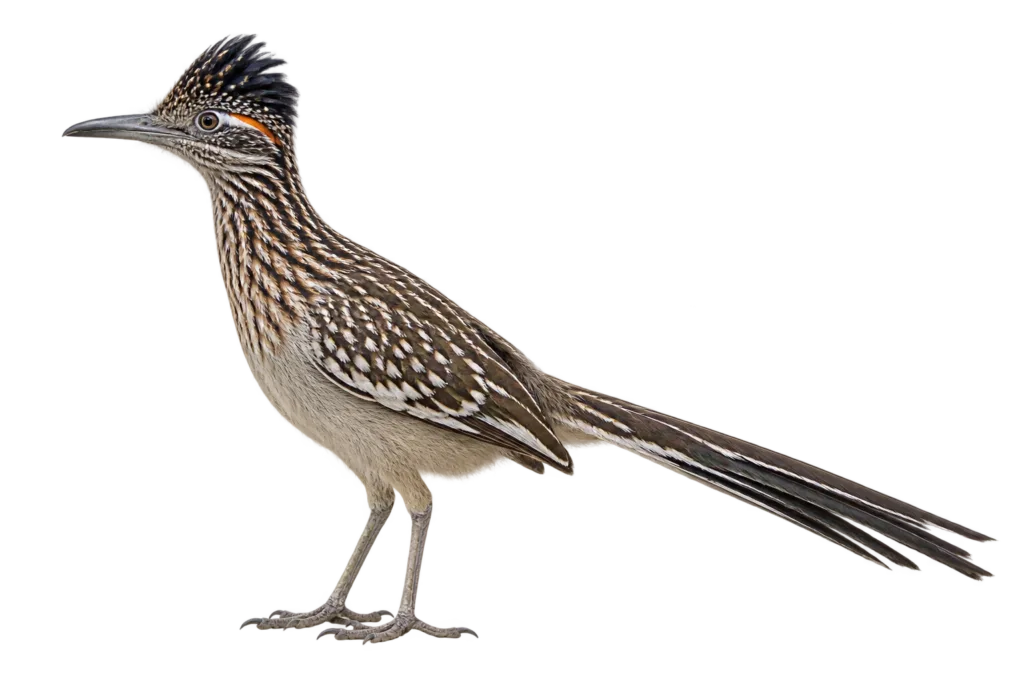
Size at a glance
How big is a Greater Roadrunner?
Compare
Compare Greater Roadrunner with another bird
Search by common or scientific name.
Morphology
Detailed measurements
Taxonomy
Classification
The Greater Roadrunner (Geococcyx californianus) has an unusual set of proportions for a cuckoo. Adult length is commonly reported at about 52–54 cm (20.5–21.3 in), while the wingspan is about 49 cm (19.3 in). That near reversal of the usual length-to-wingspan relationship is largely explained by the bird’s exceptionally long tail rather than by a large, heavy torso.
Much of a Roadrunner’s Length Is Tail
Total length can give a misleading impression of how large a Greater Roadrunner’s body actually is. Historical specimen measurements place the tail at roughly 260–316 mm (10.2–12.4 in). In a bird measuring a little over half a meter from bill tip to tail tip, the tail can therefore account for close to half of the visible length.
The visual effect becomes even stronger when the bird runs. The torso is held relatively low and almost horizontal, while the long tail extends behind it. Long legs and an extended neck add to the stretched appearance without requiring the bulky body associated with many other birds of similar total length.
Its Wings Are Compact Relative to Its Length
The Greater Roadrunner has broad, rounded wings, but they do not dominate its silhouette. A published wingspan of about 49 cm is actually a little shorter than the bird’s usual total length. This combination fits a species that spends much of its time moving on the ground and normally uses flight for relatively short movements rather than sustained aerial travel.
When the wings are folded, specimen measurements can look much smaller than the published wingspan. Older museum series give a wing measurement of roughly 162–196 mm. This is not a 16–20 cm wingspan. It represents a measurement of one folded wing, comparable to wing chord measurements used in bird morphometrics.
A wingspan measures across both extended wings from tip to tip. Wing chord or specimen wing length measures one wing from the wrist region toward the longest primary. The two figures should not be substituted for one another.
Long Legs Change the Bird’s Apparent Size
Greater Roadrunners stand roughly 25–30 cm (9.8–11.8 in) high in published descriptions. Height is a separate dimension from total length and should not be derived from it. The species combines relatively long legs with a narrow body, long neck, large tail, and substantial bill, producing a much more linear shape than its body mass alone would suggest.
The feet are zygodactyl, with two toes directed forward and two backward. Together with the long legs, this creates a distinctive ground-oriented structure. While running, the bird can change the position of its tail as it turns or shifts balance, making the tail a functional part of the locomotor silhouette rather than simply an ornamental extension.
Body Mass Varies More Than Length
Published references give a broad mass range. One widely used North American bird reference reports 221–538 g (7.8–19.0 oz), while other species accounts use narrower ranges. These figures should not be treated as though every adult population follows one fixed minimum and maximum.
Body mass can vary with the individuals included in a dataset, condition, age, season, geography, and measurement methods. Total length is structurally constrained by the skeleton and feathers, whereas mass can change without any corresponding change in the bird’s basic dimensions. A heavier Greater Roadrunner is therefore not necessarily proportionally longer or taller.
- A very long tail contributes heavily to head-to-tail length.
- The torso remains relatively slender.
- The legs increase standing height without adding much mass.
- The wings are compact compared with the bird’s total longitudinal dimension.
Males and Females Look Similar but Are Not Identical in Measurement
Male and female Greater Roadrunners are difficult to separate visually because their plumage and general proportions are very similar. Detailed morphometric work, however, has found small average differences between the sexes.
A large study of adult roadrunners combined measurements from live birds and museum specimens from across the species’ range. Several bill measurements and tarsus length averaged larger in males. Bill depth was particularly useful: the underlying research reported a female mean of about 11.49 mm and a male mean of about 12.65 mm.
| Measurement | Female Mean | Male Mean |
|---|---|---|
| Tarsus length | 57.31 mm | 58.85 mm |
| Bill tip to base | 51.51 mm | 54.48 mm |
| Bill depth | 11.49 mm | 12.65 mm |
| Bill width | 9.55 mm | 10.24 mm |
These are population-level averages, not clean visual boundaries. An individual with a deeper bill cannot automatically be identified as male. In the later peer-reviewed analysis, a morphometric model based mainly on bill dimensions correctly classified about 85% of the independent validation sample, which also shows why measurements alone do not provide certain sex identification.
The Bill Adds More to the Profile Than Its Length Suggests
The bill is long, heavy, and slightly downcurved. Morphometric datasets place bill-tip-to-base measurements near 51.5 mm in females and 54.5 mm in males on average, but bill depth is one of the more informative dimensions when studying sex-related shape differences.
This matters when interpreting photographs. A Greater Roadrunner photographed from the side can appear especially long because three elongated structures line up along the same axis: the bill projects forward, the neck can extend ahead of the torso, and the tail projects far behind it. That stretched profile is very different from the amount of physical bulk represented by the bird’s mass.
How Posture Changes the Apparent Measurements
A standing bird, a running bird, and a perched bird can look markedly different even when photographed at the same scale. During rapid ground movement, the body becomes low and elongated, the neck extends forward, and the tail trails behind. When alert or perched, the body may look more upright, the neck appears shorter, and the crest can increase the apparent height of the head.
The tail is also mobile rather than fixed in one position. It may be raised, lowered, spread, or carried nearly in line with the body. For visual size estimates, this means the Greater Roadrunner’s apparent length can change sharply with posture even though its anatomical measurements have not changed.
Data
Measurement sources
- Data status
- Measured
- Size measurements
- AVONET — Tobias et al. (2022)
- Morphology source
- AVONET — Tobias et al. (2022)
- Morphology dataset
- AVONET v7 — BirdLife taxonomy
- Morphology dataset license
- CC BY 4.0
Full source links, dataset definitions, licensing details and measurement methodology are maintained on the Data Sources & Methodology page.