Bird size profile
Green Heron
Butorides virescens
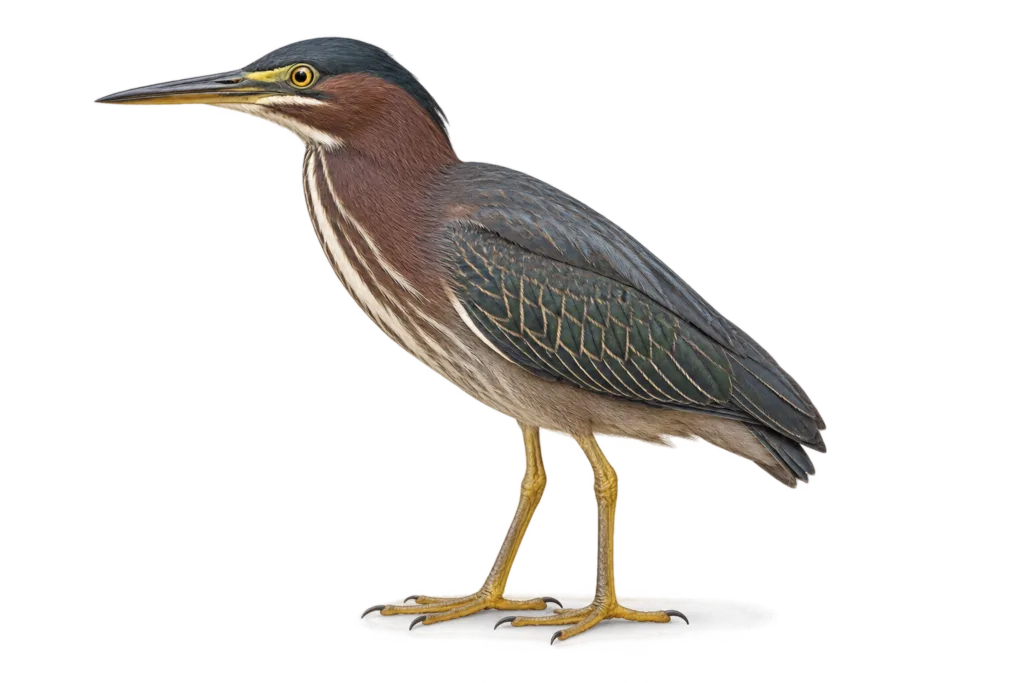
Size at a glance
How big is a Green Heron?
Compare
Compare Green Heron with another bird
Search by common or scientific name.
Morphology
Detailed measurements
Taxonomy
Classification
The Green Heron (Butorides virescens) is a small, compact member of the heron family, but its usual posture makes its size surprisingly easy to misjudge. Adults measure about 41–46 cm (16.1–18.1 in) in body length, with a wingspan of roughly 64–68 cm (25.2–26.8 in). The bird rarely displays all of that length at once. Its neck is commonly folded tightly against the body, its legs are short for a heron, and its crouched hunting stance can make it look much smaller than the measurements suggest.
A Heron That Compresses Its Own Silhouette
A resting or hunting Green Heron has a notably compact outline. The body is stocky, the tail is short, and the head often seems to sit directly above the shoulders. Much of this appearance comes from the way the neck is held rather than from an unusually short neck.
The neck can extend well beyond the outline visible when the bird is perched. During a strike, the head moves rapidly forward as the folded neck straightens. Research on heron anatomy has shown that specialized parts of the cervical vertebral column help herons produce this fast extension. In the Green Heron, the contrast between the compressed resting posture and the extended striking posture is especially noticeable because the bird otherwise looks so short and dense.
Body length should not be treated as the Green Heron’s standing height. A bird measured from the front of the body to the tail can still appear much shorter beside the water when its neck is folded and its body is crouched.
The neck also changes the bird’s shape in flight. Green Herons usually fly with the neck partly retracted, as herons typically do, but they may partially straighten it. This can give the front of the bird a heavier, slightly unbalanced appearance compared with its compact body and short tail.
Short Legs, Broad Wings, and a Long Bill
The Green Heron’s proportions differ from the tall, long-legged outline often associated with larger herons. Its legs are relatively short, while the wings are broad and rounded. The bill points straight forward and is long enough to become one of the most visually dominant parts of the bird when seen from the side.
This combination also helps explain why the bird can look very different depending on posture. A Green Heron standing upright with its neck partly extended appears slender and distinctly heron-like. The same individual crouched over the water can resemble a compact dark bird with little visible neck at all.
Color Can Make the Body Look Even More Compact
Adult plumage reinforces the dense silhouette. The crown and back are dark green to blue-green, often appearing almost black in weak light. Rich chestnut covers much of the neck and breast, while the wings are dark gray. Because several large areas of the body are dark, fine boundaries between the folded neck, back, and wing can disappear at a distance.
Better light reveals more structure. The chestnut neck becomes distinct from the darker crown and upperparts, and the folded wing shows clearer feather edges. Adults can also raise the crown feathers into a short crest, temporarily changing the head profile without changing the bird’s actual size.
The eye is bright yellow to orange, while the straight bill is mostly dark. Yellowish legs provide a narrow contrast beneath the much heavier-looking body. During breeding condition, the soft-part colors can become brighter, including stronger orange tones in the legs.
Juveniles Keep the Compact Shape but Look Less Solid
Young Green Herons share the species’ short-legged, compact construction, yet their plumage breaks up the outline differently. Juveniles are browner overall. The neck and breast carry pale streaks, and the wings show pale spots or edging rather than the cleaner dark surfaces of an adult.
Those markings can make a juvenile appear less uniformly stocky because separate feather groups are easier to see. The basic proportions remain recognizable: a relatively large head, long pointed bill, folded neck, broad wing, and short-legged stance.
Adult plumage therefore tends to create the strongest version of the familiar Green Heron silhouette, while juvenile patterning makes the same underlying body structure look more textured and less compact from a distance.
Male and Female Size Differences Are Subtle
Male and female Green Herons have very similar overall proportions. Published descriptions generally note that females are somewhat smaller and tend to have duller or lighter plumage than males, particularly during the breeding season. The difference is modest enough that apparent size alone is not a dependable way to determine sex in a free-moving bird.
Posture can easily create a larger visual difference than sex. A bird with its neck extended and body raised may look much taller than another individual crouching nearby, even when their actual body dimensions are close. Distance, viewing angle, feather position, and whether the neck is folded can all change the apparent size within seconds.
Data
Measurement sources
- Data status
- Measured
- Size measurements
- AVONET — Tobias et al. (2022)
- Morphology source
- AVONET — Tobias et al. (2022)
- Morphology dataset
- AVONET v7 — BirdLife taxonomy
- Morphology dataset license
- CC BY 4.0
Full source links, dataset definitions, licensing details and measurement methodology are maintained on the Data Sources & Methodology page.