Bird size profile
Haliaeetus vocifer
Haliaeetus vocifer
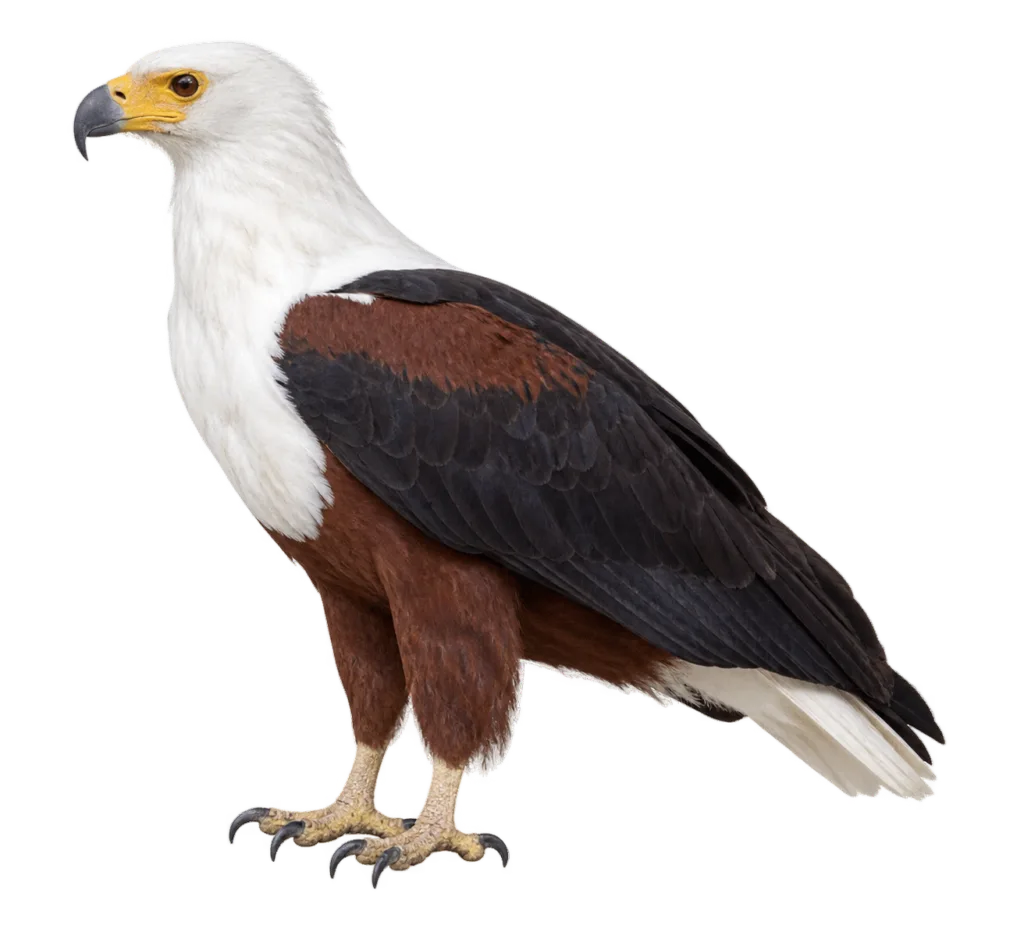
Size at a glance
How big is a Haliaeetus vocifer?
Compare
Compare Haliaeetus vocifer with another bird
Search by common or scientific name.
Morphology
Detailed measurements
Taxonomy
Classification
The African Fish Eagle is a large, broad-winged raptor whose proportions can make its body look smaller than its full dimensions suggest. Adults are roughly 63–77 cm (25–30 in) long, with a commonly reported wingspan of about 175–210 cm (5 ft 9 in–6 ft 11 in). Adult mass is strongly influenced by sex.
Females Carry Much More Mass Than Males
Male and female African Fish Eagles have similar adult plumage, so body size is one of the clearer physical differences between the sexes. Females are larger and noticeably heavier.
This difference is larger than the body-length range alone might suggest. Females are often described as roughly 10–15% larger in linear dimensions, but their greater bulk produces a much wider separation in body mass. A large female can therefore weigh well over a kilogram more than a typical male while retaining the same basic body shape and plumage pattern.
Wingspan Is the Dominant Dimension
The African Fish Eagle has broad, fairly long wings and a comparatively short, rounded tail. Its wingspan may approach three times its measured body length, which explains why a bird that looks compact while perched can appear much larger as soon as the wings open.
Published wingspan limits are not identical in every reference. A range near 1.75–2.10 m is widely reported, while some references give upper figures approaching 2.4 m. The difference should be treated as variation among published measurement sets rather than as a reason to assign every large individual the higher figure.
Wing Length and Wingspan Measure Different Things
A measured wing on a specimen or handled bird is not the same measurement as wingspan. Wingspan runs from one wingtip to the other with both wings extended. Ornithological wing length usually measures a single folded or flattened wing from the wrist area to the longest primary.
Published Avonet-derived measurements report a single-wing length of about 520–584 mm for a small sample of African Fish Eagles. This value should not be compared directly with the species’ 1.75–2.10 m wingspan because the two measurements describe different dimensions.
That distinction matters on size-reference pages. Doubling a single-wing measurement does not produce a reliable wingspan because the body width, wing posture and measurement method are not included in such a calculation.
Body Shape Makes the Eagle Look Compact When Perched
The adult has a powerful chest, substantial head and bill, broad shoulders and strong legs, but the relatively short tail limits its total head-to-tail length. When perched upright, much of the bird’s apparent size comes from body depth and bulk rather than an unusually long silhouette.
In flight, the proportions change visually. The extended wings become the dominant feature, while the short tail occupies only a small part of the outline. This combination produces the wide, heavy-winged profile associated with a large fishing eagle.
Young Birds Can Have Different Proportions
Juvenile African Fish Eagles are mainly brown rather than showing the crisp white head, breast and tail of adults. Young birds can also carry a proportionally longer-looking tail. For that reason, an immature bird may appear more elongated than an adult even when its basic body size is already large.
Age and plumage should therefore be considered separately from adult sexual size differences. A darker, longer-tailed bird is not necessarily a different-sized form; it may simply be an immature African Fish Eagle.
The Scientific Name Appears in Two Modern Forms
Haliaeetus vocifer remains widely encountered in databases and older literature. Current IOC taxonomy places the African Fish Eagle in the genus Icthyophaga, giving the name Icthyophaga vocifer. Both names can therefore appear when consulting measurement records for the same species.
Data
Measurement sources
- Data status
- Measured
- Size measurements
- AVONET — Tobias et al. (2022)
- Morphology source
- AVONET — Tobias et al. (2022)
- Morphology dataset
- AVONET v7 — BirdLife taxonomy
- Morphology dataset license
- CC BY 4.0
Full source links, dataset definitions, licensing details and measurement methodology are maintained on the Data Sources & Methodology page.