Bird size profile
Harpy Eagle
Harpia harpyja
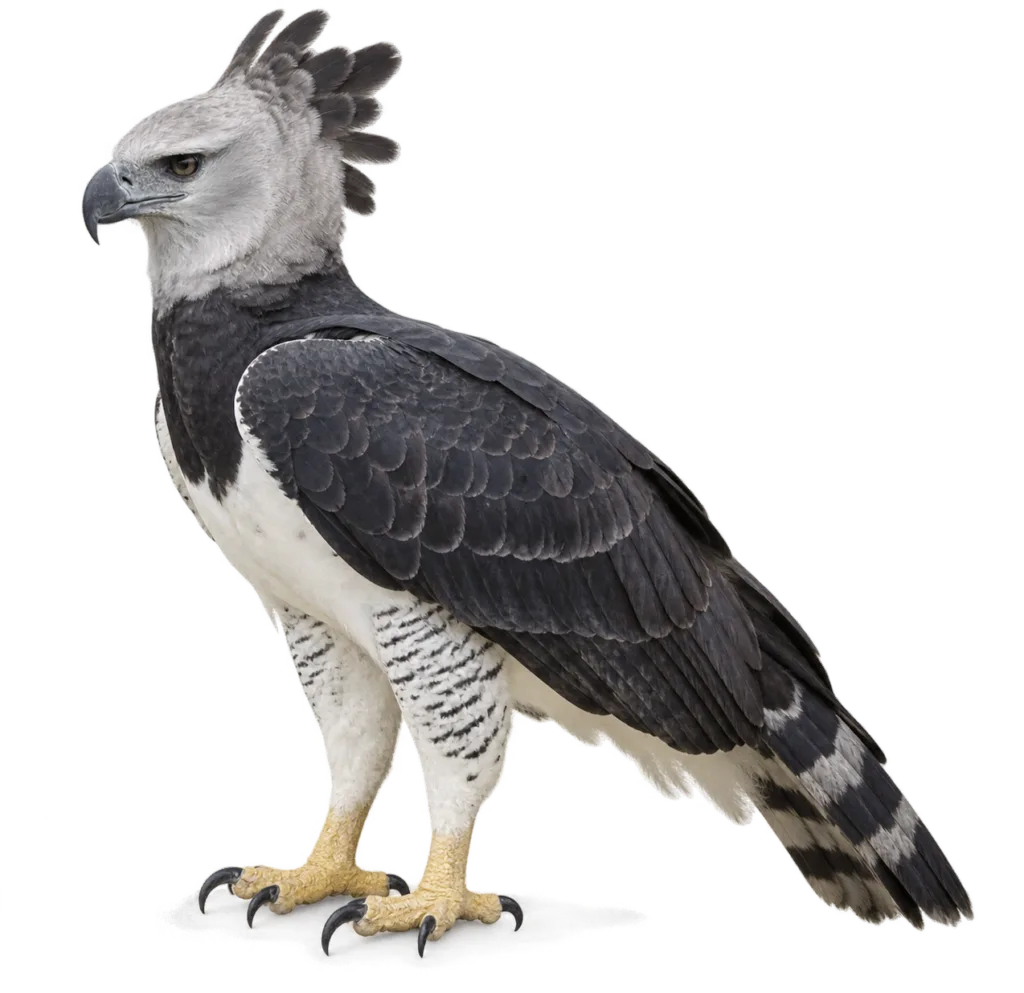
Size at a glance
How big is a Harpy Eagle?
Compare
Compare Harpy Eagle with another bird
Search by common or scientific name.
Morphology
Detailed measurements
Taxonomy
Classification
The Harpy Eagle (Harpia harpyja) combines a very large body with broad wings, a long tail, and unusually heavy feet. Adults are roughly 87–107 cm (34–42 in) long, while reported wingspans generally fall around 176–224 cm (69–88 in). Its proportions are especially notable because the bird carries considerable body mass without the exceptionally long wings seen in many large open-country raptors.
Harpy Eagle Weight Differs Strongly Between the Sexes
Female Harpy Eagles are much heavier than males even though both sexes have similar adult plumage. Adult females commonly weigh about 6–9 kg (13–20 lb), while males are usually around 4–6 kg (9–13 lb). Individual measurements vary, so exceptionally heavy captive birds should not be treated as typical wild adults.
This difference is easier to notice in body bulk than in coloration. A female can have a deeper chest, heavier legs, larger feet, and a more massive overall appearance. A male retains the same basic shape but is noticeably lighter.
Sex is especially important when interpreting Harpy Eagle weight. A value near 5 kg can be normal for an adult male, while a large adult female may weigh several kilograms more without being proportionally much longer.
Its Wingspan Is Large but Not Exceptionally Long for Its Mass
A wingspan approaching 2 meters sounds enormous, but the Harpy Eagle is built differently from large raptors that spend long periods soaring over open terrain. Its wings are broad and relatively compact in relation to its heavy body.
Published wing-chord measurements are generally about 54–63 cm (21–25 in). The broad wing surface provides lift, while the comparatively restrained span helps the bird move through gaps in tropical forest canopy. A long, barred tail, commonly around 37–42 cm (15–17 in), adds a large steering surface behind the body.
This combination gives the Harpy Eagle a distinctive silhouette. When perched, the folded wings do not make the bird look especially long-winged. In flight, however, their width becomes much more apparent.
The Feet Account for Much of Its Powerful Appearance
The lower legs and feet are exceptionally heavy for a bird of prey. The tarsus measures roughly 11.4–13 cm (4.5–5.1 in), leading into thick yellow toes armed with deeply curved black talons.
The largest talons can reach approximately 12 cm (nearly 5 in) in reported measurements. Talon figures can differ according to which claw is measured and how the measurement is taken, so a single claw length should not be treated as a universal value for every adult.
The feet also change how the bird’s overall size is perceived. A Harpy Eagle is not simply a long or tall eagle; much of its mass is concentrated in a deep torso, muscular legs, and oversized grasping structures. Those proportions make a perched adult appear especially thick-bodied.
Body Length Includes a Substantial Tail
Total length is measured from the front of the bird to the end of the tail, so the commonly reported 87–107 cm range should not be read as standing height. The tail forms a substantial part of that measurement.
This distinction matters in photographs and size comparisons. A crouched Harpy Eagle may look shorter than its published total length suggests, while an upright bird with its tail fully visible can appear much longer. Feather position, the raised crest, and posture can further change the apparent outline without changing the bird’s actual skeletal dimensions.
Adult Plumage Emphasizes the Harpy Eagle’s Shape
Adults have a pale gray head, a prominent divided crest, dark slate upperparts, and a broad dark band across the upper breast. Much of the underside is pale, while the feathered legs show dark barring. The long tail is crossed by contrasting bands.
Male and female adults are broadly alike in coloration, so plumage alone is not a dependable way to judge sex. Size provides a more useful clue when two known adults can be assessed under comparable conditions, especially because females can be much heavier.
The crest can also distort visual estimates. When raised, it enlarges the outline of the head without representing additional body size. For measurement-based comparisons, the body, folded wings, tail, legs, and feet provide more useful reference points than the crest feathers.
Data
Measurement sources
- Data status
- Measured
- Size measurements
- AVONET — Tobias et al. (2022)
- Morphology source
- AVONET — Tobias et al. (2022)
- Morphology dataset
- AVONET v7 — BirdLife taxonomy
- Morphology dataset license
- CC BY 4.0
Full source links, dataset definitions, licensing details and measurement methodology are maintained on the Data Sources & Methodology page.