Bird size profile
Harris’s Hawk
Parabuteo unicinctus
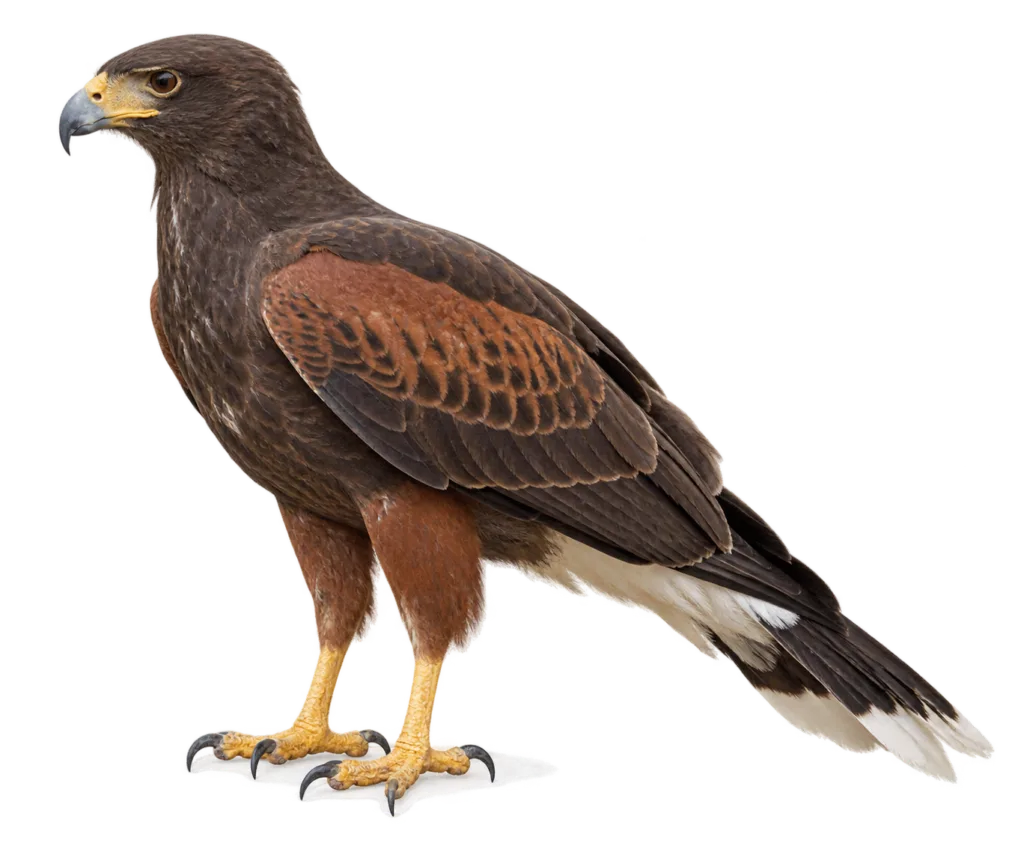
Size at a glance
How big is a Harris’s Hawk?
Compare
Compare Harris’s Hawk with another bird
Search by common or scientific name.
Morphology
Detailed measurements
Taxonomy
Classification
Harris’s Hawk (Parabuteo unicinctus) has a distinctive build for a medium-to-large raptor: broad rounded wings, a fairly long tail, long legs, and an upright stance. Adults generally measure about 46–59 cm (18.1–23.2 in) in body length, while the wings span roughly 103–121 cm (40.5–47.6 in). Body mass varies much more between the sexes than the plumage suggests.
Females Occupy the Heavier End of the Size Range
Male and female Harris’s Hawks look much alike in coloration, but females are distinctly heavier. Reference measurements place males around 550–875 g and females around 825–1,200 g. The ranges overlap, so body mass alone does not create two completely separate size classes, but the difference is large enough to affect how substantial an individual appears.
| Measurement | Typical Published Range |
|---|---|
| Body length | 46–59 cm (18.1–23.2 in) |
| Wingspan | 103–121 cm (40.5–47.6 in) |
| Male mass | About 550–875 g (1.2–1.9 lb) |
| Female mass | About 825–1,200 g (1.8–2.6 lb) |
Length and wingspan show less dramatic separation than mass. A large male and a smaller female can therefore look similar in linear dimensions even though the female carries more body mass. Plumage is not a reliable visual shortcut for distinguishing the sexes because both share the same main adult pattern.
The Silhouette Is Built Around Wings, Tail, and Long Legs
A perched Harris’s Hawk often looks taller and leaner than its weight might suggest. The legs are long, the body is held erect, and the tail extends well below the folded wings. In flight, the same bird takes on a broader profile as the rounded wings open and the tail spreads.
The long-legged structure also suits the species’ habit of using exposed perches. Harris’s Hawks regularly stand on posts, branches, utility structures, and cacti. Long legs increase the clearance between the body and the perch, which is useful on uneven or thorny surfaces.
The Tail Is an Active Part of the Flight Profile
The conspicuous tail is not simply a visual identification feature. Experimental work with a gliding Harris’s Hawk showed that tail spread changed with wing extension. In a wind-tunnel study, the tail remained folded through much of the wing’s span range and began opening when the wings approached their widest extension.
This helps explain the changing silhouette seen in the field. A gliding bird may show a comparatively narrow tail at one moment and a broad fan at another. When spread, the tail can contribute to pitch control and help balance aerodynamic changes caused by the extended wings. The interaction between broad wings and an adjustable tail gives the species a body plan suited to both soaring and controlled maneuvering.
Adult Color Blocks Emphasize the Bird’s Proportions
Adult Harris’s Hawks are predominantly dark brown, but chestnut areas on the shoulders, wing coverts, and thighs break up the otherwise dark body. The rump and base of the tail are white, and another white band marks the tail tip. Yellow legs and a yellow cere provide smaller areas of contrast around the feet and bill.
The placement of these colors makes several structural features easy to follow in flight. The pale rump marks the point where the body meets the tail, while the white terminal band makes the tail’s outer edge visible when it opens. Chestnut underwing areas become more apparent as the wings are extended.
Immature birds retain the broad-winged, long-tailed shape but have a less uniform pattern. Variable pale areas occur on the belly and underwings, with finer barring on the wings and tail. The pale terminal tail band is usually narrower than in adults.
Regional Form Can Change the Proportions Slightly
Harris’s Hawk is currently treated as a species with two recognized subspecies. The form often called the Bay-winged Harris’s Hawk, P. u. unicinctus, occurs in eastern and southern South America and differs subtly in structure from P. u. harrisi.
The Bay-winged form is described as slightly smaller but proportionally longer-tailed. Its plumage also tends to show more pale marking below. These differences are modest rather than a complete change in body design: both forms retain the long legs, broad rounded wings, long tail, dark adult plumage, chestnut wing areas, and strongly contrasting white tail markings that define the species’ appearance.
Data
Measurement sources
- Data status
- Measured
- Size measurements
- AVONET — Tobias et al. (2022)
- Morphology source
- AVONET — Tobias et al. (2022)
- Morphology dataset
- AVONET v7 — BirdLife taxonomy
- Morphology dataset license
- CC BY 4.0
Full source links, dataset definitions, licensing details and measurement methodology are maintained on the Data Sources & Methodology page.