Bird size profile
House Sparrow
Passer domesticus
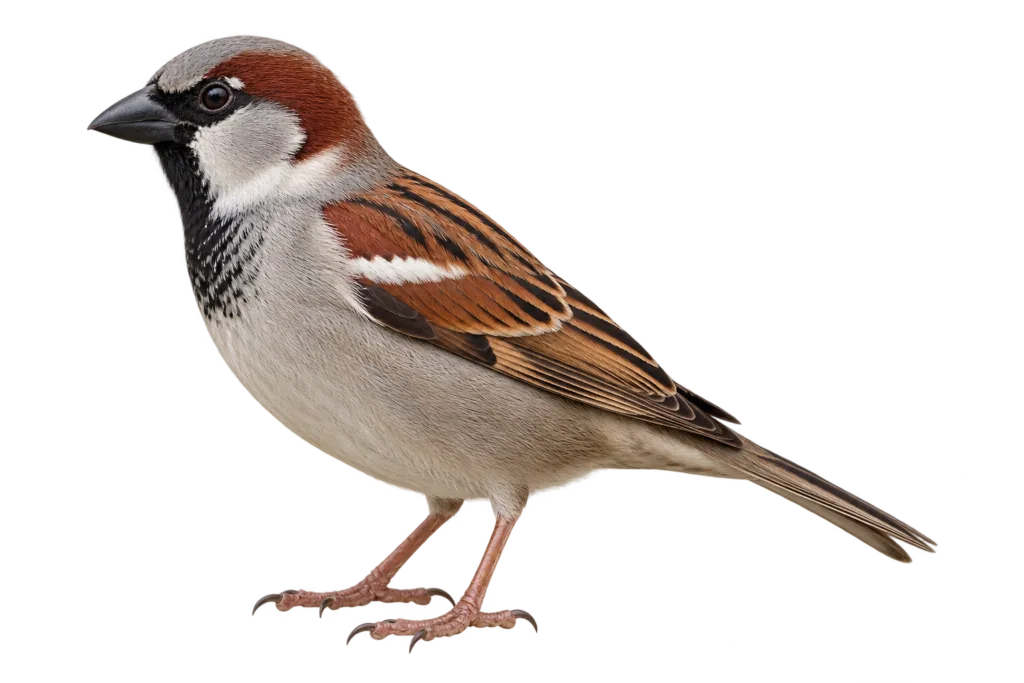
Size at a glance
How big is a House Sparrow?
True-scale visual
House Sparrow compared with a 175 cm person
When a transparent species asset and body-length data are available, BirdSize places the real bird asset and the fixed human reference on one mathematical centimetre scale.
Compare
Compare House Sparrow with another bird
Search by common or scientific name.
Morphology
Detailed measurements
Taxonomy
Classification
The House Sparrow (Passer domesticus) is a small songbird with a compact, deep-bodied build. Adults are commonly about 15–17 cm (5.9–6.7 in) long, with a wingspan of about 19–25 cm (7.5–9.8 in) and a body mass near 27–30 g (0.9–1.1 oz). Those numbers describe a bird that is short-tailed and stocky rather than slender, which is why a House Sparrow can look heavier than another small bird of similar length.
House Sparrow Size Is Compact Rather Than Delicate
Total length alone does not capture the House Sparrow’s proportions very well. The bird has a rounded head, a full chest, a relatively short tail, and a thick, conical bill. Its center of mass sits close to the body, giving it a dense silhouette on the ground, on a roof edge, or at a feeder.
| Measurement | Typical Published Figure | What It Describes |
|---|---|---|
| Total length | 15–17 cm (5.9–6.7 in) | Bill tip to tail tip with the bird in a standard measuring position |
| Wingspan | 19–25 cm (7.5–9.8 in) | Distance from one extended wingtip to the other |
| Body mass | About 27–30 g (0.9–1.1 oz) | Body weight, which can vary with condition, season, and population |
The proportions matter when judging size in the field. A long-tailed bird can appear larger even when its body is lighter, while the House Sparrow’s short tail and broad chest concentrate more of its visible bulk into a smaller outline.
Wing Length and Wingspan Measure Different Things
Published House Sparrow measurements may seem inconsistent because wing length is not the same measurement as wingspan. Wingspan is taken across both extended wings. Wing length in ringing and biometric datasets usually refers to one folded wing measured in millimeters.
British Trust for Ornithology biometric data give an adult mean wing length of 77.1 mm, based on live birds. That figure should not be converted into a wingspan estimate. The two measurements use different anatomical positions and measurement methods.
This distinction also explains why a value near 77 mm can sit beside a published wingspan of 19–25 cm without contradiction. They are describing different dimensions of the same bird.
Males Tend to Have Longer Wings, but Not Much Greater Body Mass
Adult male and female House Sparrows are easy to separate by plumage in breeding condition, but their body size difference is modest. BTO live-bird records show a clearer difference in wing length than in body mass.
| Adult Group | Mean Wing Length | Mean Body Mass |
|---|---|---|
| Male | 78.2 mm | 27.4 g |
| Female | 75.5 mm | 27.2 g |
The mean wing difference is about 2.7 mm in that dataset, while mean body mass is almost the same. Individual birds overlap, so weight by itself is not a dependable way to sex a House Sparrow. Local studies can also produce different mean masses, which makes plumage and age context more useful than a single weight reading.
Male structure often looks a little stronger because the head pattern and black throat patch draw attention to the front of the body. The underlying size difference is much smaller than that visual contrast may suggest.
The Bill Contributes Strongly to the Bird’s Stocky Shape
The House Sparrow has a short, stout bill suited to handling seeds and other small food items. Its depth and triangular profile make the head look broader than the head of many similarly sized, fine-billed songbirds. This is one reason shape can be more useful than total length when identifying the species at a distance.
Bill color changes with age, sex, and season. A breeding male develops a dark to black bill, while nonbreeding males usually show a paler, often yellowish or horn-colored bill. Females are generally paler-billed, although recent observations of captive females also show that bill darkness and yellow markings can change through the breeding cycle. Color therefore should not be treated as a fixed measurement of bill size or structure.
Juvenile Measurements Sit Close to Adult Size
Recently fledged House Sparrows can look smaller because of their softer plumage, shorter-looking proportions, and juvenile behavior, but they are already close to adult body mass. BTO records give juveniles a mean mass of 26.6 g, compared with 27.3 g for adults.
The difference is clearer in the folded wing. Juveniles average 74.2 mm in wing length, while adults average 77.1 mm in the same dataset. Juveniles also resemble females in plumage and often retain a yellow gape when recently fledged. As the feathers mature and post-juvenile molt progresses, the adult pattern becomes easier to read.
House Sparrow Size Varies Among Populations
A single worldwide average cannot describe every House Sparrow population. The species occupies a very broad geographic range, and measured traits can shift among regions. Research comparing multiple populations in Israel found geographic variation in body mass, wing length, tarsus length, and bill length, with several measurements tending to increase toward the north within the study area.
This kind of population-level variation helps explain why field measurements from one country may not match another dataset exactly. It also means that a locally measured bird should be compared with data collected using the same method and, when possible, from the same region.
Plumage Can Change the Apparent Proportions
Breeding males have a gray crown, white cheeks, chestnut on the neck and upperparts, and a black throat and breast patch. Females are plainer buff-brown with a pale eyebrow and streaked brown upperparts. Juveniles are closer to the female pattern. These color blocks can change how large the head, chest, and bill appear even when the structural dimensions differ only slightly.
The male’s black breast patch also becomes more exposed as pale feather tips wear away after molt. The bird may therefore look darker and more strongly patterned as the breeding season approaches without any corresponding increase in body size. Seasonal plumage condition is worth separating from true changes in mass or skeletal dimensions when comparing photographs or field observations.
Data
Measurement sources
- Data status
- Measured
- Size measurements
- Cornell Lab of Ornithology – All About Birds
- Morphology source
- AVONET — Tobias et al. (2022)
- Morphology dataset
- AVONET v7 — BirdLife taxonomy
- Morphology dataset license
- CC BY 4.0
Full source links, dataset definitions, licensing details and measurement methodology are maintained on the Data Sources & Methodology page.