Bird size profile
Hyacinth Macaw
Anodorhynchus hyacinthinus
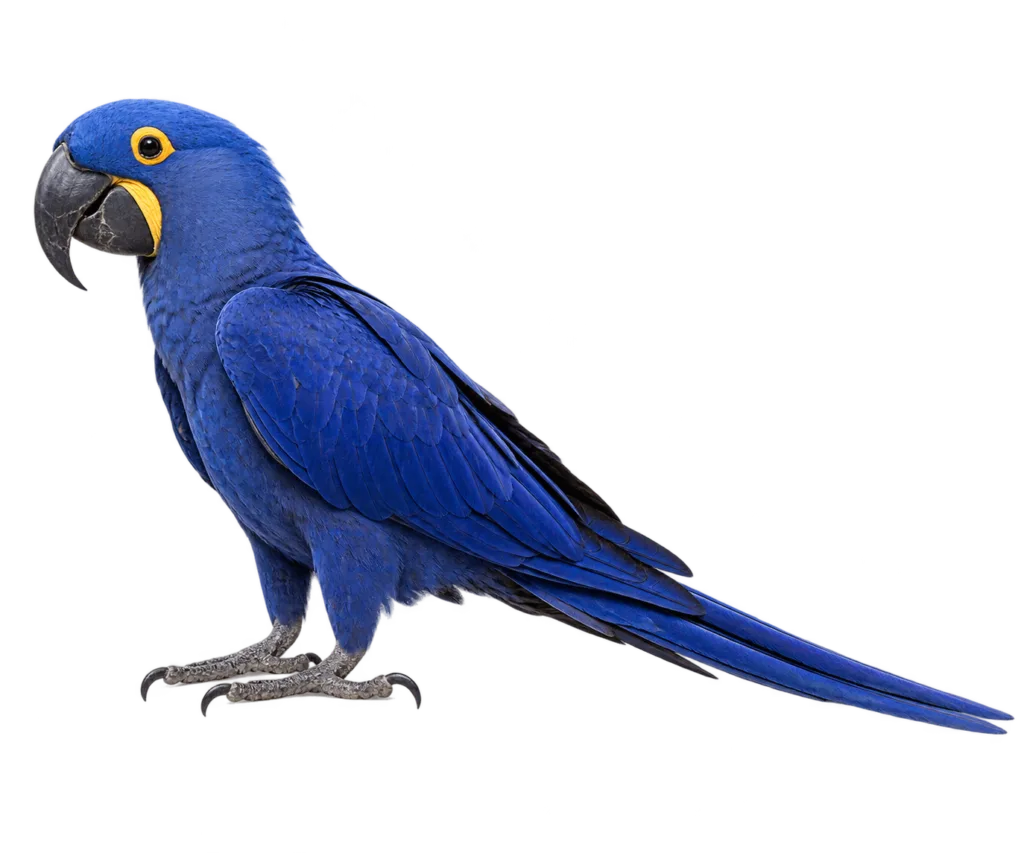
Size at a glance
How big is a Hyacinth Macaw?
Compare
Compare Hyacinth Macaw with another bird
Search by common or scientific name.
Morphology
Detailed measurements
Taxonomy
Classification
The Hyacinth Macaw (Anodorhynchus hyacinthinus) reaches roughly 90–100 cm (35–39 in) in total length, making it the longest living parrot by head-to-tail measurement. That figure can give a misleading picture of its actual body size, however. Much of the apparent length comes from the exceptionally long, tapered tail, while its mass is far lower than a one-meter bird might suggest.
Why a One-Meter Hyacinth Macaw Is Not a One-Meter Body
Total length in birds is measured along the bird from the head to the end of the tail. In the Hyacinth Macaw, the tail contributes an unusually large share of that measurement. Published descriptions place total length close to one meter and indicate that roughly half of the visible length can be associated with the long tail.
This creates a body shape that is better described as long and tapered rather than bulky. The torso itself is compact compared with the full head-to-tail dimension. A perched bird may therefore appear much larger when its complete tail is visible than when only the head, chest and folded wings are considered.
Why Published Hyacinth Macaw Weights Do Not Always Match
Adult weights are often reported around 1.2–1.45 kg (2.6–3.2 lb), although broader ranges reaching about 1.7 kg appear in some species references. Long-term measurements of wild birds in Brazil help explain why the upper figure needs context.
Hyacinth Macaw chicks become particularly heavy before they start regular flight activity. In a 30-year Pantanal study, intensively monitored chicks averaged about 1.36 kg at 90 days. Their mass then decreased as the first flight attempts began. Birds leaving the nest averaged about 1.18 kg, even though heavier values had been recorded earlier in development.
Brazil’s Instituto Arara Azul likewise distinguishes between adults and growing chicks, describing adults as reaching about 1.3 kg while chicks can temporarily reach much higher peak weights. A value near 1.7 kg should therefore not automatically be treated as the normal mass of a fully grown wild adult.
A Hyacinth Macaw’s highest recorded mass and its usual adult mass are not necessarily the same measurement. Age, growth stage and the timing of weighing can change the number considerably.
The Oversized Bill Changes the Bird’s Proportions
The head of a Hyacinth Macaw is dominated by a very large black, hooked bill. Its depth and curvature make the head look broad and heavy even though the neck and body remain comparatively streamlined.
The bill is accompanied by two features that make the head easy to recognize: a narrow area of bare yellow skin around the eye and a larger yellow patch bordering the base of the lower mandible. Against cobalt-blue plumage and a black bill, these areas create a sharp outline around the face.
The bill is not simply large in relation to smaller parrots. It is large relative to the Hyacinth Macaw’s own head, giving the front of the bird much more visual mass than the narrow tail end. Short, sturdy legs add to this compact central build when the bird is perched.
The Flight Silhouette Is Longer Than It Is Heavy
Published wingspan estimates commonly place the Hyacinth Macaw at about 117–127 cm (46–50 in). With the wings open, the bird is broad, but the pointed tail still remains one of the most noticeable parts of its outline.
The upper plumage is dominated by deep cobalt to violet-blue tones. The flight feathers are darker, while much of the underside of the wings and tail appears dark or blackish. This difference can make the wing and tail structure easier to see when a bird passes overhead.
Its long dimensions should not be confused with exceptional body mass. The Hyacinth Macaw’s position among the largest parrots comes mainly from total linear size, wingspan and tail length. Other parrots can be heavier without approaching its head-to-tail length.
Young Birds Have Different Proportions
A juvenile Hyacinth Macaw resembles an adult in general blue coloration, but its tail is shorter and the bare yellow facial areas tend to be paler. Tail length is especially useful for understanding why a young bird can look more compact even after most of its body plumage has developed.
Long-term observations of wild nestlings also show that fledging does not mark the end of physical growth. Chicks leave the nest at roughly three and a half months of age, yet they have not reached their final adult dimensions. Their tail feathers continue to develop, and adult body mass is reached after the nesting period rather than at a single fixed point before the first flight.
The same study recorded an average total length of about 67.7 cm in intensively monitored chicks as they approached departure from the nest. That value is well below the roughly 90–100 cm commonly reported for adults, illustrating how much additional length develops around and after fledging.
Male and Female Size Overlaps Too Much for Reliable Visual Sexing
Adult male and female Hyacinth Macaws have essentially the same external appearance. There is no obvious plumage pattern, facial marking or dependable overall size difference that allows routine sex identification by sight.
The long-term Pantanal growth study found no clear male-female separation in total-length growth. Differences appeared in modeled tail development, with males showing a longer tail measurement in that dataset, but the researchers also noted that such differences are difficult to recognize in free-living birds.
A bird that looks slightly larger or carries a longer tail therefore cannot be assumed to be male. Individual variation, age and feather condition can all affect apparent proportions. Studies requiring known sex use genetic methods rather than relying on external size alone.
Data
Measurement sources
- Data status
- Measured
- Size measurements
- AVONET — Tobias et al. (2022)
- Morphology source
- AVONET — Tobias et al. (2022)
- Morphology dataset
- AVONET v7 — BirdLife taxonomy
- Morphology dataset license
- CC BY 4.0
Full source links, dataset definitions, licensing details and measurement methodology are maintained on the Data Sources & Methodology page.